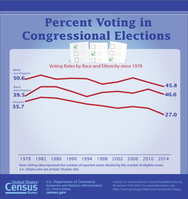
Census Bureau Reports Congressional Voting Turnout is Lowest Mark Since 1978
Census Bureau Reports Congressional Voting Turnout is at Lowest Mark Since 1978
NEWS RELEASE: CB15-122
July 16, 2015 —The 2014 congressional election turnout rate
of 41.9 percent was the lowest since the U.S. Census Bureau first began asking
Americans about voting and citizenship status in 1978. The 2014 voting rate was
7.0 percentage points lower than in 1978 and down from the 45.5 percent that
reported voting in the 2010 congressional election.
These statistics
come from Who
Votes? Congressional Elections and the American Electorate: 1978-2014,
which uses data collected by the Census Bureau’s Current Population Survey. This report provides a detailed historical portrait of
voters in congressional elections, and it examines voting patterns by
age, race and Hispanic origin and includes a look at early and absentee voting.
The voting rates of
every age group between 18 and 64 also dropped between 1978 and 2014, while the
voting rate in 2014 for those over 65 was not statistically different from 1978.
In 2014, the voting rate for the 65-and-older age group was 59.4
percent compared with 23.1 percent of 18- to 34-year-olds. For more information on voting trends by
age, see Figure 4 in the report.
“In recent
congressional elections, we’ve seen low levels of engagement among young people
and the opposite for older Americans,” said Thom File, a Census Bureau
sociologist and the report’s author. “These age differences cut across racial
and ethnic groups as well. Regardless of whether we’re looking at non-Hispanic whites,
non-Hispanic blacks or Hispanics, voting rates tend to increase significantly
with age.”
The report also
explores early and absentee voting. In the most recent congressional election
of 2014, nearly a third (31.2 percent) of all voters reported either voting
early, voting by mail or using some other form of voting. This was about a
threefold increase from 1996, when only 10.5 percent of voters reported voting
by alternative methods.
In addition to the report, the release also
includes a detailed
table package. Highlights from these tables include:
·Voting
rates for non-Hispanic whites — the largest portion of the electorate — have
declined from 50.6 percent in 1978 to 45.8 percent in 2014. The group voted at a
rate higher than their eligibility by 6.4 percentage points in 2014.
·Voting
rates for Hispanics declined from 1978 to 2014, dropping to a rate lower than
their eligibility by 4.1 percentage points in the 2014 election.
·Being
married with a spouse living in the household corresponded to higher voting
rates (50.9 percent) in 2014, particularly in comparison with those who
reported having never been married (25.9 percent).
·In
2014, reported voting rates were also high among those with advanced degrees
(62.0 percent) and those who had lived in their current home for five years or
longer (57.2 percent). The top tier of the voting rate distribution also
included government workers (56.5 percent) and military veterans (54.2 percent).
The voting rate of government workers was not statistically different from the
voting rates of those who had lived in their home for five years or longer.
·Additional
data for race groups are available via the detailed
tables.
About the Current Population Survey
The Current Population Survey has collected data on voting and voter
registration in November of even-numbered election years since 1964 and
provides voting estimates alongside other population characteristics, including
age, sex, race and educational attainment.
As in all surveys, these statistics are subject to sampling and
nonsampling error. The strength of Census
Bureau voting statistics is that they look at voters’ social and demographic
characteristics, which are not available from an official vote tally. The
estimates of total voters presented in this report may differ from those based
on administrative data or exit polls for a variety of methodological reasons. For more information, see the sections of the
report onSource
and Accuracy of the Data.