Millennials Outnumber Baby Boomers and Are Far More Diverse, Census Bureau Reports
Young Children Now Majority-Minority
NEWS RELEASE: CB15-113
JUNE 25, 2015 — Millennials, or America’s
youth born between 1982 and 2000, now number 83.1 million and represent more
than one quarter of the nation’s population. Their size exceeds that of the
75.4 million baby boomers, according to new U.S. Census Bureau estimates
released today. Overall, millennials are more diverse than the generations that
preceded them, with 44.2 percent being part of a minority race or ethnic group
(that is, a group other than non-Hispanic, single-race white).
These latest
population estimates examine changes among groups by age, sex, race and
Hispanic origin nationally, as well as in all states and counties, between
April 1, 2010, and July 1, 2014.
Even more
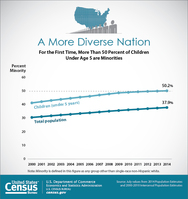
diverse than millennials are the youngest Americans: those younger than 5 years
old. In 2014, this group became majority-minority for the first time, with 50.2
percent being part of a minority race or ethnic group.
Reflecting these
younger age groups, the population as a whole has become more racially and
ethnically diverse in just the last decade, with the percentage minority
climbing from 32.9 percent in 2004 to 37.9 percent in 2014.
Five states or
equivalents were majority-minority: Hawaii (77.0 percent), the District of
Columbia (64.2 percent), California (61.5 percent), New Mexico (61.1 percent)
and Texas (56.5 percent). Among the remaining states, Nevada is the closest to
crossing this threshold, with a population 48.5 percent minority. More than 11
percent (364) of the nation’s 3,142 counties were majority-minority in 2014. Five
reached this milestone during the year beginning July 1, 2013: Russell, Ala.;
Newton, Ga.; Eddy, N.M.; Brazoria, Texas; and Suffolk city, Va.
Other highlights
from the estimates:
The 65-and-older population
·The nation’s
65-and-older population grew from 44.7 million in 2013 to 46.2 million in 2014.
This group, which now contains the oldest four years of the baby boom
generation (born between 1946 and 1964), is 21.7 percent minority, less diverse
than younger age groups.
·Between 2010 and
2014, the only two counties to add more than 100,000 people 65 and older to
their total populations were Los
Angeles, Calif. (167,000) and Maricopa,
Ariz. (103,000).
·San Juan, Colo., had the
highest rate of increase in the 65-and-older population of any county between
2010 and 2014 (70.9 percent). Two other Colorado counties (San Miguel and Douglas)
were also in the top five.
·Florida had the highest percentage of its population age 65 and
older among states in 2014 (19.1 percent), followed by Maine (18.3 percent). Alaska had the lowest percentage (9.4
percent), followed by Utah (10.0
percent).
·Sumter, Fla., was the
nation’s only majority 65-and-older population county in 2014 (52.9 percent). Chattahoochee, Ga., had the lowest
percentage of its population in this age group (4.1 percent).
Some states and
counties become younger
·In contrast to most
states, five experienced a decline in median age between July 1, 2013, and July
1, 2014: North Dakota, Hawaii, Montana, Wyoming and Iowa.
·Median age declined
in 434 counties over the period, with McKenzie,
N.D., leading the way (32.9 to 31.6).
·Maine experienced the
largest increase in median age among states, rising from 43.9 to 44.2 over the
period.
·St. Helena, La.,
experienced the largest rise in median age among counties or equivalents, climbing
from 40.2 to 41.3.
·There was a greater
than 13-year difference between the state with the highest median age (Maine at 44.2) and that with the lowest
(Utah at 30.5).
·There was a more
than 42-year difference between the county with the highest median age (Sumter, Fla., at 65.9) and that with
the youngest (Madison, Idaho, at
23.1). There were 74 counties where the median age was greater than 50, and 57
counties where it was less than 30.
States with more males than females (and vice
versa)
·There were only 10
states where males made up a majority of the population in 2014. Alaska had the highest male percentage
(52.6 percent), followed by North Dakota
(51.3 percent).
·The District of Columbia had the highest
percentage of females of any state or equivalent (52.6 percent), followed by Delaware (51.6 percent).
Births versus deaths
·All race and ethnic
groups except single-race, non-Hispanic whites had more births than deaths
between 2013 and 2014. This group had 61,841 more deaths than births.
Hispanics
·The nation’s Hispanic population totaled 55.4 million as of July 1, 2014,
up by 1.2 million, or 2.1 percent, since July 1, 2013.
·California had the largest Hispanic population of any state in 2014
(15.0 million). However, Texas had the largest numeric increase within
the Hispanic population since July 1, 2013 (228,000). New Mexico had the
highest percentage of Hispanics at 47.7 percent.
·Los Angeles had the largest Hispanic population of any county (4.9
million) in 2014 while Harris, Texas, had the largest numeric increase
since 2013 (45,000). Starr — on the Mexican border in Texas — had the
highest share of Hispanics (95.8 percent).
Blacks
·The nation’s black
or African-American population totaled 45.7 million as of July 1, 2014, up by
578,000, or 1.3 percent, since July 1, 2013.
·New York had the largest black or African-American population of
any state or equivalent in 2014 (3.8 million); Texas had the largest
numeric increase since July 1, 2013 (88,000). The District of Columbia had the highest percentage of
blacks (50.6 percent), followed by Mississippi
(38.2 percent).
·Cook County, Ill. (Chicago) had the largest black or African-American population
of any county in 2014 (1.3 million), and
Harris, Texas, had the largest numeric increase since 2013 (21,000).
Holmes, Miss., was the county with the highest percentage of blacks or
African-Americans in the nation (82.5 percent).
Asians
·The nation’s Asian
population totaled 20.3 million as of July 1, 2014, up by 631,000, or 3.2
percent, since July 1, 2013.
·California had both the largest Asian population of any state (6.3
million) in July 2014 and the largest numeric increase of Asians since July 1,
2013 (162,000). Hawaii was the nation’s only majority-Asian state, with
people of this group comprising 56.2 percent of the total population.
·Los Angeles had the largest Asian population of any county (1.7
million) in 2014 and the largest numeric increase (29,000) since 2013. Honolulu
and Kauai, both in Hawaii,were the nation’s only majority-Asian counties.
American Indians
and Alaska Natives
·The nation’s
American Indian and Alaska Native population totaled 6.5 million as of July 1,
2014, up by 93,000, or 1.4 percent, since July 1, 2013.
·California had the largest American Indian and Alaska Native
population of any state in 2014 (1.1 million) and the largest numeric increase
since 2013 (13,000). Alaska had the highest percentage (19.4 percent).
·Los Angeles had the largest American Indian and Alaska Native
population of any county in 2014 (235,000), and Maricopa, Ariz., the
largest numeric increase (4,700) since 2013. Shannon, S.D. — on the
Nebraska border and located entirely within the Pine Ridge Indian Reservation —
had the highest percentage (93.4 percent).
Native Hawaiians and
Other Pacific Islanders
·The nation’s Native
Hawaiian and Other Pacific Islander population totaled 1.5 million as of July
1, 2014, up by 33,000, or 2.3 percent, since July 1, 2013.
·Hawaii had the largest population of Native Hawaiians and Other
Pacific Islanders of any state (370,000) in 2014 and the highest percentage
(26.0 percent). California had the largest numeric increase since 2013
(7,000).
·Honolulu had the largest population of Native Hawaiians and Other
Pacific Islanders of any county (239,000) in 2014, and Hawaii County had the highest percentage (34.4 percent). Clark,
Nev., had the largest numeric increase since 2013 (1,100).
Non-Hispanic white alone
·The nation’s
non-Hispanic white alone population totaled 197.9 million in 2014, up by
94,000, or 0.5 percent, since 2013.
·California had the largest non-Hispanic white alone population of
any state in 2014 (14.9 million). Texas had the largest numeric increase
in this population group since 2013 (79,000). Maine had the highest
percentage of the non-Hispanic white alone population (93.8 percent).
·Los Angeles had the largest non-Hispanic white alone population of
any county (2.7 million) in 2014. Maricopa, Ariz., had the largest
numeric increase in this population since 2013 (23,000). Leslie, Ky., comprised the highest percentage
(98.1 percent) of single-race non-Hispanic whites.
Unless otherwise
specified, the statistics refer to the population who reported a race alone or
in combination with one or more races. Censuses and surveys permit respondents
to select more than one race; consequently, people may be one race or a
combination of races. The detailed tables show statistics for the resident
population by “race alone” and “race alone or in combination.” The sum of the
populations for the five “race alone or in combination” groups adds to more
than the total population because individuals may report more than one race.
All references to age, race, and Hispanic origin characteristics of counties
apply only to counties with a 2014 population of 10,000 or more. The federal
government treats Hispanic origin and race as separate and distinct concepts.
In surveys and censuses, separate questions are asked on Hispanic origin and
race. The question on Hispanic origin asks respondents if they are of Hispanic,
Latino, or Spanish origin.
Starting with the 2000
Census, the question on race asked respondents to report the race or races they
consider themselves to be. Hispanics may be of any race. Responses of “some
other race” from the 2010 Census are modified in these estimates. This results
in differences between the population for specific race categories for the
modified 2010 Census population versus those in the 2010 Census data.