Val Palazzolo, National FAASTeam Manager
 Hello everyone!
Spring is almost here and soon many more pilots will be
taking to the air again. We have some good presentations lined up in Approved
Resources for improving safe flying skills for you and your representatives to
use in your seminars and webinars. For example, see the
25
Tips for Summer Flying and the topics of the month for March (Maneuvering
Flight) and April (Mountain
Flying).
Be sure to read “Proficient Pilots Train to Fly Another
Day” by Jay Flowers. Jay provides some creative suggestions about
reviewing aircraft charts and running numbers, and looking at different
scenarios — perfect things to do right now before getting back in the air.
UAS news/highlights — As of March 7th, the number of people
registered for the ALC-451 Part 107 course is 56,734. Of those, 33,501 have
completed and passed the end of course exam.
Moving on to the industry and FAA collaboration efforts with
regard to UAS, the Association
for Unmanned Vehicle Systems International (AUVSI) and industry have been
holding meetings with their members and the FAA, to provide input into the
operations of UAS and regulatory input to the FAA. These meetings have produced
a very good understanding on what the 107 operators would like to see in the
regulations, and how the operators interface with the FAA. The FAA has gained
invaluable knowledge in the use of UAS in the National Airspace System and ways
to integrate them safely into the NAS.
The
FAASTeam is looking into building a preflight presentation for sUAS and
hobbyists, to ensure the sUAS they’re flying is safe for flight.
|
Train
to Fly Another Day
By Jay Flowers,
FAA Safety Team Program Manager,
North Dakota
 Start
it on fire, secure the engine, establish a glide to somewhere in the middle of
nowhere, touch down safely on an open section of road or narrow grassy field,
all from the comfort of your favorite chair.
Flying
from the comfort of your favorite chair allows you the “undistracted”
opportunity to dig back into those logbooks and manuals that you probably have
not looked at for some time. As responsible airmen, we know that two of the
most critical safety of flight tasks are performance, and weight and balance and
yet they are the simplest tasks we have as responsible airman.
14 CFR Part 91.103 in part states:
“Each pilot in command shall,
before beginning a flight, become
familiar with all available information concerning that flight. This
information must include … Airplane or Rotorcraft Flight Manual containing the
Take-off and landing data …”
Like
many of us, you probably familiarized yourself with your flight manual years
ago when you first purchased the aircraft. Most likely, there haven’t been any
significant changes to the aircraft since. However, I don’t know about you, but
the older I get, the more I forget - especially when it comes to anything I did
15 years ago. The point here is, take another look at your flight manual, and do
so with the conviction that the data you review has value, and is important in
your day-to-day flying safety.
Here’s
an example. Take a moment and list the hottest or coldest temperatures you
would normally fly in, the highest airport you would normally fly in and out
of, figure all at the maximum gross for your aircraft, and use the smooth dry
runway with no wind scenario. Making these sorted few calculations for your
aircraft you will find that if the temperature is less than “X,” or greater
than “X” at gross weight, with no wind and dry runway, that your airplane can
be landed in “X” amount of runway, or needs “X” amount of runway to operate
safely EVERY TIME, ALL OPERATIONS.
Since
the outcome is mainly controlled by you, the pilot, add a percentage or
personal minimum adjustment as needed for your skill level, keeping in mind
that the charts for your aircraft are based on a PROFICIENT Pilot at the
controls of a new, not tired, aircraft. If you want to tighten up the numbers,
you must train regularly, or you will eventually bend an airplane.
Training
is basically an active and diligent action to improve your knowledge and skills
in the aircraft you fly. Whether you decide to simply train a couple of times
per quarter with a local flight instructor, or you have enjoyed the training
benefits of FAASafety.gov and the WINGS program for example, active
participation will increase your knowledge and skill level to a point higher
than the minimum standards. Think of proficiency as the fudge factor that will
allow you the time and perception necessary to prevent bending metal or causing
injury.
As
general aviation pilots, we sometimes forget about the necessity for
proficiency and instead mistake competency as the goal. Although aviation is safer
today than it ever has been, it is important to take the time to improve our
skills and remain well above the competent base line so this trend will
continue.
Safety
is a motivated action which requires attention, skill, and refreshment
throughout time.
Fly
Safe!
|
Twelve
Openings for Maintenance Human Factors Train the Trainer Course
 Dr. Bill Johnson, the FAA Chief Scientific and
Technical Advisor for Human Factors, is potentially planning another Maintenance
Human Factors Train the Trainer course this year.
The course is not a study in human factors, but is designed
to train AW FPMs on how to prepare Human Factors presentations for IA Renewal
Seminars, or whenever the opportunity arises otherwise. It will focus on human
factors information delivery methods. First offered last August in Oklahoma
City, it was very successful.
We are looking for 12 AW FPMs who would like to
attend the course this year. If you are interested, please e-mail
Jim Hein (jim.r.hein@faa.gov)
to get on the list. Dates have not been set, and the course will only be
scheduled if there is enough interest.
|
Ashley Volpicelli –
Administrative HQ Employee of the Year
 Congratulations
to Ashley Volpicelli on being selected as the AVS Administrative Employee of
the Year. Many of you have worked with Ashley on Master Pilot and Master
Mechanic Awards, or FAASTeam Representative IDs. She does a great job supporting all of us,
and we are very happy to have her on our team. Please be sure to take a moment
to send her your congratulations.
|
2017 National GA Award Honorees
Please congratulate the recipients of the
2017 General Aviation Awards. Take a few moments to read their biographies. They
are three very outstanding individuals.
Charles Orville Gensler of Parker, Colorado — 2017
Certificated Flight Instructor of the Year
Brian John Carpenter of Corning, California — 2017 Aviation
Technician of the Year
Mark Alan Ducorsky of Lakeland, Florida — 2017 FAA Safety Team Representative
of the Year
 |
|
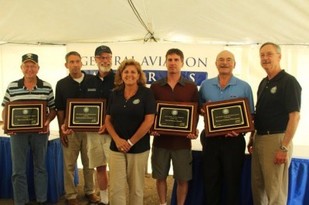
Last year's 2016 award winners with Val Palazzolo, Jim Viola, and John Duncan
Photo: Glenna Blackwell
|
Indoor Airport
 FPMs
– Did you know that there is a great educational tool on runway safety available
for your use? It’s called the Indoor Airport. This is a walkable-size airport that
can be displayed inside a hangar. It brings
airport operations to life from a unique perspective.
The
Indoor Airport has two runways, taxiways, a ramp area, and uses current airport
signage. The Indoor Airport can be used with students, as well as seasoned
aviators, to expand their knowledge of ATC communications, aircraft movements,
and how runway incursions happen.
Scenario based training is used to demonstrate
critical airport safety concerns such as runway incursions. The Indoor
Airport gets everyone involved in understanding airport safety by allowing
attendees to role play during the analysis of selected scenarios.
For more information and
ordering details, see the Indoor Airport tab on our National Sharepoint Site (note;link only works for people with FAASTeam sharepoint access)
|
Update on Approved Resources
The 3rd and 4th Quarter CFI Forum content is available now in the Approved Resources
Library.
The 4th Quarter Forum will require a little more effort to
present. This Forum is largely about surveying attendees with respect to CFI
issues and best instructional practices, then reporting survey results to FAASTeam
Headquarters. FAASTeam HQ will collate survey results and publish a report of
findings to be discussed in a FY 2018 Forum. Two FPM Webinars will be conducted
in the 3rd quarter to acquaint FPMs with the 4th quarter Forum content and
reporting requirements. In the meantime, please take a few minutes to look over
the 4th Quarter FY 17
CFI Forum content.
Approved
Presentations will not be accessible after March 31, 2017. All relevant content
has been moved to Approved Resources. Starting April 1, Approved Resources will
be the go-to location for all National FAASTeam program support. All FPMs, and
those Reps who have active SharePoint accounts, have full Approved Resources
access.
Look for the Blue Box. The blue border around boxes in the Approved Resources
Library indicates available content. Boxes without borders do not
have content.
Archived Topics of the Month can be found in Approved
Resources\General Resources\Operations\Airmen.
Did you know? FAASTeam-branded templates are in the General
Resources area of the Approved Resources Library. Click on the WIs &
Production Resources box.
Airworthiness
Program Support products are available in the Approved Resources Library. Check
out NPP 08, 17, 18, 21, and 31.
If you have questions , contact John.w.steuernagle@faa.gov
Welcome
Welcome to new FPMs
Pamela
Charles, AW Nashville
Grant Gillian, AW St. Louis
Sarah Hughes, OPS
Oakland
Magazine Handouts for Future Events
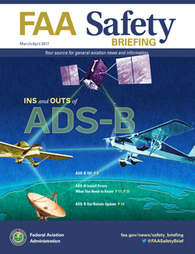 To ensure delivery prior to your event, order
FAA Safety Briefing magazines by the dates listed below.
Very few extra copies are printed for each issue. If you know of an event during the year where you will need a one-time amount over your regular copies, please place an order in advance. Contact Felice.Brunner@faa.gov.
Order FAA Safety Briefing (FAASB) magazines on or before the
following dates:
- July/August "Aeromedical" order by May 15
- September/October "CFI Refresher" order by July 15
- November/December "Winter Currency" order by September 15
|
Newsletter Info
The purpose of this monthly newsletter is to share information between FAASTeam management at FAA headquarters and POCs/FPMs in the field with other POCs/FPMs. If you have questions, concerns, or an article or photo to submit, email Felice Brunner at Felice.Brunner@faa.gov.
|