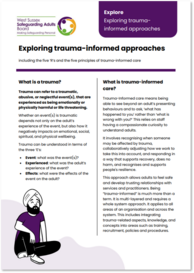
Trauma-informed care means being able to see beyond an adult’s presenting behaviours and to ask, ‘what has happened to you’ rather than ‘what is wrong with you?’
It involves recognising when someone may be affected by trauma, collaboratively adjusting how we work to take this into account, and responding in a way that supports recovery. Below are some ideas taken from our resource Exploring Trauma-Informed Approaches | Explore Series (PDF, 229KB) for how to introduce empathy, understanding, co-production, and positive risk-taking, into your practice to create a trauma-informed approach.
Empathy and understanding
For adults who have experienced trauma, it can be difficult to establish trust. Develop trust by implementing good personal and professional boundaries; be aware that you may need to re-establish trust each time you meet with the adult.
Be reliable and honest about what you can and cannot do, while recognising and addressing the power imbalances between you and the adult. Use a non-judgmental, compassionate approach and be responsive to the experiences of those you work with, remembering that everyone experiences trauma differently.
Co-production and collaboration
Collaboration means working towards a common goal or purpose. Adults who have experienced trauma may have very little trust in their needs mattering to others, or very little experience of being involved in decisions, so may need support and encouragement to do this.
Interactions that contain a psychoeducational element, where staff invite people to collaborate in their recovery by sharing information, are particularly useful. Collaboration could involve asking someone what they need for a certain part of the meeting or visit or identifying coping strategies that may be helpful or problematic in the longer term and discussing options for support.
Positive risk-taking and empowerment
Showing someone that they can be safe, demonstrating you can be trusted and so can they, offering choice and collaboration to someone who has never had these options, are all empowering.
Empowerment means treating the person as an equal. This may include offering challenge (constructively, rather than judgmentally), which can enable reflection and be very useful. Supporting and empowering adults to recognise unhealthy coping strategies can be a life-changing opportunity.
Explore our resources:
|