Celebrate the Safer Cultures
Friday 21 November 2025
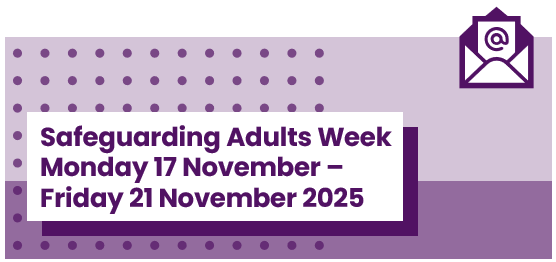
This week is Safeguarding Adults Week. During this week, we'll be sharing daily bulletins with you, related to the Ann Craft Trust themes.
Let’s round-up the week with some ‘good news’ stories. Today we’re sharing how some of our partners are succeeding in developing a ‘safer culture’, with excellent safeguarding practice at its heart.
A 'safer culture' is one in which everyone feels that their concerns are listened to and addressed; where organisations encourage learning and reflection; and where staff are encouraged to challenge and instigate change.
Safer cultures at West Sussex County Council
Within Adult Social Care, at West Sussex County Council, we have developed regular opportunities for staff to join reflective practice sessions.
The sessions are facilitated by the Deputy Principal Social Worker, the Principal Occupational Therapist, and colleagues with the Quality, Practice and Service Development Team.
Each month of the year, the reflective sessions cover a theme, which has been identified as areas of learning, following Safeguarding Adults Reviews (SARs) or Serious Incident Reviews, and areas for development, in practice, following audit. Themes have included: Professional curiosity, Executive functioning, and the Mental Capacity Act (MCA), Self-neglect, and Cultural competency. There are a variety of drop-in sessions, for designated staff groups, for example, Senior Practitioners, Team Leaders and Service Managers, in addition to sessions that can be booked onto via the organisation’s learning and development gateway.
The sessions are confidential and supportive, and offered as protected time to learn from each other. Articles, and research findings are circulated in advance, to give attendees an opportunity to pre-read around the topic. The facilitators encourage sharing of example cases, with a collaborative approach, with colleagues, sharing suggestions and encouragement, acknowledging good practice and potential for learning and improvement.
Please see below feedback from reflective session evaluations:
- "I will remain person centred and focused on my customers..."
- "I will take a proactive approach and continue to challenge assumptions..."
- "I will use this in my future assessments of capacity..."
|
Safer cultures at NHS Sussex Integrated Care Board
Freedom to Speak Up Guardians were introduced to NHS trusts by Sir Robert Francis, following his review and report into the failings in Mid Staffordshire.
Since his report in 2018, there have also been several other high-level cases that have highlighted the importance of building a speaking up culture in NHS organisations: the Lucy Letby trial at the Countess of Chester Hospital, where a number of babies were murdered, and the Michelle Cox case, a senior nurse in Manchester around race discrimination.
Freedom to Speak Up Guardians and the policy and practice which supports them is to improve the experience of both employees and people who use public services. They also help create a culture of learning and improvement, rather than blame and cover-up.
The NHS People Promise commits to ensuring that “we each have a voice that counts, that we all feel safe and confident to speak up and take the time to really listen to understand the hopes and fears that lie behind the words. Staff members are assured that they will receive no detrimental treatment should they choose to Speak Up. They can be anonymous, confidential or open about the enquiry. However if patient safety, safe practice or staff safeguarding is at risk this can be waived.
All NHS staff have access to a Freedom to Speak Up Guardian and online training around Speaking Up. The Guardians role is impartial and neither represents the staff member or the organisation, but rather aims to navigate and resolve issues justly, in the interest of patient safety and patient experience, and to allow staff to fulfil their roles to the best of their ability and with reasonable safe adjustment if necessary.
At present there is a National Guardians office where enquiries and themes are reported. This function will be taken over by NHSE next year.
Where issues are not able to be resolved internally, external investigation can be sought. Oversight is given by the non executive director to ensure follow through. Issues can also be raised to external governing bodies and inspectors such as Care Quality Commission or the General Medical Council if necessary.
|

Safer cultures at Sussex Police
Sussex Police are continuously working to encourage learning and reflection, not just within their own organisation, but also on a multi-agency basis.
Their Learning Board forms part of the Public Protection workstream, and shares learning across Sussex Police, both at command level, and force-wide where relevant. In addition to this, No Further Action panels are multi-agency panels led by Sussex Police, in which services review redacted investigations to identify key learning that can be used to shape processes and improve outcomes for service users and members of the public.
Safer cultures at Sussex Police doesn't stop with learning from past events, though. Sussex Police are also challenging behaviours and instigating change in a proactive manner. Op Signa is a reporting tool used to highlight micro-aggressions within the organisation, to stop unwanted behaviours before they escalate to misconduct or beyond.
|

Often in safeguarding it can feel like we only hear about the things that are going wrong. Today, we're looking at what is going right.
Consider whether you have experienced excellent safeguarding practice, whether it's from someone in your own organisation, or from a partner organisation. It could be excellent multi-agency working, or innovative application of policy and procedure leading to positive outcomes for the adult.
Send a 'thank you' to the person responsible for this excellent practice. This could be something as simple as a 'thank you' email, or using any employee recognition platforms your organisation may have access to. Don't underestimate how appreciated a simple 'thank you' can be.
|

Thank you for joining us this week during Safeguarding Adults Week 2025.
For a round-up of everything covered during this week, which focussed on 'Prevention: act before abuse', visit the Ann Craft Trust website.
|
|