I
was pleased to see so many of our Adults' Services workforce attend the recent
staff engagement sessions held across the county and to be able get the chance
to hear first-hand some of your thoughts, concerns, and ideas for the future.
Hopefully this has given you some important updates as to where we are with our
journey of transformation and encouraged you to begin to discuss with your teams and
colleagues how this might benefit you and the people we support. I very much valued your contributions and we have used your feedback to inform our proposals for a new operating model and to update our Frequently Asked Questions.
The
next step will be holding focus groups with some of the staff who expressed an
interest in contributing further to the discussions about our future operating
model, and I look forward to hearing the outcomes of those sessions.
We are now starting to plan Phase 2 with innovation staff who would like to continue with this new approach.
We will be building on the learning of the innovation work that has been completed so far, with a renewed emphasis on ‘Talk Local’ sessions, and a plan to trial the
use of a ‘deep front door’ in Adur using dedicated staff to take all referrals - this will enable us to explore how this might work in practice.
For those that did not get the chance to contribute at the engagement
sessions, or if you have had further thoughts following your attendance, please share
these with us using the contact details at the end of this newsletter.
Mark Howell, Director of Adult Operations
|
Content
News * Evaluation * Experiences * Case study * Timeline * Contact Us
Staff Engagement Events
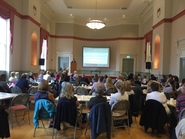
The three engagement events held in early September
provided an opportunity for staff to hear about the outcome of the formal
evaluation of the innovation sites, to hear from Mark Howell about the Directorate
Transformation programme, and from staff working in the sites about their
experiences.
The events were well attended with between 60-100
staff at each event. This meant the breadth of views shared was wide ranging
and will be a valuable source of information which will be used to inform the
development of the new operating model.
The
main themes around which discussion focussed were:
- Evaluation outcomes
- Culture
- Partnerships/Communities
- NHS Integration
- Resources/Job Roles
- Future implementation – the transition process
Following the events,
staff were invited to share their feedback on the sessions and 76 people
responded – approximately 35%. The general view was that the events and
the content were welcomed, although a high number felt that they would have
liked more definite information about the next steps and the implications for
their jobs. Attendees would have preferred more time for discussion and less
emphasis on presentations. Feedback from staff about the events will be shared with staff shortly.
Videos of the staff engagement sessions can be viewed below.
Staff
will have more engagement opportunities over the coming weeks. Watch
out for news about how to get involved.
|
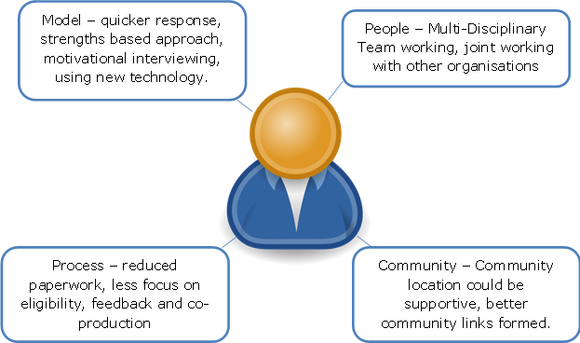
Staff perceptions - Strengths of the model
 Evaluation of all of the innovation sites have now been completed and the outcomes are detail in an analysis report which will be shared with staff shortly.
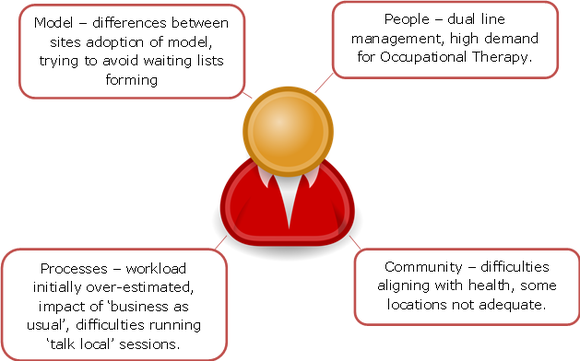
In a 12 week period, over 1,000 people were seen, with 937 in the four geographic sites, and 156 in the other 'themed' sites. The evaluation took into account first hand staff accounts of staff who set out the strengths and some of the challenges of working in the innovation sites using the 3 Conversation model.
|
Staff perceptions - Difficulties with the model
Customer experiences and residents' survey
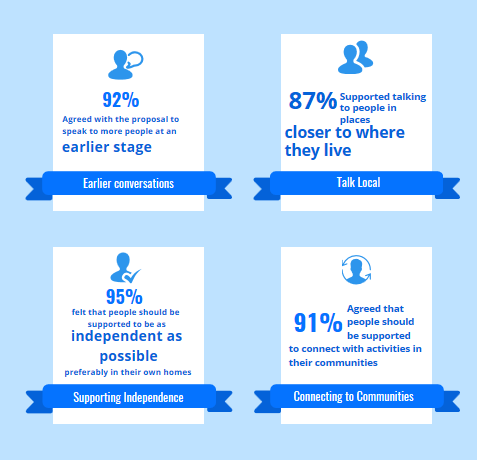
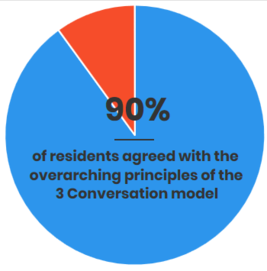
Over 700 participants responded to the residents' survey to find out how people felt about the principles of the 3 Conversations model. The survey identified a high proportion of people agreeing with the principles of the model.
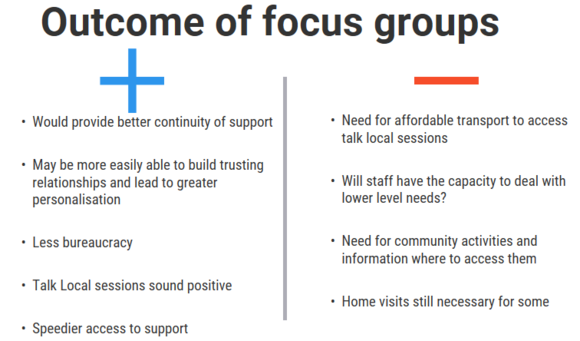
Focus Groups
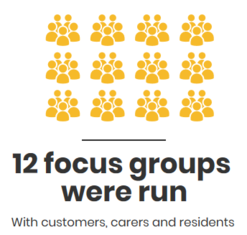
A series of focus groups were held with people across the county and the feedback essentially mirrored the findings from the survey. In general, participants were supportive of the approach feeling that the model represents a step forward form the current assessment-based model.
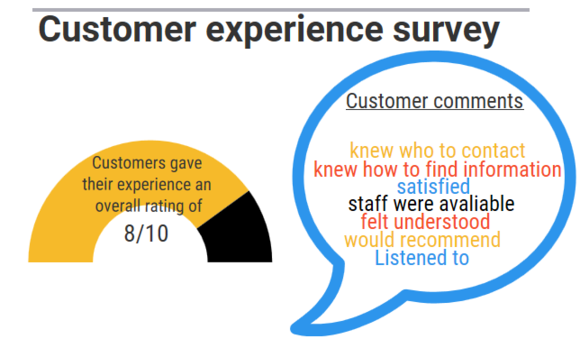
Customer experience survey
Customers who directly experienced the model were also surveyed, with an overall rating of 8 out of 10, and some comments were provided as to their thoughts about the use of the model which can be found below.
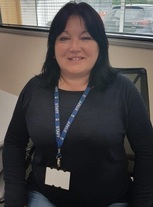
What is it like to work in an innovation site? - Emma Radley, Supporting Lives Chichester Rural
I work within the Supporting Lives Chichester Rural Team, as
Team Leader. We are based at Pulbourgh Medical Centre and work closely with
Proactive Care who are also based at the site. We are aligned to the Chichester
Rural Local Community Network, which includes Pulborough, Midhurst, Petworth,
Loxwood and Billingshurst GP Surgeries. I was seconded from my role as Support Broker
Manager in Western.
My role is to lead a Multi-disciplinary Team that includes
Social Work staff, Occupational Therapists, a Support Broker, Prevention and
Assessment Team nurse and a Community Connector. I see my role very much as a
co-ordinator in terms of the day to day management of the team. The team managers
retain supervisory responsibility for team members and I am responsible for
supervising our Support Broker.
One of the challenges has been learning the different processes
and roles of team members and working with them to figure out how best to utilise people’s
skills, sticking to the principles of the 3 Conversation approach and key worker model.
I need to identify gaps in people’s knowledge and organise training, or
speakers to attend our reflective meetings. As the team leader I represent the team’s views
and I attend meetings where our experiences and views are discussed with senior
managers. I arrange fortnightly reflective meetings, which gives us
the opportunity to reflect on how we are applying the approach, what is working
well and what do we need to improve on.
Being based in the local area has been beneficial to both
people requiring our service, and also as a team. Part of my role is linking
with local community groups; I attend the Local Community Network meetings and
meet with the District Council and the Proactive Care team on a regular basis, and
I also link with other community services to enable a joined up approach to
providing information and guidance to people in the local community. I give daily advice and guidance to the team, attend visits
to support team members if required and organise the allocation of work.
I was apprehensive when I first started in the role, and
have been out of my comfort zone on almost a daily basis. My confidence
has grown however, and I feel far more knowledgeable about our community services and what
voluntary groups and organisations are available for local people.
|
Case Study

Aaron Curtis, Supporting Lives Crawley
The customer
has health conditions and suffers with anxiety. She was living in Adur and
wished to move back to Crawley to be near her family members.
She had found a mutual exchange property in Crawley and wished to be supported to
view this property and discuss possible adaptations required.
The Occupational Therapy Assistant (OTA) from Adur liaised with the OTA from Crawley to
see if they could accompany and support the customer during a visit to ensure the
property would meet her long term needs and could be adapted as required.
The customer also has a mobility scooter and good access was required at the rear
of the property.
The OTAs
arranged a visit time and met wit the customer and her husband at the
property to view and check access/ bathroom/ suitability. The property was deemed
to be suitable.
The OTA in
Crawley completed recommendations for adaptations to the bathroom adding lever
taps to all sinks, and for galvanised rails to be fitted at the rear door. The OTA in
Adur continued to liaise with the customer and support her until the move. The OTA also
ordered some additional smaller items of equipment to be at the address within
the customer’s first few days at the property to support her safety.
The customer
has now moved into her new property and the recommendations for adaptation have
already been sent to Crawley Borough Council.
The new approach was efficient and this customer was dealt with
in a timely manner. She was supported throughout the moving process which
reduced her levels of anxiety.
What were the outcomes?
- Reduced anxiety and stress for an already anxious customer.
- Fast house move time for customer.
- Ensured customer is safe and all equipment was provided for her moving date.
- Ensured customer was moving to a suitable property to meet her needs.
- Good joint working across teams in West Sussex.
What
was the previous approach?
Previously
the customer might have had to wait until she was in her new property until an
OTA/OT would have visited to look at the adaptations required. She would have
been placed on a waiting list. An OTA/OT may not have been able to get out to
view the property so quickly prior to the exchange happening.
|
|