
March 2017 - Issue 5

I am pleased to announce that since my last newsletter the
Chichester Rural and East Grinstead innovation sites have now gone live, as
well as the Learning Disability team’s themed site.
You may recall that the Chichester Rural team are
working in Pulborough Medical Centre and, therefore, have the opportunity to
work more closely with Health colleagues.
The East Grinstead team will be working across two
sites to test a more centralised ‘deep’
front door offer; as well as testing the Three Conversation approach the team
is working with day centre staff to consider how Glen Vue can better support
their community.
I am encouraged by the positive outcomes for both the people
we support and our staff, some of which are highlighted in this newsletter.
Please let me know if you have any feedback or if there
is anything you would like featured in future editions by using the contact details given at the end of this
newsletter.
Mark Howell,
Director of Adult Operations
|
Content
News
* Evaluation * FAQs * Public Engagement * Timeline *
Contact Us
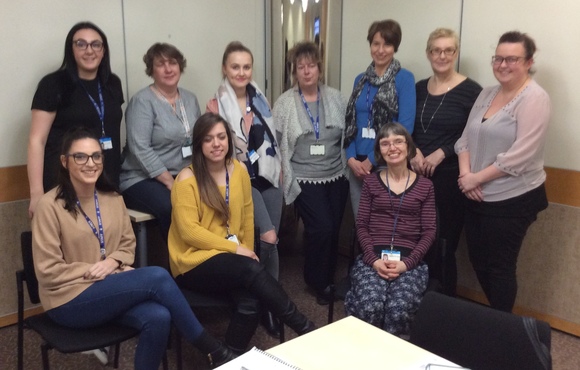
Team members - Top left to right: Alice Summerfield,
Sarah Sellis (Team Leader), Francesca Kavanagh, Mel Palmer, Rosie Sapherson,
Beverley Westbrook and Lily Turrell. Bottom left to right: Ellie Boniface, Anna
Silva and Bernadette Uwins. Not available for the photo: Kate Shelley
The 13th March saw the East Grinstead innovation
site go live. The site is the fourth to start using the Three Conversation
approach and will be split across two different locations.
The site will be split between County Hall North in
Horsham (the ‘deep’ front door’) and Glen Vue Day Centre in East Grinstead.
Staff in County Hall North will be made up of CarePoint 1 and CarePoint 2
workers who will be testing the three conversation approach supported by a
multi-disciplinary team working from and with Glen Vue staff.
The
innovation site is led by Sarah Sellis who is currently a Senior Practitioner
in the Mid Sussex Community Team. The team have followed suit with other sites
and have decided to call themselves Supporting Lives East Grinstead, and will
be engaging with people from the wider East Grinstead area.
We
recently caught up with the Supporting Lives Adur Team who are now over half
way through their innovation journey, and asked them about their experiences so
far.
What are the top three
benefits for the team from a staff perspective?
- The reduced paper work which is quicker to complete for Conversations 1 and 2.
- Working with each other and being able to do joint visits.
- The opportunity to get to people quicker and provide early advice and support.
What are the benefits for the people
we support?
There is a quicker referral process with no waiting at CarePoint
2 or on team waiting lists. People are provided with an end-to-end process that
is held within one team, and staff are building up the local knowledge that
they can share with people who make contact with the site.
What were the most notable
challenges faced by the team?
There were a number of challenges with being the first
team to go live and those included:
- Coping with the constant change as things evolved.
- Working out the level (1-3) of conversations we were having and how best to record them.
- Collating data for the evaluation.
- The time commitment for duty work.
- Carrying out unfamiliar work that was outside our professional or usual comfort zone.
What is it like working within a multi-disciplinary
team?
It is fabulous!
Staff are gaining knowledge and both the team and the
people we support are seeing the benefits. Having a Community Connector within
the team has allowed us to connect with the local community and widen our
approach to supporting people’s lives.
What are the most
common cases coming through to the site?
Requests for assistance with bathing, people requesting
assessments for benefits claims, and mostly straightforward requests for advice
and / or information.
What is the new practice paperwork
and Frameworki process like to work with?
The paperwork is better than it was before, but as the
innovation site has progressed there are regular changes, and process issues that
need to be managed in a timely way. Conversation 3 is the ‘business as usual’ assessment
paperwork and process so there’s the same amount of work to complete.
TEAM UPDATE – following a review
with Managers within Adur and the Innovation site Team leader it has been
agreed that the site will continue for a further six months after the initial
12 week period. Discussions will be arranged with individual staff to agree
this with them; this will also allow the site to take in more complex work
through targeted reassessment work.
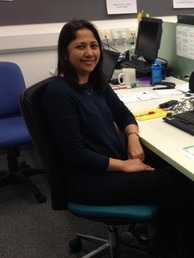
I come from the Prevention and Assessment
Team (PAT North) and have recently joined Supporting Lives Crawley.
Having worked in the field of services and
support for older people for the past few years I have built up substantial knowledge
to help the people and the team, many of whom have come from other disciplines.
The new innovation team has a way of
working that enables sharing of skills and ideas between team members who have a
wide range of skills. For example, working alongside occupational therapist colleagues
enables me to provide people with an end-to-end service, whereas in the past
there was a need to refer them from one team to another.
The new model is providing a quicker
service for the customer whilst reducing paperwork and time.
Helena McNamee, Team Leader for Supporting
Lives Crawley had this to say about Chetna:
“Having someone
from the PAT has been of huge benefit to the new team. Chetna’s wealth of
knowledge around services in the area and how to access a range of services has
been of use to all members of the team. We have all learned a great deal
from Chetna and value her input into a wide range of cases within the
team. With Chetna’s support we feel that we are able to offer our customers
a more rounded service”.
|
The
Learning Disability innovation sites at Bognor and Worthing went live on Monday
27 March 2017.
The
last two innovation site themes will be at the Coastal Hospitals and Reviews and
Reassessments in Worthing which will both go live on the 3rd April
The
hospital theme will test the new approach on wards at St Richards Hospital in
Chichester and Worthing Hospital.
The
Review and Reassessment approach will be tested within the Worthing Locality
Team which will include a Social Worker and an Occupational Therapist.
|

A
case study from an innovation site showing how the Three Conversation model worked for a recent case.
Scenario: A nephew contacted
the site to raise concerns about his uncle who has Alzheimer’s. The primary
issue was his uncle’s lack of hygiene and the fact that he sleeps in and does
not change his clothes. The nephew thought the issue involved safeguarding due
to this self-neglect. He wanted an assessment and for his uncle to have
assistance with bathing.
What would the previous approach have been?
A
route into CarePoint 2 via Carepoint 1 and then potentially on to a Community
Team. This could have impacted on the carers (nephew and the gentleman’s wife)
who appeared to be tired and frustrated.
What was the new approach? Two staff from the Innovation site were able to visit
the family very quickly to get a better idea of the actual situation (their
previous roles were as a dedicated Prevention and Assessment Team nurse and a
dedicated support broker). The staff assessing the situation did not have any
concerns about self-neglect. Family concerns around hygiene were discussed and
the possible use of Attendance Allowance to fund a private agency for domestic
tasks and to assist with bathing. They also suggested a thorough cleaning of
the gentleman’s room and the removal of potential obstacles which were
hindering access to clean clothes.
What
were the outcomes?
- Applying for a Blue Badge in order to improve the wife’s ability to take her husband out and reduce their social isolation.
- Applying for Attendance Allowance with help from Age UK, with a view to using it for domestic support.
- Ordering a Toilet frame to prevent the toilet seat being broken again which was a source of family friction.
- A referral for Carers Support and Crossroads Care is now in process.
The
nephew and wife felt heard and understood. The wife had described “giving up”
on her husband early in the visit, but conceded that having assistance with
cleaning would improve their lives significantly. There will also be a follow
up in four weeks to ensure the actions discussed have moved forward and the
proposed outcomes for the couple are met.
|

In
Adur, during the first nine weeks of
the innovation period, over 204 new referrals have been received. Of the
conversations recorded, 87% have been Conversation 1, 6.5% Conversation 2 and
6.5% Conversation 3.
Crawley have had 144
referrals during the first six weeks and of the conversations recorded, 97%
have been Conversation 1, 1.5% Conversation 2 and 1.5% Conversation 3.
Chichester Rural have had 34
referrals in their first three weeks and of the conversations recorded, 73%
have been Conversation 1, 23% Conversation 2 and 4% Conversation 3.
East Grinstead had 27 referrals during
their first week of which 93% were recorded as Conversation 1, 7% Conversation
2 and no Conversation 3s.
Within
the sites there have been some Safeguarding referrals, and only a very small
number of people have needed a further in depth Conversation 3 assessment.
|

Find a list of FAQs
on SharePoint here.
Some
questions recently asked were:
How
is the new practice paperwork and frameworki process working for the innovation
sites?
They
are working really well, there is constant feedback that the reduced paperwork
is allowing staff more time to spend on visits and support people who need our
help.
Reviewing
the practice for conversations 1 and 2 and how information is recorded on
frameworki is a focus over the innovation period; and where necessary,
essential changes to the system have been made following requests from staff.
We do however have to ensure that we adhere to the 3 conversation model
principles and any legal or statutory requirements. We are aware that the
current BAU assessment form will be reviewed in time (for conversation 3) , but
at present we are focusing on Conversation 1 & 2 practice and how this is
being recorded.
What
will happen to the innovation sites after the 12 week innovation period?
All innovation sites will have a six week review and
a collaborative decision will be made between the site and Senior Managers about
the next steps for each team at 12 weeks.
A six week review for Adur
was completed and chaired independently by Amie Crews (Organisational
Development Consultant from West Sussex County Council). The decision was made
to continue for three weeks with the existing approach due to the delay with
all staff being able to order small equipment items. After this period a
further extension of six months was agreed and the team will start to take on
reassessments.
What
will our roles and responsibilities look like in the future?
Tracy Davis (Service Development Lead – Professional
Practice) and Jackie Campbell (Senior Consultant in Workforce and Development)
are currently leading a Task and Finish Group to start considering what the
future workforce could look like. This work is currently in its early phase with
a small cohort of managers and we should be able to give you further updates in
future newsletters.
Are the innovation sites making a
difference to supporting lives?
Whilst it is still early days, feedback from staff is
that they are reaching people earlier. As they are spending less time on
paperwork they are able to spend more time supporting people and connecting
them to resources in their community.
Evaluation
surveys have also started being sent out to customers and carers who have been
in contact with the Innovation site staff. These will be collated analysed by
colleagues in the Public Health Research Unit.
|
We
are working with the three local CCGs to jointly host two large stakeholder
events for voluntary and community sector organisations – one in the Coastal
region and another in the north of the county.
These are intended to provide an opportunity for voluntary and community
sector organisations to hear from senior managers in Adults’ Services and the
NHS about future plans for place-based services and to share their views on
these developments. The event in Coastal is being held on 24th April
and invitations have been sent.
We are
currently considering dates in late May/early June for the northern event.
Planning for both events has involved representation from the voluntary and
community sector, Healthwatch West Sussex, Carers Support West Sussex and
officers from WSCC and the CCGs.
From
June to August we will be holding a series of focus groups with local community
groups, and people who use our services. We are also currently planning
activities to reach the broader community, for example through roadshows.
Feedback
from engagement activities will inform the Cabinet Member decision being taken
in the Autumn and the accompanying Equalities Impact Assessment.
|
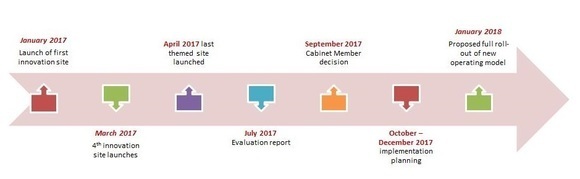
|