 In case you missed it
We published a review of our plastic kerbing trial as part of a new cycle path on London Road in Wokingham. Plastic kerbs are lightweight kerbstones made using 88% recycled materials and the installation gave carbon savings big enough to power 35 houses for a year.
As part of the Government’s Active Travel Fund, we are working to improve the cycle and walking connection between Woodley town centre and the Reading borough boundary at Palmer Park. We are currently asking for feedback on detailed plans. To give your feedback, please visit our Engage Wokingham borough platform.
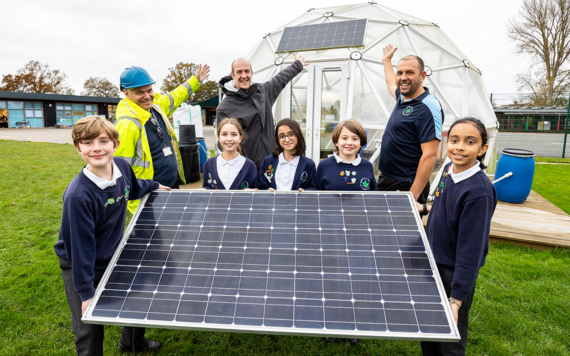
2021 saw Shinfield St Mary’s Primary School get even greener following the installation of 116 new solar panels across the school roof, allowing it to massively increase the amount of sustainable energy generated on site.
We launched our Let’s Talk Climate project, inviting interested parties across the area to take part in peer groups and e-panels on climate change. We're looking for local businesses, teachers, primary and secondary pupils, residents and community groups. There's still time to sign up!
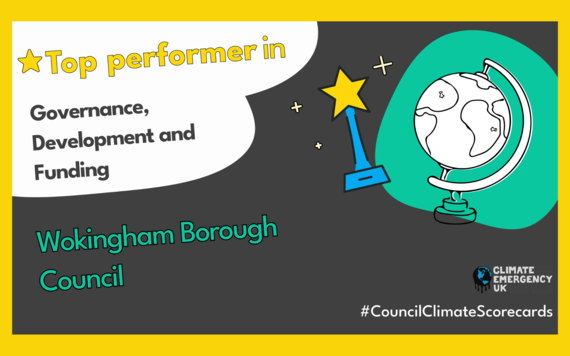 National recognition for our Climate Emergency Action Plan
We have been awarded eighth place for our Climate Emergency Action Plan (CEAP) by Climate Emergency UK, an independent organisation whose aim is to support local authorities in their climate goals.
Climate Emergency UK scored all council’s CEAP's, a total of 325, against 28 questions, including how well councils’ plans would mitigate the impact of climate change locally, whether climate and ecological emergency was integrated into existing policies, community engagement, climate education, scale of emissions targets and commitments to tackle the ecological emergency.
We scored very highly across all the focus areas with an overall score of 79 per cent, the average being 50 per cent. Full marks were also awarded in four areas:
- Co-benefits
- Education, skills and training
- Ecological emergency
- Governance, development and funding, where we were the only council to get full marks.
Full results for all councils in the UK and full methodology can be found on Climate Action UK’s Climate Action Scorecards website.
 Talking about climate change
Read any number of articles about what you can do about climate change online, and one of the things that comes up over and over again is talk about it.
But what does talking about it do?
Talking with friends, family, neighbours and colleagues can be an important way to help us understand how collectively, the small changes we all make to our habits and lifestyle can make a big difference.
When we hear information from people we know and trust, we are more likely to take notice. This doesn't mean we'll make immediate changes, but it can be a start.
Greenpeace give these six tips for talking to friends and family about climate change:
1. Pick your moment, and take your time
Generally we have our best conversations when we’re feeling positive, and have the time and energy to do the topic justice. So if you’re feeling tired, angry, rushed or anxious, save it for another day.
The same applies for the other person, of course. Are they in a position to be thoughtful and open-minded right now? In certain situations or in front of certain groups, people might feel they have to quickly shout you down or change the subject so they don’t lose face.
2. Don’t try to ‘win’
It sounds strange, but often the best way to be persuasive is to stop trying to persuade people. Trying to turn the whole room into die-hard climate activists before lunch sets you up to fail, and sets everyone else up to have a terrible time.
Rather than playing the advocate working to ‘get people on board’, be the moderator: the one who gives people a chance to explore the issue in their own way, without feeling judged or pressured. And this isn’t just about changing minds and inspiring action. In an age of rising climate anxiety, creating this space can really help people’s well-being.
And remember you don’t have to pack everything into one conversation. It’s better to have an interesting, friendly exchange that leaves the door open for next time, than to rush to a solid conclusion.
3. Share your story
Remember you’re talking to people who (hopefully) love and trust you, and care about your life. So don’t be afraid to make it personal. Your feelings, hopes, questions and experiences are more powerful than all the stats and talking points under the sun.
Try telling the story of how you came to care about this issue. Talk about what makes you feel afraid, frustrated or hopeful. Share your experience of taking action, and ask for help or advice.
4. Listen, and show you’ve heard
Even if someone’s being critical, let them speak without interrupting. Then rather than trying to immediately argue back, take your time to really absorb what they’re saying. Sometimes it’s even worth paraphrasing the person’s idea back to them.
For example, if someone is complaining about a proposed bike lane causing traffic jams, chances are they already find getting around town slow and frustrating. So say that! By showing that you understand where they’re coming from, you’ll make the other person much more receptive to whatever you want to say (or ask!) next.
This can be tricky, particularly if you disagree. But genuine listening gives people space to explore their own potentially complicated and negative thoughts.
5. Ask questions
Asking open questions gives people the space to reflect and feel heard. And remember, you don’t have to have all the answers. Asking things like “How could we change that?” or “What do you think should happen instead?” can open up the conversation and stop it from feeling one-sided.
6. Be kind to yourself
Every conversation is worthwhile, even if it might not seem it initially. You might not change someone’s mind on the spot, but you’ll have given them a chance to think about things in a new way.
 How much do you know about carbon emissions?
Before you talk to others about climate change, you might want to test your own knowledge. Have a go at our carbon emissions quiz...answers are at the bottom.
1. Watching how many hours of TV is equivalent to the carbon footprint of a typical paperback book?
a) One
b) Six
c) 15
2. How far could you fly from London for the same carbon emissions as buying two big weekend papers a week for a year (even if you recycle them?)
a) London to Bristol
b) London to Barcelona
c) London to Brazil
3. Which of these has the highest carbon emissions?
a) growing and producing a kilo of rice
b) burning a litre of diesel
4. Which of the following would be the greenest way to communicate?
a) Calling your mum for five minutes on a mobile phone
b) Writing your mum a small letter (written on recycled paper) by second-class post
c) Spamming your 500 closest Facebook friends
5. Between birth and two-and-a-half, a child will go through around 4,000 nappies. If using disposable nappies, how many lattes would it take to produce the same carbon emissions?
a) 95
b) 900
c) 2,500
6. We often hear that seasonal, locally grown vegetables are best. To get strawberries out of season, what is their carbon emissions compared to in season?
a) Double
b) Seven times as much
c) Twelve times as much
7. Is the carbon emissions (per year) for a pet goldfish more or less than...
a) Crawling in traffic for ten miles
b) Taking a five minute shower (in a 5kW economy electric shower)
c) An average UK citizens tap water consumption (including drinking, washing, cooking).
8. How many bananas have the equivalent carbon emissions of a UK reared steak?
a) 15
b) 35
c) 50
9. If you drive 10,000 miles a year in an average car and want to offset your carbon emissions, how many trees (per year) would you need to plant?
a) Two
b) Four
c) Ten
10. Flying from New York to London contributes as much to global warming as eating how many pounds of beef?
a) Four
b) 400
c) 4,000
*Information to compile questions largely from How Bad are Bananas by Mike Berners-Lee
 Could you be in the spotlight?
Our Spotlight feature is taking a break this month. If you run a local business, community group or initiative that is working towards reducing carbon emissions in some way, we'd love to hear from you.
You could be doing something directly related to climate change, or be introducing good practices.
If you are interested, please drop us an email and we will get back to you.
 Find out how many you got right!
How did you do? Are you ready for the 'big black chair' or back to the classroom?
1. Watching how many hours of TV is equivalent to the carbon footprint of a typical paperback book?
b) Six
2. How far could you fly from London for the same carbon emissions as buying two big weekend papers a week for a year (even if you recycle them?)
b) London to Barcelona
3. Which of these has the highest carbon emissions?
a) growing and producing a kilo of rice
4. Which of the following would be the greenest way to communicate?
c) Spamming your 500 closest Facebook friends
5. Between birth and two-and-a-half, a child will go through around 4,000 nappies. If using disposable nappies, how many lattes would it take to produce the same carbon emissions?
b) 900
6. We often hear that seasonal, locally grown vegetables are best. To get strawberries out of season, what is their carbon emissions compared to in season?
b) Seven times as much
7. Is the carbon emissions (per year) for a pet goldfish more or less than...
a) Crawling in traffic for ten miles
b) Taking a five minute shower (in a 5kW economy electric shower)
c) An average UK citizens tap water consumption (including drinking, washing, cooking).
8. How many bananas have the equivalent carbon emissions of a UK reared steak?
c) 50
9. If you drive 10,000 a year in an average car and want to offset your carbon emissions, how many trees (per year) would you need to plant?
b) Four
10. Flying from New York to London contributes as much to global warming as eating how many pounds of beef?
a) Four
 What's coming up this month
Let's Talk Climate
Applications to join one of the peer groups closes later this week, with first panels expected to take place towards the end of February.
|