Climate change and biodiversity loss are global issues that affect us all. We are, unfortunately, becoming increasingly familiar with more extreme weather events such as flooding, wildfires, and droughts. This summer - the hottest on record for the UK - has seen periods of extreme heat, with amber and red heat-health alerts issued across parts of the UK, highlighting the very real risks high temperatures pose to our health, communities, and environment.
Last month's report from the Met Office warned that the El Niño event developing over the Pacific Ocean is likely to be the strongest in living memory.
El Niño is a natural climate phenomenon that can push up global temperatures and increase the risk of extreme weather. Combined with the effects of climate change, the Met Office says it is “very likely” that 2027 will replace 2024 as the warmest year on record.
While hot weather can feel like a welcome change from our usual cooler climate - especially in Cumbria - these events are a stark reminder of the growing impacts of climate change.
However, it is not too late to play our part in tackling the climate and biodiversity emergencies. Whether big or small, we can all consider the changes we can make in our day-to-day lives.
As a council, we are determined to be at the forefront of addressing these challenges. Our ambition is to provide strong leadership on climate action and nature recovery, working to ensure the council is carbon net zero as soon as possible, and that our area reaches carbon net zero by 2037.
There has been a huge amount happening across the Council and the Westmorland and Furness area over the last few months and we’re pleased to share it with you in this bumper edition.
Councillor John Murray
Cabinet Member for Climate, Biodiversity and Regulatory Services
|

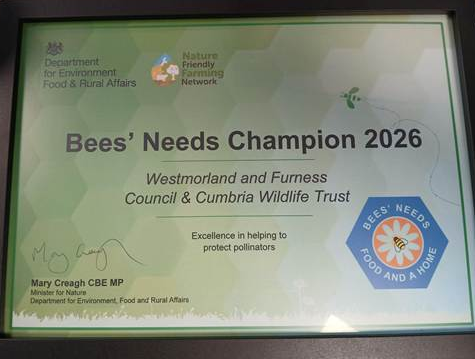 |
We're buzzing to have been awarded the Bees' Needs Champion Award alongside Cumbria Wildlife Trust for our joint project - Planting for Pollinators!
Since the project’s launch in 2023, 22 sites across Westmorland and Furness have begun their transformation to species-rich lowland meadow or pollinator-friendly community gardens.
From these 22 sites, a total of 4.2 hectares of pollinator-friendly habitats have been created, supporting local pollinator populations and transforming our green spaces into nature-rich spaces for residents to enjoy.
Over 700 people have directly taken action to help support pollinators, creating habitats that are a lifeline, providing much-needed pollen, nectar and larval foodplants for insects in the heart of our villages and towns across the area.
We look forward to seeing these wildflowers sites and the pollinator species they support flourish.
This project is ongoing so if you’d like to be involved, get in touch at: pollinators@cumbriawildlifetrust.org.uk
It’s been two years since we launched Part Two of our Climate Action Plan, and we’ve continued to make real strides in laying the foundations for a greener future.
Our Climate Action Plan identifies suitable actions we can take across the organisation to reduce emissions, reduce environmental inequalities and create a climate positive council culture, building on our ‘ecologically aware’ value.
This includes how we can work with others to make changes and collaborate with partners such as Futureproof Cumbria, the Zero Carbon Cumbria Partnership (ZCCP) and the Love Windermere Partnership to deliver net zero across Westmorland and Furness.
The Climate Action Plan is a five-year plan which will be reviewed regularly and updated annually, with the council focusing its actions on several categories, identifying that a holistic approach is needed to tackle climate change and achieve net zero.
|

Our achievements to date include:
-
The way we work: We have completed building surveys to explore opportunities to decarbonise schools. In partnership with Future Proof Cumbria, Cumbria Tourism and local businesses, we have also delivered the Innovate UK funded Rural Net-Zero project, exploring the principles of circular economy, green finance and local food systems.
-
The way we travel: To promote active travel we have developed an active travel digital platform (Travel Actively) to encourage and engage residents with cycling, walking and wheeling. We have also introduced an EV salary sacrifice scheme to council staff, helping them to choose lower carbon commutes.
-
The way we live: We have delivered national energy efficiency and retrofit schemes including Local Authority Delivery (LAD), Home Upgrade Grant Scheme (HUG) and Energy Company Obligation (ECO) to support homeowners in accessing accredited advice on house retrofitting and energy.We have also funded and expanded the Green Doctor programme across Westmorland and Furness, helping to give advice to residents on how to make their homes more energy efficient.
-
The way we protect and enhance nature: We produced a Local Nature Recovery Strategy for Cumbria and are working closely with partners to implement the strategy to generate investment in nature recovery which could have carbon sequestration potential.
-
The way we use things: We have held a series of community ‘take back’ events for unwanted daily aids to living such as shower chairs and commodes to help reduce waste and allow the items to be reused. We have also held several public engagement events on waste reduction to encourage circular economy practices.
|
Looking ahead, we remain committed to reducing emissions and supporting our ambition to reach net zero. There’s still much to do, but together, we can create a greener, healthier, more resilient Westmorland and Furness and continue to make it to be a great place to live, work and thrive.
Read our Climate Action Plan.
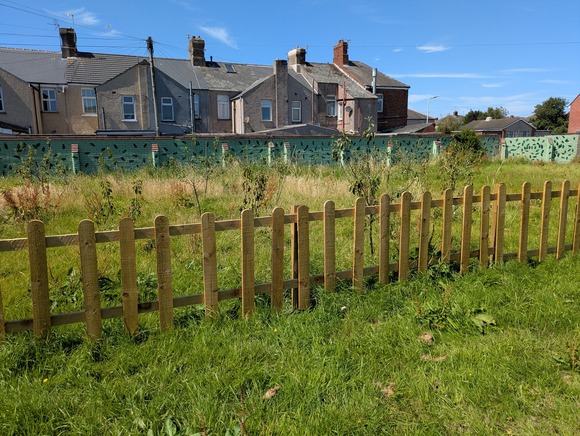 Thanks to support from the Council's Community Orchard Grant scheme, Far Field Orchard at Cambridge Primary School in Barrow has now been successfully completed and is already becoming a valued part of the school environment.
Fifty fruit trees have been planted and are thriving. Protective fencing has been installed around the orchard to shield the young trees from everyday playground activity while they become established and grow stronger. The site has also been designed with room for future expansion, giving the school the opportunity to add more trees and further develop this growing outdoor space in the years ahead.
The children have played a key role in bringing the orchard to life by painting the walls surrounding the orchard and creating beautiful leaf prints to decorate the area, helping to mark it out as a special place within the school grounds. The artwork has transformed the space and reflects the pupils' pride and ownership of the project.
School staff said:
"We are really pleased and proud of what we have achieved. Lots of our families do not have gardens or their own outdoor spaces, nor can they easily access our local countryside, so it's vitally important that they can access nature at school every day and spend time in a natural outdoor environment.
"We look forward to seeing our fruit grow, caring for the trees, and hopefully enjoying the harvest in the years to come."
The orchard will provide a lasting environmental asset for the school community, creating opportunities for outdoor learning, biodiversity, wellbeing, and a stronger connection with nature for generations of pupils to enjoy.
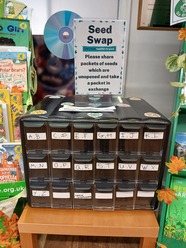
Westmorland and Furness Libraries continue to make meaningful progress through the Green Libraries project, embedding sustainability into everyday library services and community engagement.
Central to this work is a dedicated working group of Climate Champions from across the library service, who collaborate to deliver an annual programme of activities and initiatives aligned with environmental priorities.
The group plays a vital role in building partnerships with local organisations, community groups and volunteers, helping to extend the reach and impact of green initiatives. This collaborative approach has led to the successful delivery of a number of creative and well-received projects across the area.
|
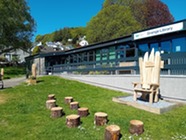
Recent highlights include the installation of swift nesting boxes in Penrith to support local biodiversity, the “Folk and Nature” story trail in Grange, and the Culture Nature Crafts programme in Barrow which has encouraged residents of all ages to engage with sustainability through hands-on activities.
Alongside these projects, libraries continue to offer a growing range of ongoing green resources. Seed libraries are now available in Barrow, Penrith, Kendal, Grange and Windermere, promoting local growing and sharing. “Go Green” book collections for both adults and children provide accessible information and inspiration on environmental topics, while regular craft activities focus on using environmentally friendly materials and encouraging recycling.
Together, these initiatives demonstrate the library service’s commitment to supporting climate awareness, community resilience and sustainable living across Westmorland and Furness.
|

Are you a library member?
Did you know that if you live, work or study in Westmorland and Furness you can apply for a free library membership?
A library membership allows you to:
- access all libraries in Cumbria
- search and reserve items for collection
- use computer, printing and scanning facilities
- access our online catalogue of eBooks, audiobooks, newspapers and magazines via Borrowbox
Find or indulge your love of reading whilst saving your pocket and the planet!
|
In November 2025, the National Emergency Briefing brought together leading independent experts to present the latest evidence on the climate and nature crisis to politicians and other influential people in Westminster.
Following this, a 50-minute film was created as a public information initiative to ensure the UK is fully briefed on the climate and nature crisis. It presents the national implications of climate and nature breakdown - along with credible, positive responses - in a single, accessible account designed for screening in communities across the UK.
Find a screening of the People's Emergency Briefing near you on this map.
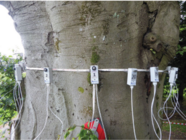
As part of our routine tree safety inspections, we recently investigated a mature 25-metre beech tree in the Abbot Hall area of Kendal after signs of a naturally occurring fungus, known as oyster mushroom (Pleurotus ostreatus), were found growing on its trunk.
While this type of fungus can sometimes lead to decay within a tree, it can also live harmlessly on a host tree for many years. Because the extent of any internal decay was unclear, we brought in a specialist arboricultural consultant to carry out a detailed assessment.
Using advanced diagnostic technology, including sound-wave imaging and wood density testing, specialists were able to examine the tree's internal structure without causing damage. These tests created a detailed picture of the tree's condition and helped identify any areas of concern.
The results showed only minor decay around the fungal growth, with the tree remaining healthy and structurally sound. No remedial work is needed at this stage, and the tree will continue to be monitored through our regular inspection programme.
Thanks to this specialist technology, we have been able to keep this valuable and prominent tree in place while ensuring it remains safe. Although such assessments are only needed occasionally, they help us make informed, evidence-based decisions that support both public safety and the long-term protection of our trees.
|
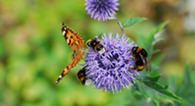
Nature is in crisis. England is one of the most nature-depleted countries in the world, with one in six species at risk of extinction. Even in areas like Westmorland and Furness, which is known for its natural beauty, wildlife has declined significantly. Habitats have become split up and many species are relying more on towns and villages for survival.
Wildlife-friendly gardening is not just about helping nature, it can also mean creating or enhancing spaces that bring joy, improve wellbeing, and strengthen our connection to the natural world. Every action, no matter how small, contributes to a bigger picture of nature recovery across Westmorland
and Furness.
Our Wildlife-Friendly Gardening guide has ideas for every space as well as important tips, cost saving approaches, benefits and more.
This guide will:
- Introduce wildlife-friendly gardening
- Explain why wildlife-friendly gardening is important
- Describe the benefits of wildlife-friendly gardening
- Provide ideas to help native wildlife in your garden, allotment, balcony or outdoor space
Read and download the guide to get started.
|

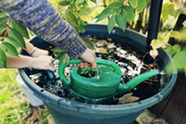
The sun has been out a lot over the last few months and lots of us spent time in the garden but did you know your garden can help reduce flood risk?
Our gardens can help manage the risk of flooding by absorbing rainwater and easing pressure on drains.
Simple changes such as installing rainwater gardens, permeable paving, and water butts are great examples of Sustainable Drainage Systems (SuDS) that help manage the risk of surface water flooding. These features not only slow the flow of rainwater but also create greener, more climate-resilient outdoor spaces.
Using SuDS in gardens can support biodiversity, improve drainage, and manage the risk of localised flooding during heavy rainfall.
Find out more in the Flood Hub's blog.
WATCH: Milligan the hedgehog explains how to help wildlife at home and help to prevent the risk of flooding.
|
What is a rainwater garden?
A rainwater garden offers the opportunity to manage rainwater runoff from hard surfaces after downpours by planting an attractive, low maintenance, wildlife-friendly space.
-
Collection: Rainwater runs off from impermeable surfaces into the shallow garden.
-
Infiltration: The water seeps through the soil and plant roots, which slows the flow and allows the soil to absorb and store the water.
-
Filtration: As the water filters through the soil and plants, pollutants and sediments are removed.
-
Evaporation and transpiration: Plants absorb water and release it back into the atmosphere.
For further information on creating your own rain garden, visit the RHS' website.
Why choose a resilient driveway?
Replacing grass and plant beds with concrete and asphalt surfaces means that water does not soak into the ground. This reduces the amount that reaches our natural underground aquifers. Some water that soaks into the ground will evaporate back into the air, causing a cooling effect around the house. This is lost if the garden is covered with hard impermeable surfaces and can cause local temperatures to rise.
Using non-porous materials in hard landscaping can increase the amount of rainwater run-off by as much as 50%, often causing flooding. To avoid this problem, using permeable paving and keeping hard surfaces to a minimum is very effective.
Options for resilient driveways include grass reinforcement, using gravel, using permeable block paving, porous asphalt or concrete; directing water from an impermeable surface to a border rain garden or soakaway.
For further information see the Environment Agency’s guidance on permeable surfacing.
For design suggestions and planting tips, visit the RHS' website.


Composting is a simple concept but a powerful and meaningful action we can all take to help combat climate change.
By composting at home, you are embracing the most sustainable way of managing the organic waste - including food scraps - that we all generate.
It is estimated that each domestic compost bin in use prevents 125kg of waste being transported and disposed of by councils every year. When you choose to compost, you’re not only protecting the planet, you’re also transforming your waste into something useful and life-giving for your garden.
In Westmorland and Furness, we are fortunate to have a team of compost enthusiasts who are happy to share their extensive composting knowledge and experience: with people who need help to start as well as those who want to improve their home composting.
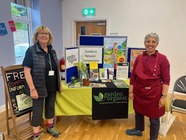
The Master Composter programme is run through the organic growing charity Garden Organic and funded by Westmorland and Furness Council. Master Composter volunteers have a wealth of composting know-how and are keen to enthuse others to join the composting revolution. They can often be found at local community events promoting home composting and offering advice.
|
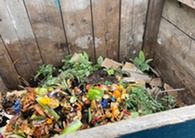
Top tips for composting
- Decide which type of compost bin or system best suits you and your garden. You can make your own compost bin from recycled wood, or upcycle an old plastic dustbin but if DIY is not your thing, there are numerous different designs available to purchase. If you are unsure where to start, why not visit one of our compost demonstration sites? There you’ll see a good variety of compost bins in use, with plenty of information on display to help you decide on the right system for you.
- Understanding what you can and can’t put on your compost pile is important, but as a general rule of thumb, most uncooked plant-based material can be added, either in the form of kitchen scraps or plant cuttings from the garden.
- Getting the right balance of nitrogen-rich ‘green’ materials (cut grass, vegetable peelings, fresh new plant growth) and carbon-rich ‘brown’ materials (dry plant material, cardboard/paper) is also key, as it ensures the compost will not get too wet (too many greens) or too dry (too many browns).
- The composting process is aerobic. This means that the decomposition needs air, so check that the heap is not too compacted and has plenty of air pockets. As lots of small creatures such as worms, and even smaller creatures like micro-organisms, are all helping to produce compost, it is also a good idea to chop up your material into fairly small pieces so that it is more manageable for your little helpers.
- Turning your compost or giving it a bit of a mix every time you add some fresh material will help speed up the process to get your compost ready to use in your garden. If you have given your compost the right balance of materials and attention, it should produce good compost in about 6 months. If you have just left it to its own devices, it might take around 18 months – and either method is perfectly fine.
Whatever type of soil you have in your garden, adding compost will improve its structure. The organic matter in compost improves drainage in heavy clay soils and allows sandy soils to retain moisture and nutrients better. Compost will also stimulate beneficial soil life and add nutrients to help your plants thrive.
|

Schoolchildren across Westmorland and Furness are playing a key role in preventing battery-related fires and protecting the environment by taking part in a county-wide ‘Baa-ttery Campaign’.
We're proud to have once again supported the initiative, providing book token prizes to the schools that collected the most batteries per pupil. The top-performing primary schools in the area were:
- 1st Place – Patterdale CofE School, Penrith
- 2nd Place – Selside Endowed CofE School, Kendal
- 3rd Place – Asby Endowed CofE School, Appleby
Together, these top three schools saved more than 88kg of batteries.
The top performing secondary school in the area was Lakes School in Windermere.
From November 2025 to February 2026, 201 schools across Cumbria collected used batteries to ensure they were safely recycled rather than being disposed of in household waste. Thanks to their efforts, over one and a half tonnes of batteries have been collected, reducing the risk of waste facility fires and promoting sustainable recycling habits.
With the help of Renewi, Valpak Limited, Westmorland and Furness Council, Cumberland Council, and Plus3K, this campaign has not only sparked awareness but also inspired fantastic action among young eco-champions.
A big thank 'ewe' to everyone who took part – your efforts are 'shear' brilliance and have helped to tackle a shocking statistic - each year, 3.2 million batteries are binned in Cumbria alone. That’s the equivalent of over 3,650 Herdwick sheep in weight!
|

A huge thank you to everyone who took part in our series of Aids to Daily Living Take Back events over the last few months.
We received a wide range of items including commodes, toilet frames, perching stools, shower chairs and overbed tables.
Thanks to you, these vital pieces of community equipment can now be cleaned, sanitised, and reused, helping others in need while also reducing unnecessary waste.
Keep an eye out for more take-back events coming soon.
Together, we are making a real difference - both for people and the planet.
|
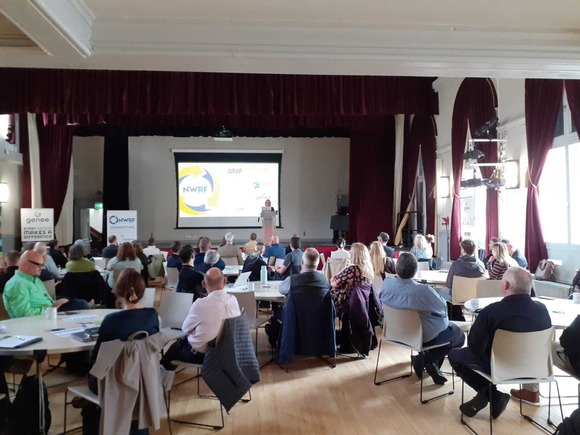
It was a pleasure to host the North West Resources Forum (NWRF) at Kendal Town Hall in June, and to welcome the forum to Cumbria for the first time.
The event brought together an excellent range of speakers, all connected by the shared theme of waste, and provided a valuable opportunity for networking and knowledge-sharing across the sector.
We were especially pleased to showcase Kendal Town Hall as a venue, and to receive such positive feedback on the event.

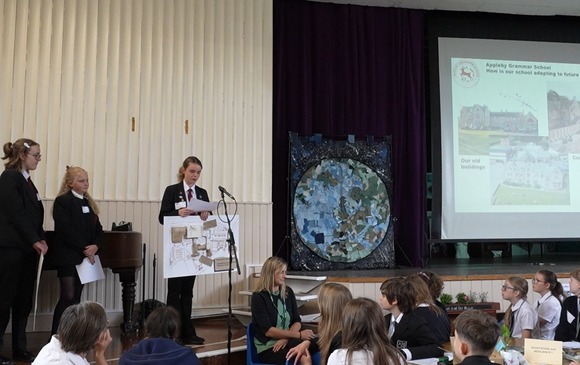
We were pleased to once again work with the Cumbria Development Education Centre (CDEC), to host the sixth annual Cumbria Youth Climate Summit. This year it took place for the first time across two separate events for primary and secondary pupils.
This expanded format reflected both the growing enthusiasm of younger children to engage with climate issues and the clear need to support climate learning and empowerment from the earliest ages.
This year saw the highest number of participants to date, with pupils from primary and secondary schools across Cumbria taking part. A total of 134 students from 26 primary and secondary schools across Cumbria attended, representing an engaged generation of climate-conscious young people.
The primary school Summit took place on Thursday 12 June at Bishop Harvey Goodwin School in Carlisle, and the secondary school summit on Wednesday 2 July at The Lakes School in Windermere.
Building on the success of last year’s summit at Furness Academy in Barrow, hosting the event in schools once again provides young people with easy access to a current, real-world conversation and creates space for them to be heard in their own environment.
This year’s secondary school summit directly responds to recommendations from the Cumbria Citizens’ Climate Assembly held in March 2025, answering the call to ‘give young people space, voice and influence’. The programme has been shaped with the help of students themselves.
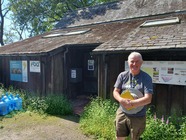
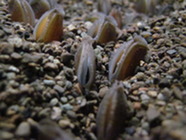
Last month, our Cabinet Member, Councillor John Murray, visited the Freshwater Biological Association's (FBA) Freshwater Pearl Mussel Ark to see first-hand the work being carried out to protect one of our key priority species.
Established in 2007, the Ark breeds freshwater pearl mussels from five populations across England and Wales to protect them from extinction. The FBA are currently rearing more than 55,000 juvenile mussels for release into their native rivers. Working with partners across river catchments, the team combines conservation action with scientific monitoring to improve survival rates and help restore wild populations.
|
Healthy hedgerows support hundreds of different species and provide natural wildlife corridors through our countryside. Only 20% of English hedgerows are in good condition, with many disappearing due to lack of management.
Friends of the Lake District are looking for landowners who would like their hedgerows surveyed by trained
volunteers, who identify healthy biodiverse hedges or hedges in need so they can then provide advice and help fund recovery and conservation work.
They can also fund hedgerow planting, laying, and restoration.
To have your hedgerows surveyed or register your interest in funding, email your name, address, phone number, and if possible a map of your farm’s hedgerows, to naomi.walker@fld.org.uk.
Become a hedgerow surveryor
Help survey the condition and biodiversity of hedges in Cumbria, and
collect vital information that will improve hedges for wildlife, people and livestock.
Join one of our training sessions and learn how to identify hedgerow plants, how to carry out the survey, and why we’re surveying hedges. See FLD's events web page to book or for more information, email: naomi.walker@fld.org.uk.
The Lancaster Towpath Trail is a unique place for walking, cycling, paddling and enjoying the tranquillity of our rural landscape.
Stretching between historic Kendal and Lancaster, it follows the original canal towpath - both the watered and un‑watered sections - to create a stunning route that connects communities, wildlife and heritage.
Today, the Towpath Trail is more than just a path. It’s a growing blue‑green corridor - a place where nature thrives along the water’s edge and where people of all ages can enjoy the simple pleasure of being outdoors.

In our previous issue, we shared plans to improve a much‑loved section of the Trail, thanks to investment through the Council’s Thrive Heritage Fund.
We’re pleased to report that this work is now complete and already making a positive difference for residents and visitors alike.
The project focused on creating a safer, more accessible link between the towpath and The Dairy Shed near Kendal, a popular self‑serve milk and milkshake vending spot. What was once a less straightforward route is now a clearly defined, easy‑to‑navigate connection, opening up the trail to more people and making a car‑free visit both practical and appealing.
Funding has also enabled the restoration of Natland Hall Bridge, protecting an important local heritage asset while making this stretch of the route feel safer and more welcoming for everyone.
These improvements represent exactly the kind of practical progress we want to support - helping people of all ages to get outside, connect with nature and enjoy everything the Towpath Trail has to offer, whether it’s a family outing, a gentle stroll with a friend or a breath of fresh air after work.
Read more about the opening of the new footpath at Natland.
WATCH: a video with councillors from Westmorland and Furness Council as they joined members of the Lancaster Canal Regneration Partnership to walk a new public footpath diversion at Natland.
|
 Care about the future of Windermere and its catchment? So do we. The Love Windermere Partnership (LWP) brings together communities, businesses, environmental groups and organisations committed to improving the health of our lake. And there are now more ways than ever for you to get involved.
Join our monthly drop‑in events
Every month, we host informal drop‑in sessions where anyone can come along to ask questions, share ideas, and learn about the work happening across the catchment. Whether you’re a resident, a business owner, or simply passionate about protecting Windermere, you’re always welcome.
Upcoming sessions include:
- 12 September - The Marina, Bowness-on-Windermere, LA23 3JQ, 10am-3pm
- 15 October - Windermere Library, Windermere, LA23 2AJ, 10am - 3pm
- 19 November - Force Cafe & Terrace, Kelsick Grammar, Stockghyll Lane, LA22 0QY, 10am - 3pm
- 9 December - Ambleside Library, Kelsick Road, Ambleside, LA22 0BZ, 10 am to 3pm
For more information, visit the LWP website.
Sign up to the newsletter
Stay up to date with the latest projects, scientific developments, community initiatives and ways to support the lake. Our regular newsletter brings you behind‑the‑scenes updates and opportunities to get involved - all straight to your inbox.
Read the latest newsletter (May 2026).
Sign up now via the LWP website.
Explore the website
Want to understand the challenges facing Windermere and what’s being done about them? The Love Windermere website offers clear, accessible information about current projects, data and partnership activity, as well as practical guidance on how you can help.
Visit the LWP website.
Follow LWP on social media
Help spread the word by following and sharing our content:
These channels are great ways to stay connected and see what’s happening in real time.

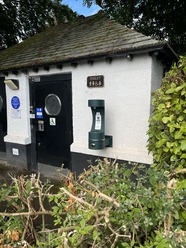
Residents and visitors to Grange-over-Sands have a welcome new addition along the Prom with a brand-new water bottle refill station designed to help reduce plastic waste and protect our beautiful coastal environment.
The unit, which has been purchased with the support of a grant from the environmental charity Sea-Changers, marks an important milestone for Peninsula Environmental Action Together (PEAT) and the wider community. Built to withstand the demands of a coastal setting, the station is WRAS-approved, vandal-resistant and specially designed for durability in seaside locations, ensuring it will serve the public reliably for years to come.
With the valuable support of Grange Town Council and Miniheat, the project has finally come to fruition.
The refill station was installed on the toilet block opposite the Lido - just in time to support both residents and the influx of summer visitors. It offers a free and convenient way for people to top up their water bottles, reducing reliance on single-use plastic bottles that often end up as litter.
To celebrate its launch, PEAT promoted the station at PromArt events in June and July where visitors to the stall were welcomed and even had the chance to pick up a pre-loved reusable water bottle to try the new station for themselves.
These bottles were generously collected by local organisations including Age UK, St Mary’s Hospice, and Bay Search and Rescue, with additional donations gathered via a collection point at the local library. It’s a great example of reuse and community spirit working hand-in-hand.
|
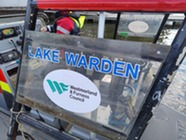
Our Lake Wardens have been making (air)waves with a feature on BBC Sounds’ Secret Cumbria. But do you know what they do?
For 75 years, this dedicated team has been quietly keeping Windermere safe. Based at Ferry Nab on the lake’s eastern shore, they provide a 24-hour emergency response service on behalf of the Maritime and Coastguard Agency, attending around 200 incidents every year.
As fully trained First Responders, Wardens are often first on scene with patrol and rescue boats equipped with life-saving medical kit including defibrillators. Their work can make all the difference in critical moments.
But emergencies are only part of the story. With the Council owners of the lakebed, the Wardens play a key role in managing it day-to-day helping keep England’s largest lake running smoothly. That includes delivering water safety sessions to schools, checking nearly 800 moorings, overseeing boat landings and winter storage, managing a private 28-berth marina and licensing commercial hire craft.
Listen now on BBC Sounds
|
People across the UK can now sign up for a new air quality alerts service, giving them an easy way to check local pollution levels through accurate, up-to-date information.
Millions of people live with conditions made worse by poor air quality, and treating lung conditions and asthma costs the NHS millions of pounds each year.
The new service allows people to select an area - such as their home, workplace or local park - and receive an alert by SMS or email when air pollution is forecast to be high.
Air pollution can affect everyone, but some people are particularly vulnerable to its effects, including people with respiratory and cardiovascular conditions. Having timely information about pollution levels can help people make informed decisions about their activities and take steps to reduce their exposure.
The service tracks five key pollutants: Particulate Matter (PM2.5), Particulate Matter (PM10), Nitrogen dioxide (NO2), Ozone (O3) and Sulphur dioxide (SO2).
Sign up for alerts and check air quality information through GOV.UK.

From October 2027 a new Deposit Return Scheme (DRS) for drinks containers comes into force.
A Deposit Return Scheme is a system designed to increase recycling and reduce litter. Under the scheme a deposit is added to the price of the drink when it is sold and the deposit is refunded when the empty bottle or can is returned.
Businesses will play a key role in the scheme for example by hosting reverse vending machines where consumers can return their containers to collect the deposit.
Exchange for Change - which is the industry-led organisation responsible for designing, implementing, and operating the Deposit Return Scheme across England, Scotland, and Northern Ireland - is holding a series of free 45 minute introductory webinars to provide more information about the new scheme.
For more information sign up via their website.
|

Did you know there are multiple textile recycling banks across the Westmorland and Furness area you can take your unwanted clothes, shoes and textiles to?
The Fire Fighters Charity has collection points at several fire stations including:
- Penrith
- Shap
- Appleby
- Ambleside
- Windermere
- Staveley
- Kendal
- Milnthorpe
- Grange
- Arnside
- Barrow
- Walney
- Broughton-in-Furness.
Find your nearest recycling bank by checking the charity's map
|
How we talk about climate change can inspire and motivate people to act, or make it feel more overwhelming and confusing than it needs to be.
By understanding the issues, we can help explain to others why it's important to act on climate change, the scale of that action and how to be part of that change on an individual and community level.
To help, we'll be sharing useful links and highlighting some great resources that help explain the main issues.
Futureproof Cumbria is out and about offering free advice with their home energy pop up sessions. You don’t need to book - just drop in!
Futureproof Cumbria are hosting a series of events where you can learn skills and gain knowledge to help yourself and your community. Why not take a look at one of the below?
Cumbria Sustainability Network: championing climate concerns
- 30 September 2026
- 10.00am to 3.30pm
- Quaker Friends House, Meeting House Lane Penrith CA11 7TR
People involved in local climate and sustainability work are welcome to come along, hear from Climate Emergency UK, and connect with others across Cumbria.
For full details and to book your FREE place.
Climate and Carbon Literacy training
- 15 and 22 October 2026
- 9.15am to 1.15pm
- Via Zoom, Online
Delve into the causes of climate change and what we can do about it. Boost understanding with this in-depth, accredited online course. Pay-what-you-can-afford option!
For full details and to book.
Care to Repair? How to Start Your Own Repair Café
- 17 October, 2026
- 9.45am to 2.30pm
- Cockermouth Methodist Church Hall, Lorton Street Cockermouth CA13 9RH
Thinking of starting a Repair Café? Learn from Cumbrian groups and discover what you need to get started.
For full details and to book your FREE place.
Climate Fresk
- 17 November 2026
- 10.00am to 1.00pm
- Kendal Town Hall
An interactive, engaging and collaborative in-person workshop to understand the fundamentals of climate science.
For full details and to book your FREE place.
 On the 50th anniversary of the 1976 summer heatwave, Met Office scientists highlighted how similar events could become significantly more intense in the future, with a plausible scenario showing UK temperatures reaching 45°C by 2056.
The anniversary came as the Met Office issued a Red Extreme Heat National Severe Weather Warning for parts of the country in June - reflecting the potential for significant impacts to health, infrastructure and daily life. Temperatures broke UK June records, highlighting the severity of the current conditions.
Watch the video on YouTube.
|