|
The Westmorland and Furness Safeguarding Children Partnership (WFSCP) is pleased to share the following information from Children's Services regarding the Kinship Local Offer.
 We are pleased to share our Kinship Local Offer, designed to provide clear information about the support available to kinship carers, children, and young people.
The Local Offer sets out the services, guidance, and financial support that may be available to kinship families in a range of different circumstances. It aims to help professionals better understand the support available and ensure that families receive the right help at the right time.
Kinship carers do not always identify themselves as ‘kinship carers’. It is therefore important that professionals feel confident in recognising and understanding the different types of kinship arrangements, so that families do not miss out on valuable support
Definition and Types of Kinship Care
Kinship care can take many different forms, and many people do not always realise that they are kinship carers. Kinship care refers to any situation in which a child is being raised by a friend or family member who is not their parent. These arrangements may be temporary or long term.
Types of kinship care arrangements include:
-
Informal kinship care: Private family arrangements where a child lives with a close relative without local authority involvement or a court order
-
Short-term private arrangements: Where a child under 16 stays for fewer than 28 days with someone who is not a close relative
-
Private fostering: Where a child under 16 is cared for by someone who is not a close relative for 28 days or more (as defined under Section 66 of the Children Act 1989)
-
Child Arrangements Orders: Legal orders placing a child with a friend or family member (either on a temporary or long-term basis)
-
Special Guardianship Orders: Where a court appoints a friend or family member as the child’s special guardian
-
Kinship foster care: Where a child is in the care of the local authority and placed with an approved family member or friend as a foster carer
-
Adoption by relatives or friends: Where the adopter was known to the child before the adoption order
Who can be a kinship carer?
A kinship carer may be:
- A close relative of the child (as defined by the Children Act 1989, including grandparents, siblings, aunts, uncles, and stepparents)
- A relative of the child’s half-siblings
- A former stepparent or partner of the child’s parent
- A close friend of the child or their parent(s)
- A close friend of the child’s wider family
We encourage all professionals working with children and families to familiarise themselves with the Local Offer so they can confidently advise and support kinship carers. It is also a useful resource that can be shared directly with families.
By improving awareness of the support available, we aim to strengthen outcomes for children living in kinship arrangements and ensure a consistent approach across services.
The Local Offer is accessible for professionals and families at: Kinship Local Offer | Westmorland and Furness Council
If you have any questions or would like further information, please contact the Kinship Team on SGOsupport@cumbria.gov.uk
 |
|
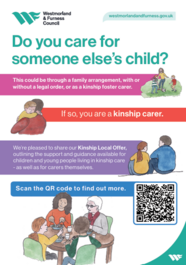
Please find an attached poster that you can print and display in your setting to help raise awareness and share information more widely.
Kinship Local Offer Poster
|
|