|
|
Having trouble viewing this email? View it as a Web page.

Drowning Prevention Week
Today focuses on what to do when something goes wrong.
Evidence shows many fatalities occur when people attempt to help others by entering the water themselves, often leading to multiple casualties. National guidance is clear: Do not enter the water to attempt a rescue.
Simple, well‑understood actions taken in the first few minutes can keep someone alive until emergency services arrive.
- Float to live if you fall in
- Never jump in after a person or a pet
- Call 999 – Tell them to float – Throw something
|
|

The initial response should prioritise trying to stay calm and regaining breathing control.
Float to Live
- Tilt your head back, keeping ears submerged
- Relax and try to control your breathing
- Move your hands and legs to help you stay afloat
- Your legs may sink — that’s ok, everyone floats differently
- Practice floating at a supervised location, like a swimming pool
Cold water can cause an immediate shock response, making it difficult to swim. Floating allows time for breathing to stabilise before attempting to move.
Once breathing is under control:
- Look for a safe place to exit the water
- Signal or shout for help
Watch this Video from the RNLI on how to float: https://rnli.org/video-player/7B4CC3A8-B63E-431C-A78A3DE610F6D4EB
|
|
|
Many of Cumbria’s water locations are:
- Remote or difficult to access
- Away from immediate emergency response
- Subject to changing weather and water conditions
This means: bystanders play a critical role in the first few minutes of an incident.
Taking the right actions — calling early, giving clear instructions, and avoiding entering the water — can be lifesaving.
Follow the principles used nationally across RNLI, RLSS, NFCC and Cumbria Fire & Rescue:
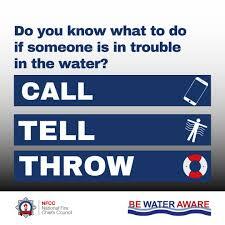
Call – Tell – Throw (or Phone – Float – Throw)
CALL
- Dial 999 immediately
- Ask for:
- Fire & Rescue (lakes, rivers, inland water)
- Coastguard (coastal incidents)
Early contact ensures help is on the way as quickly as possible.
TELL
- Talk to the person
- Encourage them to:
- Float on their back
- Stay calm and keep their airway clear
Clear, simple instructions can help reduce panic and improve survival.
THROW
- Throw something that floats:
- Lifebuoy or throwline
- Bag, bottle, or rucksack
- Football or any buoyant object
- Extend an object (branch, clothing, lead) if safe to do so
|
- Entering the water puts the rescuer at immediate risk
- Cold water, currents and panic can quickly overwhelm even strong swimmers
- Many incidents involve multiple people entering the water and getting into difficulty
The safest rescue is always from the bank, edge, or shoreline.

Incidents involving dogs are a common trigger for people entering the water, often leading to serious risk.
People naturally want to protect their pets, however, there have been multiple fatalities in the UK where individuals entered the water to try to rescue a dog and were unable to get out themselves. This is often due to the combined effects of cold water shock, panic, and difficult water conditions.
Why this is high risk:
- Cold water can quickly overwhelm breathing and movement
- Rivers, lakes and becks may have strong currents or steep edges
- Dogs may behave unpredictably in distress, increasing danger to the person
- Many incidents occur close to the bank, where the risk is underestimated
National water safety messaging highlights that rescuers entering the water can quickly become casualties themselves, turning one emergency into two.
Key messages:
- Do not enter the water after a pet
- Most dogs are strong swimmers and will usually find a way out
- Entering the water significantly increases the risk to life
Instead:
- Keep the pet in sight and move along the bank
- Encourage it towards a safe exit point (e.g. slope, steps, shallow edge)
- Use Throw, Don’t Go:
- Throw a lead, stick, or floating object
- Call 999 if the situation escalates
|
RNLI Float to Live: Float To Live – What To Do In An Emergency – RNLI
RNLI Float to Live resources to download: Float to Live Toolkit: resources for download
RNLI Float to Live Video: Download video confirmation
Respect the Water Phone, Float, Throw: PhoneFloatThrow_Toolkit.pdf
|
|
|
|