 Inside this edition
1. SEND services continue to make progress and have a positive impact
2. Wolverhampton SEND Data: Informing Future Development
3. SEND Strategic Improvement Plan
4. SEND Quality Assurance Framework
5. Partnerships for Inclusion of Neurodiversity in Schools
6. A position statement for the identification of SpLD (Dyslexia) in Wolverhampton
SEND services continue to make progress and have a positive impact

We’re pleased to share that Wolverhampton is continuing to make strong progress in improving services for children and young people with special educational needs and disabilities (SEND).
At the latest review meeting in September 2025, which brought together the city’s SEND and Inclusion Partnership Board, the Department for Education (DfE), and NHS England, Wolverhampton was recognised for making sustainable improvements that are having a real and positive impact – even in the face of ongoing pressures across health and council services.
This review follows a Local Area SEND inspection which identified six key areas for development. Since then, a Written Statement of Action has guided our work, and we’re proud to say that five of those areas have now been successfully addressed.
The latest monitoring report praised Wolverhampton’s strong leadership and commitment to working with families and young people. This includes co-production with HY5! and other routes while the Parent Carer Forum is being reshaped with support from Contact. A new forum is on the way, and plans are in place to involve more parents and carers in shaping services.
Reviewers also highlighted improvements in how quickly and accurately Education, Health and Care Needs Assessments and Annual Reviews are being completed – despite high demand. A recovery plan is in place to tackle delays, and we’re looking forward to seeing the results in the coming months.
To find out more visit Ofsted and CQC Local Area SEND Inspection - Wolverhampton SEND Local Offer
|
Wolverhampton SEND Data: Informing Future Development
Wolverhampton’s recent SEND data is helping the SEND and Inclusion Board identify areas for further development in the following areas:
-
Increasing Requests for Assessments: We’re seeing more families asking for Education, Health and Care Needs Assessments (EHCNAs), which may reflect the additional support children need following COVID.
-
Working Together to Resolve Disagreements: Mediation and tribunal figures show there are times when families and services need to work through differences. This helps us learn where we can make processes clearer and improve communication.
-
Specialist Placements Outside Wolverhampton: Some children attend specialist schools outside the city. This can affect travel and planning, so we’re looking at how to meet more needs locally.
-
Support Across Services: More Education, Health and Care Plans (EHCPs) now include social care, showing that some children have more complex needs that require different teams working together.
-
Mental Health Support: Data from NHS CAMHS highlights that mental health is an important part of many children’s SEND needs, and we’re focusing on how to provide the right help.
Future Priorities
The Board has agreed to look more closely at:
- Annual reviews of EHCPs
- How children are achieving, especially at GCSE level
- Whether we have enough provision locally (sufficiency)
- How efficiently our workforce is supporting families
- Opportunities for young people aged 16–17 in education, training, and employment
|
SEND Strategic Improvement Plan

Wolverhampton continues to make strong progress in delivering its SEND and Inclusion Improvement Plan, aimed at improving outcomes for children and young people with special educational needs and disabilities (SEND).
The plan is structured around five key priorities and is being delivered in partnership with education, health, social care, voluntary services, and families.
Priority 1: A System Underpinned by National Standards
- The Inclusion Framework is being updated to better support attendance, medical needs, and alternative education options.
- The “Support While You Wait” offer from the NHS is now standard, helping families access guidance while waiting for services.
- SEND guidance is being improved on the WISE website, and a new support page is coming to the Local Offer.
Priority 2: Successful Transitions and Preparation for Adulthood
- Transition information is now available on the Local Offer website.
- Health transition clinics are running in key areas, and a new Health Transition Passport is being piloted.
- Young people are helping shape a new policy to support their move into adulthood.
- Tools are being developed to ensure their voices are central to planning.
Priority 3: A Skilled Workforce and Excellent Leadership
- Young people have helped shape a new online SEND training module.
- A refreshed Co-production Charter and a workforce development plan are in progress.
- A skills matrix is being created to identify training needs across services.
- A toolkit will be used to support ongoing improvement.
Priority 4: Strengthened Accountabilities and Clear Routes of Redress
Recent progress includes:
- Improvements are being made to decision-making and tribunal processes.
- A new Quality Assurance Framework is in place.
- Family feedback is being reviewed regularly, with a “You Said, We Did” update coming in November.
- Work is underway to improve digital tools for EHCP reviews.
Priority 5: A Financially Sustainable System Delivering Improved Outcomes
- A new Joint Commissioning Strategy is nearly complete, bringing together data from health, education, and care.
- A pilot project is testing better ways to share information securely.
- New frameworks are being developed for alternative and special school provision.
Planning is underway to better meet future needs and reduce pressure on special school places.
|
SEND and Inclusion Quality Assurance Framework is now live on the Local Offer
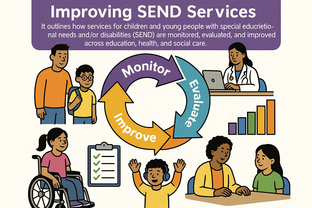
The SEND and Inclusion Quality Assurance Framework has been developed by the Wolverhampton SEND and Inclusion Partnership.
It outlines how services for children and young people with special educational needs and/or disabilities (SEND) are monitored, evaluated, and improved across education, health, and social care.
The aim is to ensure that all children and young people with SEND receive high-quality, consistent support that helps them thrive and reach their full potential.
The framework was shaped through research, feedback from education, health, and social care partners, and learning from other local authorities. Workshops helped map current quality assurance activities and identify gaps, which directly informed its design.
For parents and carers, this framework is a reassurance that the services supporting their children are being held to high standards. It shows that feedback from families is actively sought and used to shape improvements.
The framework promotes working together—between professionals and families—to make sure that support is joined-up, effective, and focused on what matters most to children and young people. It also highlights the importance of listening to the voices of children, young people, and their families in shaping services and making sure they are truly inclusive and responsive to individual needs.
All partners are expected to engage in quality assurance activities and contribute feedback to support ongoing improvement. The framework will be reviewed annually to ensure it continues to meet the needs of children, young people, and families.
The framework is live on Wolverhampton’s Local offer and can be accessed here: SEND and Inclusion Quality Assurance
|
Partnerships for Inclusion of Neurodiversity in Schools (PINS)

The PINS initiative is a national, needs-led program designed to improve outcomes for neurodivergent children in mainstream primary schools. The project ran from March 2024 to March 2025, involving 40 schools per ICB area, including regions like Sandwell, Wolverhampton, Walsall, and Dudley.
The key aims were to develop a whole-school SEND provision including:
- Embedding inclusive practices across leadership, teaching, and school culture.
- Early intervention: Supporting children before needs escalate.
- Upskilling staff: Training teachers and support staff in neurodiversity awareness and strategies.
- Parent-school partnerships: Strengthening co-production and communication between families and schools.
In Wolverhampton 7 schools took part, and schools reported improved staff confidence and better engagement with neurodiverse pupils. Teachers noted that small, practical changes had a big impact on inclusion.
Parents reported that the Parent Carer Forums facilitated regular drop-ins and feedback loops where parents appreciated being heard and involved in shaping school practices.
Due to Wolverhampton being in the process of recruitment for a new Parent Carer Forum, phase 2 of the pilot has not been able to be rolled out, however funding has been made available for continued collaboration between the local authority, ICB, existing schools, and the new parent forum once they are in place to continue the work that has started. Consideration of embedding the positive developments of the PINS model has been included in the broader SEND strategies.
|
A position statement for the identification of SpLD (Dyslexia) in Wolverhampton

This position statement is designed to support both educational settings and parents by clearly outlining the steps and expectations required of settings when preparing and providing evidence for a dyslexia assessment.
It emphasises that, before involving a specialist, schools must demonstrate they have implemented a thorough and sustained graduated approach to meet the individual needs of the child or young person. This includes providing detailed evidence of the support strategies and interventions used over time.
Stakeholder feedback was collected across all levels to ensure the guidance is clear, accessible, and aligned with the needs of its intended audience.
To find out more view guidance document for schools, the recommendations for targeted support are provided in the downloadable documents under each area of SEND need.
|
Related news
For information about what’s on, information, awareness raising, sessions, activities and local support please see news from the following trusted sources:
Wolverhampton Local Offer
Latest News | Wolverhampton Young Opportunities (yowolves.co.uk)
WIASS E-Bulletins
Wolverhampton Voluntary and Community Action
|