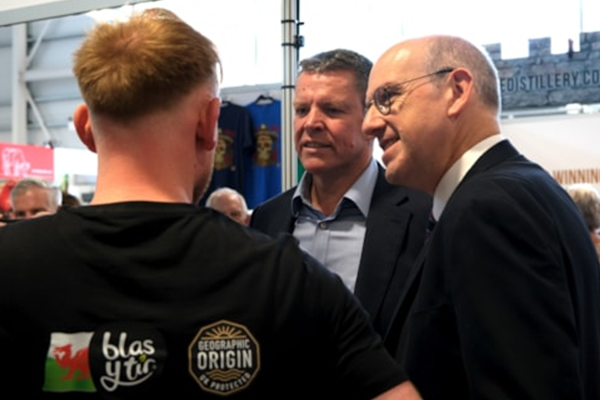
Wales is set to transform the way it thinks about food, with the announcement of the National Food Strategy for Wales and the appointment of a Chair and future expert group to drive its development.
The Cabinet Minister for Rural Resilience and Sustainability made the announcement today – 21 July - at the Royal Welsh Agricultural Show, setting out plans for a transformational whole-system approach to link-up food policy, spanning production, processing, retail as well as how the food we produce factors into health, education, public procurement and the circular economy.
Continue reading...
Back to content
 A new Dairy Sheep Cluster has been launched at the Royal Welsh Show, bringing together farmers, processors, retailers, academia and industry stakeholders to support the development of the Welsh sheep milk sector.
The launch marks the next phase of work to establish a sustainable and commercially viable industry in Wales, building on market research and supply chain development commissioned by the Welsh Government. This work identified significant opportunities for growth, supported by increasing global demand for sheep milk products.
The Food & Drink Wales Dairy Sheep Wales Cluster has been established to encourage collaboration across the supply chain, facilitate knowledge exchange, strengthen market confidence and provide a coordinated approach to sector development. Its activities will include producer engagement, developing commercial pathways and helping to create the conditions necessary for long-term sector development.
Continue reading...
Back to content
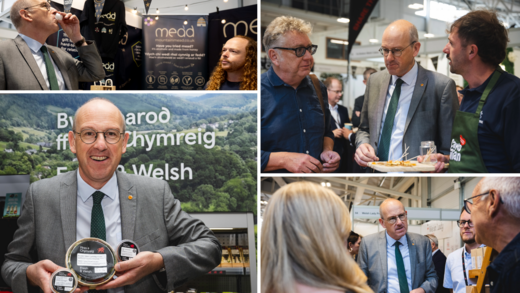 Innovation, investment, business support and new market opportunities are taking centre stage at this week's Royal Welsh Show, as the Welsh food and drink industry comes together for one of its busiest weeks of the year.
Centred around the Food Hall, Business Lounge and International Pavilion, Welsh Government Food & Drink Wales is showcasing the quality, diversity and ambition of the sector, while providing businesses with access to specialist support, networking opportunities and expertise designed to help them grow.
Continue reading...
Back to content
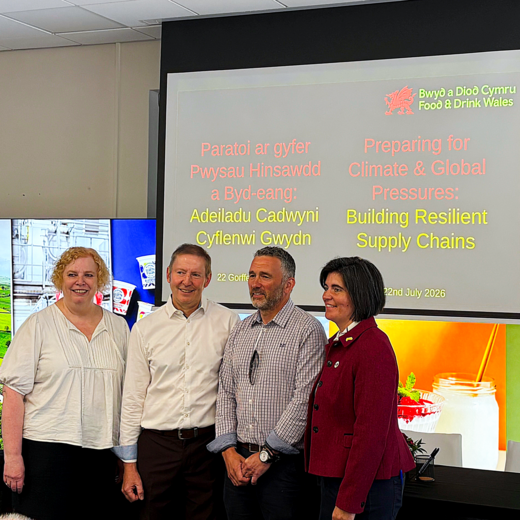 Food and drink sector stakeholders came together at the Royal Welsh Show to shine a spotlight on the climate and supply chain risks affecting the industry.
Produced as part of the Welsh Government-funded Food & Drink Wales Climate Resilience Service, a new report examines how the climate, geopolitical conflict, commodity markets, logistics disruption and economic pressures combined during the first half of 2026 to create significant challenges for food supply chains.
The Food and Drink Climate and Supply Chain Risks Quarterly Monitor Report highlights that Welsh manufacturers are increasingly exposed to events occurring far beyond the UK’s borders, with growing risks from extreme weather, rising commodity prices, export restrictions and transport disruption, while also highlighting the UK’s dependence on imported food and agricultural inputs from regions increasingly vulnerable to climate change.
Alongside analysing global developments, the report provides practical guidance for Welsh food and drink manufacturers, encouraging businesses to review contingency plans, strengthen supplier relationships and incorporate climate-related risks into strategic decision-making.
Speaking at the Preparing for Climate and Global Pressures: Building Resilient Supply Chains and Procurement Strategies event at the Royal Welsh Show, at which the first issue of the report was introduced, Abi Reader, NFU Cymru President, shared insights at the event from her role as both a dairy farmer and a representative of the farming sector. She commented:
“My farm has experienced drought conditions over seven of the last eight years. The extreme heat places burdens on livestock and farmers alike and is something that we must adapt to. Farmers are innovative and are finding adaptations, from technology to nature-based solutions. For example, I have been delighted to work with Coed Cymru and the South East Wales Rivers Trust to plant more trees to provide shade for our cows. Working together with stakeholders, our industry is adapting and playing our part in ensuring Wales continues to produce high quality food.”
The Food and Drink Climate and Supply Chain Risks Quarterly Monitor will be published every quarter, providing businesses with timely intelligence to support procurement, forecasting and business resilience.
Castell Howell has seen the value of this support firsthand and Edward Morgan, Group CSR Manager, highlighted how working with the service has helped to shape their future supply chain strategy. He remarked:
“We benefited from Welsh Government funded detailed research looking at key points of our supply chain, here in the UK and overseas. We are seeing pressures from more climate vulnerable countries such as Spain and Morocco as well as some of our UK suppliers who have struggled in the recent heatwaves or are vulnerable to other climate risks. I would urge any food or drink manufacturer to engage with the Climate Resilience Service, which offers bespoke leadership team workshops to help guide businesses through the risks and opportunities that climate change is already bringing. It is vital for us to be a resilient supplier to our customers and, in turn, for our own suppliers to be resilient in the face of climate change.”
To learn more about how the Food & Drink Wales Climate Resilience Service can support your food or drink business contact bwyd-food@bic-innovation.com
Back to content
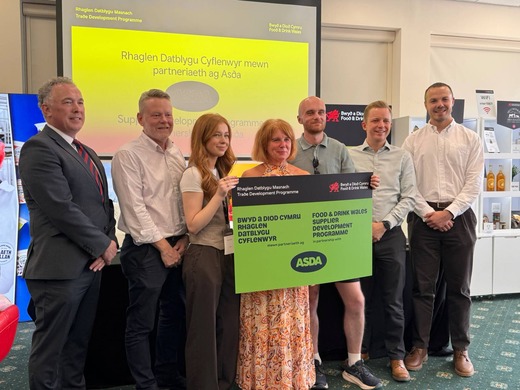
Asda is teaming up with Food and Drink Wales to launch a Supplier Development Programme to help companies across the country upskill and grow their businesses.
The initiative, announced this week at the Royal Welsh Show, will involve more than 30 local suppliers from across Wales, sharing insights on everything from compliance and marketing to product development, logistics and account management.
Continue reading...
Back to content
 Free expert support to help your business thrive.
The Welsh Government’s Sustainability Service gives food and drink manufacturers a clear, joined-up route to reduce costs, improve environmental performance and strengthen resilience - all through fully funded, practical support.
What the service offers
-
Carbon foot printing and reduction planning - fully funded expert support to measure emissions, identify savings and develop a robust Carbon Reduction Plan aligned to recognised standards.
-
Sustainability Cluster membership - access specialist advice, peer networks and targeted support, including guidance to progress towards B Corp
-
Training, tools and insight - webinars, practical resources and sector intelligence. **Coming soon – our new topics will cover carbon management and reporting, food waste, packaging, sustainable growth for your business and a step by step guide to B-Corp.
Why it matters?
This is delivery-focused support designed to help your businesses:
- Cut energy and operating costs
- Improve resilience and energy security
- Meet customer, retailer and procurement expectations
- Prepare for increasing sustainability reporting requirements
How to access support
All support is fully funded for eligible Welsh food and drink manufacturers, making it easier to take action and realise benefits quickly.
To find out more or discuss your business needs, contact SustainableFD@gov.wales
Back to content
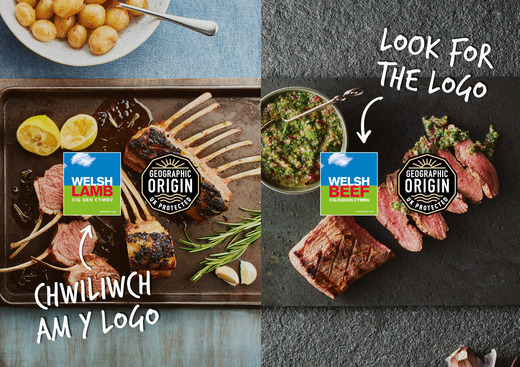 HCC has launched its new strategic industry action plan, Red Meat Industry: Delivering Value for Wales, in readiness for its next four-year delivery cycle (April 2026 – 2030).
The action plan focuses on three priorities: increasing the volume and value of branded Welsh red meat sales, driving initiatives that enhance economic and environmental sustainability, and providing strong, evidence-based advocacy for the industry.
Building on the momentum a new £300k integrated marketing campaign has been launched encouraging consumers in Wales to ‘Look for the Logo’ when purchasing lamb and beef.
A scholarship fund is now open, up to 31 August, to interested applicants from across the industry. Applicants for the 2026 HCC Scholarship will be asked to demonstrate how their proposed study programme aligns with at least one of these priorities and contributes to the future success of the Welsh red meat industry.
Back to content
 |
|
Iona Minerals Capture of Ammonia from Agriculture and its Re-use as a Natural, Sustainable Fertiliser |
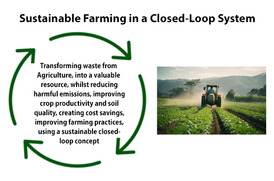
The innovative technology captures ammonia from agricultural sources, thus reducing the degradation to environmental ecosystems and natural habitats and protecting public health. By repurposing waste streams into a natural, sustainable fertiliser, Iona Minerals has created a ‘closed-loop’ system that transforms agricultural waste into a high-value resource. This strategy reduces reliance on the current production of energy-intensive synthetic fertilisers, directly supporting farmers and fostering a greener agricultural sector and food supply chain from ‘farm to fork’.
This on-farm closed nutrient-loop, alleviates the need for synthetic fertilisers and mitigates the escape of emissions directly to the atmosphere and environment which is proven to be harmful to the climate, human & animal health and water quality.
The Contracts for Innovation Cymru Challenge project has identified ways to optimise the process of ammonia capture at the source, and the subsequent production of a natural and sustainable nitrogenous fertiliser for use on land and horticulture applications, resulting in improved crop yields and other important benefits. By capturing waste streams and reducing the need for synthetic inputs, this technology fosters a more resilient, low-carbon agricultural sector.
Project Benefits Snapshot:
🌬️ Air Quality
Reduces ammonia at source → healthier animals & farm workers
Mitigates emissions direct to atmosphere → cleaner air
⚙️ Efficiency
Effective, low-cost solution → less reliance on synthetic fertilisers
Scalable innovative technology → commercial potential
♻️ Sustainability
Turns agricultural waste streams into natural fertiliser → true circular solution
Reduces pollution → protects the environment, air & water
🌱 Farm Productivity
Grass growth → proven yield improvement
Slow-release nutrients → longer-lasting performance vs synthetics
An innovative circular solution delivering cleaner air, improving crop yields, less reliance on synthetic fertilisers — with scalability and sustainability benefits
To express an interest to learn more, please contact Selwyn Owen at IonaMinerals@outlook.com or ContractsforInnovationCymru@wales.nhs.uk
LanoTech Ltd: World-First Broiler Trial Confirms Welsh Lanolin as a Feed Ingredient |
|
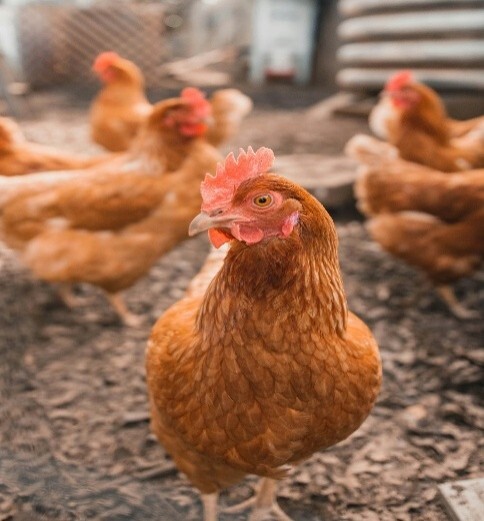 |
Welsh Agri-Tech start-up LanoTech has completed the world’s first live broiler trial using lanolin from sheep wool as a replacement for soya oil in poultry feed.
The trial concluded in January 2026 at Scotland’s Rural University College (SRUC), in conjunction with AberInnovation at Aberystwyth University. It marks the culmination of LanoTech’s Contracts for Innovation Cymru Phase 2 work, supported throughout by Contracts for Innovation Cymru and Welsh Government.
The trial introduced lanolin only at the finisher stage, the final few weeks when broiler chickens lay down their commercial weight. As the birds adjusted to the new feed there was an initial dip in weight gain, but this recovered and the breast meat weight of the lanolin-fed birds matched that of the birds on conventional soya. In a sector where breast yield drives commercial value, that is the result that opens the door.
“Our Phase 1 project told us the science was sound in a laboratory environment. In theory, lanolin could be a viable feed ingredient. Phase 2 has shown us the product works in real birds and that breast meat yield holds up. These results give us the confidence to move towards commercial development,” says Clodagh Weingart, LanoTech’s founder and managing director.
Those findings have unlocked the next stage of funded work. Building directly on the Phase 2 data, LanoTech has secured Innovate UK Mid and North Wales Agri-Tech Launchpad funding to scale its proprietary feed-grade lanolin refinement process from bench to pilot. A second Scotland’s Rural College (SRUC) trial is scheduled for August 2026, this time introducing lanolin from the starter phase to assess how birds perform when adapted earlier, followed by the first on-farm trials across Wales in late 2026 or early 2027 with support from Mentera Farming Connect. Bangor University is leading a detailed life cycle assessment, to quantify the carbon benefit of Welsh lanolin against imported soya and palm. In parallel, an Innovate UK SPARK award is funding an aquaculture trial at Swansea University, extending the use case from poultry into fish feed, where the commercial pull is stronger still. Naturally carnivorous fish such as farmed salmon are now fed increasingly vegetarian diets that rely on large quantities of imported feed oil with high calorific value. LanoTech believes that lanolin’s unique properties make it a compelling alternative ingredient.
“Contracts for Innovation Cymru and Welsh Government have supported LanoTech from the very first laboratory test through to live animal data. Without that early continuity, neither the Launchpad nor the SPARK award would have been within reach.”
Phase 2 has done what it set out to do: turn a promising laboratory ingredient into a tested feed product with a credible commercial future, carrying Welsh wool from undervalued by-product to the heart of a homegrown circular economy.
To express an interest or learn more, please contact Clodagh.Weingart@lanotech.org or ContractsforInnovationCymru@wales.nhs.uk
 |
|
Turning Waste into Colour: Madarch Cymru’s Circular Bioinnovation |
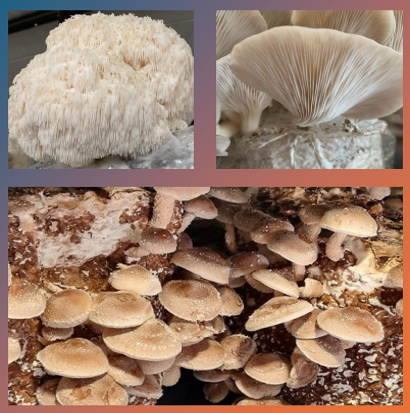
YR ARDD FADARCH ERYRI CYF trading as Madarch Cymru, with support from Welsh Government funded through the AgriFood Tech Phase 2 Contracts for Innovation Cymru Challenge has successfully developed and validated an innovative process that transforms by-products from mushroom farming into natural pigments, enzymes and bioactive products.
The WASTE-TO-COLOUR project demonstrates how spent mushroom substrate (SMS) - a by-product often discarded after cultivation - can become a valuable raw material for producing sustainable, low-carbon colourants. Using a simple, tray-based solid-state fermentation system, the team has successfully grown pigment-producing fungi such as Pycnoporus sanguineus to yield bright red-orange natural dyes including cinnabarin and cinnabarinic acid. These pigments have potential applications in cosmetics, textiles, and natural product formulations.
Phase 2 of the project, has now been completed, successfully scaling production from lab to pilot level. SMS has been converted into high-value pigment and enzyme products, confirming the process as both technically feasible and environmentally sustainable. Key innovations include a low-energy, low-solvent production method and a surface-harvesting approach that significantly reduces extraction requirements, supporting Welsh Government’s circular economy and Net Zero ambitions.
The project has also demonstrated strong commercial potential, with early engagement from industry and the development of a scalable model combining decentralised fermentation with centralised extraction. Alongside pigments, enzyme and bioactive co-products offer additional value streams, improving economic viability and supporting future growth.
Next steps focus on expanding colour diversity—particularly green and blue pigments—and advancing towards commercial deployment through decentralised “micro-hub” production sites near mushroom farms.
This model aims to support local employment, rural innovation, and the development of a new Welsh bio-materials industry where sustainability and creativity grow side-by-side.
This innovative project brings together partners from the private, academic and agricultural sectors in Wales, working towards delivering the Well-being of Future Generations (Wales) Act Ways of Working.
To express an interest or learn more, please contact Cynan@yrarddfadarch.cymru Tel: 07855441126, mari@tetrimteas.cymru or ContractsforInnovationCymru@wales.nhs.uk
Mechapres: Turning Waste Heat into Useful Steam for Food Manufacturing |
|
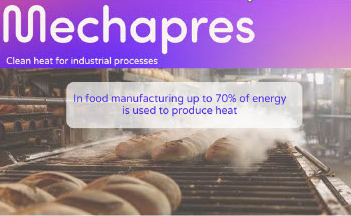 |
A large share of heat demand in food and drink manufacturing sits in the 100°C to 200°C range - think cooking, drying, sterilisation, evaporation. Almost all of it is met by burning fossil fuels. Yet the technology to address this has remained out of reach for most food manufacturers - existing solutions are built for much larger industries and don't translate well to the scale and economics of food processing.
Mechapres was set up to close that gap. We develop compact, high-temperature heat pumps that recover waste heat from industrial processes and upgrade it into useful steam. What sets us apart is the combination of a small-scale industrial heat pump capable of producing steam, integrated with thermal storage - both technically challenging to deliver together, and largely absent from the market at this scale.
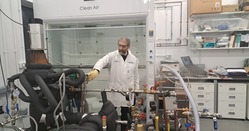
The Contracts for Innovation Cymru Agri-Food Technology Challenge gave Mechapres the opportunity to build and test a working prototype under real industrial conditions. Working alongside the team at AberInnovation's industrial labs in Aberystwyth, Mechapres designed and commissioned a full instrumented test rig, ran safety validation and achieved live steam compression under controlled conditions. A thermal storage module was also tested, confirming it performs closely to theoretical predictions. Both workstreams produced clear engineering data that directly informs the next stage of development.
 |
|
“The Contracts for Innovation Cymru programme was incredibly useful, enabling Mechapres to access excellent infrastructure - AberInnovation's Biorefinery Centre - that would have been difficult to reach at our stage. |
Moreover, thanks to the support of the Agri-Food Tech Board and our project partners, the project also connected us with potential end users in Wales”.
Industrial heat accounts for a significant share of food manufacturing energy use. Mechapres technology could help food processors reduce fossil fuel consumption by recovering and reusing waste heat.
To express an interest or learn more please contact fabio@mechapres.co.uk , tasiosvas@mechapres.co.uk or ContractsforInnovationCymru@wales.nhs.uk
Back to content
|