Welcome to the Welsh Government’s quarterly newsletter for Mwy na geiriau / More than just words – which is the Welsh Government’s plan to strengthen Welsh language services in health and social care.
I'm Cariad Hazard – new Deputy Director for Cross-cutting Strategy, Policy and Corporate Business in the Health, Social Care and Early Years Group in Welsh Government (replacing Emma Spear).
Welcome to the third edition of our More than just words newsletter – which coincides with the Mwy na geiriau National Stakeholder Event being held on 9 October. This national conference brings together senior leaders from across health and social care, education, and local government to explore the strategic role of the Welsh language in planning and delivering person-centred services. As part of the event – there are workshops in the morning focussing specifically on leading in a bilingual country; the work of Coleg Cymraeg Cenedlaethol and opportunities for partnership working and increasing the skills of the future workforce; the work of the National Centre for Learning Welsh and increasing the skills of the current workforce; and the role of DHCW in supporting priorities in Mwy na geiriau. In the afternoon – we have the opportunity to learn from colleagues in Cwm Taf Morgannwg UHB and their implementation of a Leadership Competencies Framework. There are also workshops focussing on the Welsh Government’s new project to map and review key data for measuring the impacts of actions underpinning Mwy na geiriau; the Welsh Government’s new Dementia Action Plan (which will be out for consultation shortly); and a discussion led by Elin Wyn (Chair of the Advisory Board for Mwy na geiriau) on priorities for Mwy na geiriau – as we move into the remaining two and half years for the plan. An important part of the day will be hearing from a panel of speakers who will share their experiences of the impacts that learning Welsh can have – on the workforce and those accessing health and social care.
Reminder: If you haven’t already done so – you can register online to automatically receive this newsletter via the following link: Welsh Government
More than just words: Partnership in Practice at the Eisteddfod
Following the success of the collaborative approach at the Urdd Eisteddfod earlier this year, NHS Wales partners once again joined forces at the National Eisteddfod in Wrexham to highlight the strength of partnership working under the More than just words strategy. The week-long programme demonstrated how collaboration across health boards, national organisations and the Welsh Government is delivering positive outcomes for patients, staff, and the wider public.
The NHS Wales stand provided a strong platform to showcase bilingual services in action. Presentations and demonstrations throughout the week reflected the Active Offer principle, ensuring that Welsh is available without the need for patients or service users to request it.
Some highlights from the programme included:
- The launch of the Learn Welsh Croeso course, a key workforce initiative designed to embed courtesy-level Welsh among all health and social care staff.
- Save a Life Cymru sessions demonstrating lifesaving techniques and reinforcing the value of bilingual training resources.
- Spotlighting on Betsi Cadwaladr University Health Board clinical services such as Help Me Quit, Stroke Prevention and Speech and Language Therapy.
- SBRI Centre of Excellence supplier exhibiting their innovative design concept for health and care spaces.
- Bringing words to life at Wrexham University, showcasing how higher education is preparing the future workforce to deliver services bilingually.
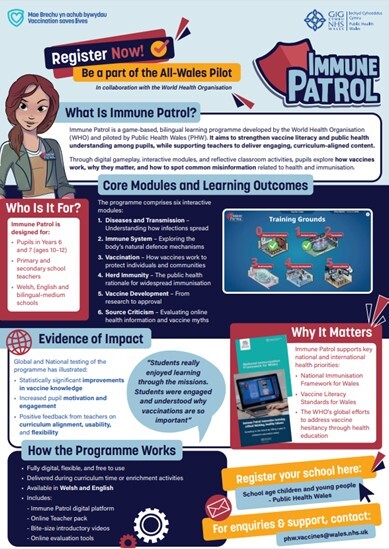
- Showcasing Immune Patrol by Public Health Wales: a bilingual, game-based learning programme designed to strengthen vaccine literacy and public health awareness among school pupils. The engaging, curriculum-aligned resources support teachers in delivering key health messages in a fun and accessible way.
In addition to this, staff from Health Education and Improvement Wales (HEIW), NHS Wales Shared Services Partnership, Velindre University NHS Trust and Welsh Ambulance Services University NHS Trust were present throughout the week, in order to highlight the breadth of more than 350 NHS career pathways and the integral role of Welsh language skills in supporting NHS Wales.
The National Eisteddfod presence has emphasised the clear benefits of collaboration: raising awareness, supporting the workforce, and embedding the Welsh language into service delivery. Through these collective efforts, More than just words continues to move from strategy to lived experience, ensuring that Welsh language services remain central to high-quality, person-centred care across Wales.
For more information, contact: heiw.translation@wales.nhs.uk
Mwy na geiriau films
Welsh Government has commissioned the development of an animation and six supporting films to explain and promote the aims of Mwy na geiriau / More than just words.
The animation provides a general introduction to More than just words and the six supporting films showcase the impact of providing services in Welsh and speaking Welsh to those receiving health and social care. They also highlight the opportunities in place to learn Welsh and the impact this can have. We are now sharing these films with NHS organisations and Local Authorities. They can be used alongside existing resources, information and training.
The animation and films can be accessed by clicking on or scanning the QR code below:
Animation – Introduction to More than just words
Supporting people with dementia – Haulfryn Residential Care Home
Supporting young people with additional needs – Elm Care Home
Bilingual care for children in hospital – Children's Ward, Ysbyty Glan Clwyd
Bilingual care for people accessing Stroke Care Therapy and Speech and Language Therapy, Flintshire
Supporting patients to access bilingual services – Tynycoed Surgery, Bridgend
Accessing bilingual care and support – Pharmacy services in Cathays, Cardiff
 Please contact the Welsh Language Policy Team in the Health, Social Care and Early Years Group in Welsh Government for further information: HSS.WelshLanguagePolicyTeam@gov.wales
Mwy na geiriau Welsh language provision for new unit set to transform mental health experience for new and expectant mums
New and expectant mums from North Wales who need specialist hospital care for severe mental health problems will be able to access treatment closer to home, when a new mother and baby unit opens its doors at the end of this year.
The new unit on the site of the Countess of Chester Hospital will significantly reduce travel times for patients and families from across North Wales, who are currently offered admission to specialist units in Manchester, Chorley, Birmingham and Nottingham, as well as the Uned Gobaith Mother and Baby Unit (MBU) in Swansea.
The eight-bedded purpose-built facility will support new and expectant mothers in a therapeutic environment which has been purposefully designed for people experiencing maternal mental health difficulties, such as postnatal depression, psychosis, or a relapse of an existing mental health condition.
As modelling shows that just two ring-fenced inpatient beds are required to serve the population of North Wales, Betsi Cadwaladr University Health Board has worked with partners in NHS England on a joint solution that improves access for women in North Wales, Cheshire and Merseyside.
As part of the development, language requirements of North Wales patients has been taken into consideration and mainstreamed into the development of the unit.
The Health Board has taken a range of actions to strengthen Welsh language provision at the new Unit, including providing bilingual signage throughout; prioritising Welsh speaking applicants in recruitment to the new unit; and providing access to a Welsh language line 24 hrs a day, 7 days a week.
Alaw Griffith, from the Welsh Language Team has conducted two Welsh Language Awareness sessions for staff at the unit to date, which emphasises the importance of the Active Offer for Welsh speaking patients. The staff will also be able to take advantage of the Health Board’s Translation Service, as well as undertake a Welcome Course, provided by our in-house Welsh Language Tutor. The Health Board has also secured Welsh resources for the Unit including wall prints, toys, and books for babies, children and adults in order to create a comforting bilingual environment to support women attending with their babies/children. We’re delighted that we have been able to introduce measures to ensure that the Welsh language is considered throughout.
Women from North Wales who have a lived experience of perinatal mental health difficulties that have played a central role in shaping these plans and we’re extremely grateful for their input.
For further information, contact: BCU.WelshLanguageServices@wales.nhs.uk
Leading in a Bilingual Country
 Why not join us for a half a day in-person ‘Leading in a Bilingual Country’ taster session? This is a great opportunity to develop your leadership skills where Welsh and English go hand in hand. We support senior leaders to create a supportive bilingual culture, wherever you are on your Welsh language journey. You’ll learn about leading bilingual teams, get to know different cultures, and share experiences with other leaders. Everyone is welcome, and it’s free to join – all you need is interest and enthusiasm! Apply now, and help us help you make the Cymraeg thrive in your organisation!
4 December: Session for leaders approaching senior leadership - Leading in a Bilingual Country Taster Session (Approaching senior leadership) - Events - Academi Wales
5 March: Session for senior leaders and executives / top tier, such as CEOs and Directors - Leading in a Bilingual Country Taster Session (Senior Leadership) - Events - Academi Wales
NEW – More than just Words, Courtesy Welsh Course – developed by the National Centre for Learning Welsh
The Welsh Government’s More than just words (Mwy na geiriau) strategy aims for all staff working in health and social care should have courtesy level Welsh by 2027. This short course is for the health and social care sector and you can learn simple but essential words and phrases to greet and welcome people in Welsh. The course will develop your confidence in speaking Welsh, and encourage you to learn more.
Go for it and start your language journey here!
If you'd like to attend a Croeso Course online with a Learn Welsh Tutor, here are the dates and links to register for October:
October 10th (14:30 – 15:30) – Welcome Course – Iechyd a Gofal – Taster
October 10th (18:00 – 19:00) – Welcome Course – Iechyd a Gofal – Taster
October 24th (14:00 – 15:00) – Welcome Course – Iechyd a Gofal – Taster
To access the digital self-study Croeso Course please follow the link below:
Croeso: Health and Social Care | Learn Welsh

Careers Wales Events
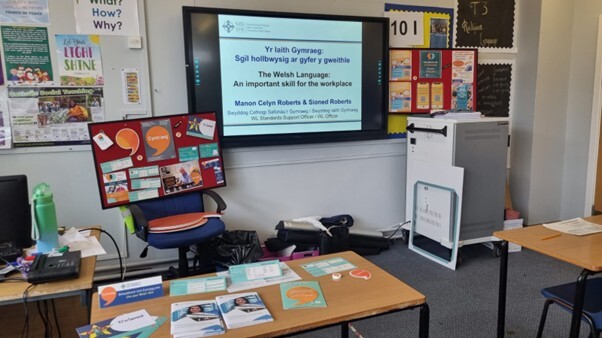
As part of a series of Careers Wales events within north Wales secondary schools, BCUHB's Welsh Language Services Team was invited to give a presentation on the importance of Welsh in the workplace and in applying for a job in the public sector in Wales as part of a skills building day at Ysgol Richard Gwyn (Flint); to give mock interviews to year 10 Ysgol Morgan Llwyd (Wrexham) so that they can practise their question-answering, eye contact and quality skills and the submission of their CV form; and a quick networking session for year 10 pupils at Rhosesni High School (Wrexham) where they had the opportunity to ask questions about our career journey such as staff, skills, qualifications, opportunities, and how Welsh is used within the Health Board.
The discussions between Ysgol Richard Gwyn and Ysgol Rhosesni included why it is vital that the Health Board is able to provide services through the medium of Welsh, highlighting the need to ensure that patients are accurately assessed, and that their care needs are fully met and therefore it is vital that BCUHB staff do everything within their power to facilitate patient experiences ensuring that patients feel as comfortable and happy as possible when using BCUHB services.
Collaboration is essential for building respect and understanding of the importance of language choice and a more inclusive and confident bilingual workforce of the future. The sessions were all beneficial for us as the Welsh Language Services Team as well as the pupils and we thank the Schools and Careers Wales for the opportunity.
 For further information, contact: BCU.WelshLanguageServices@wales.nhs.uk
Betsi Learners' Trip to Wrexham National Eisteddfod 2025
A group of BCUHB learners had a rewarding day exploring the Eisteddfod Maes in Wrexham on Wednesday, 6 August with BCUHB Welsh Tutor, Beth Jones and BCUHB Welsh Learner Support Officer, Sioned Jones. The learners were immersed in the Welsh language and culture and had the opportunity to use their Welsh skills. Highlights of the day were supporting Leanne Parry in the Learner of the Year competition and taking part in a Q&A session in Maes D. Huge congratulations to Lucy Cowley for winning the title of Learner of the Year 2025.
Congratulations also to Steph Lowe, Clinical Scientist in the Department of Audiology at Maelor Hospital for coming third in the learner open solo competition in Field D.
Congratulations also to Steph Lowe, Clinical Scientist in the Department of Audiology at Maelor Hospital for coming third in the learner open solo competition in Field D.
Steph had a busy week at the Eisteddfod performing in the show 'Y Stand' on Saturday and Monday nights, singing with Côr Ni, Wrexham on Sunday evenings and competing individually.
For more information, contact: BCU.GwasanaethauCymraeg@wales.nhs.uk
Welsh Lessons Success
Congratulations to Tehmeena Ajmal, Chief Operating Officer of Betsi Cadwaladr on passing the BCUHB Language Courtesy internal exam. Tehmeena is originally from Oxford and has been teaching Welsh with Betsi Cadwaladr Tutor Beth Jones since January 2025. She was keen to learn Welsh before joining the Health Board in April and is now using her new Welsh skills in the workplace. “I've enjoyed my learning sessions with Beth. Welsh is such a beautiful language but I was worried about pronunciation before the lessons started. Beth has helped me build from words to sentences, and have the confidence to use my new Welsh skills in meetings and with colleagues." (Tehmeena Ajmal, Chief Operating Officer of BCUHB)
For further information, contact: BCU.WelshLanguageServices@wales.nhs.uk
|
The Impact of Welsh Language Provision – Delyth's Story
Engagement work to understand patients' views on Welsh language provision within Betsi Cadwaladr University Health Board (BCUHB) is particularly important as it links directly to the Health Board's commitment to providing equitable healthcare services that have empathy towards the language and its culture.
|
|
 |
Patients are the best source of insight into how Welsh services are being tested in practice. Engagement helps identify gaps, successes, and areas for improvement from the patient's perspective, not just the organization's perspective.
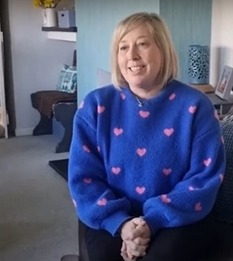
Delyth had a very positive experience in the Children's Ward at Ysbyty Glan Clwyd following her 6-year-old daughter being hit badly, and she was very keen to share her story.
The aim of the service is to aim to encourage health staff to use Welsh with patients, especially when Welsh is their first language, and therefore emphasise the importance of language as an integral part of quality healthcare.
To achieve this goal, the service has recognised and responded to the linguistic and cultural needs of patients ensuring that staff use Welsh where possible, even if they have few words; Record patients' language choice as part of the care process; and promoting the message that language is more than choice – for some, it's a necessity.
And this is what Delyth's story reflects – so much difference that being cared for through the medium of Welsh, their mother tongue, made such a difference to the emotional well-being of her daughter while in the Children's Ward. The staff not only recognized their linguistic requirements, but their culture as well, and respected it. Delyth believed that this was an integral part of offering a first class service to patients.
This highlighted the importance of recording the choice of Iaith and the impact this had on ensuring that Iaith was considered as an integral part of the care, throughout the process. Patients of all ages appreciate the effort of staff to use whatever Welsh skills they have, and for children, and many other vulnerable patients, Iaith is a necessity rather than a choice. Patients need to be able to communicate in their first language as this can be the main reason for having a positive experience and results.
"Being able to speak Welsh with someone and explain symptoms, and that the girl herself is able to explain to symptoms by means of the Welsh, in her mother tongue, is nicely awful and particularly good for our emotional well-being".
Watch Delyth's Story video here.
For further information, contact: BCU.WelshLanguageServices@wales.nhs.uk
|
University of Velindre NHS Trust – Delivering the Active Offer
Velindre University NHS Trust have developed a series of small videos to provide staff with an insight into bilingual provision. One video shows a learner explaining how important learning Welsh is to him and how he shares this in the workplace. Another is about a clinical member of staff and this video is specifically related to the Active Offer and front of house services.
|
|
 |
We are committed to providing the Active Offer and reception staff are one of our most important as they are the first point of contact for a visiting donor to the Welsh Blood Service. Our recruitment process was failing to capture the staff that we needed so we decided to change things a little and from then on had the best results.
Carol explains the route we took on our journey to find the best staff for our reception at the Welsh Blood Service.
Welsh Blood Service - Welsh Language Recruitment
Launching Helwyr Heintiau to Enhance Vaccine Literacy in Schools:
Helwyr Heintiau (Immune Patrol) (WHO) is a digital, game-based learning platform introducing pupils to immunology, vaccine-preventable diseases, and the public health rationale for immunisation. https://seriousgames.net/who/
Public Health Wales has worked with the World Health Organisation and partners to produce a complete Welsh language version of Immune Patrol, Helwyr Heintiau, with a large-scale national pilot set to take place of both Welsh and English language versions over the coming academic year.
Catherine Courts (Lead Nurse Public Engagement, Vaccine Preventable Disease Programme –
VPDP – Health Protection Programme) said:
"The Immune Patrol platform offers a pioneering way to improve young people's vaccine and health literacy through the Welsh school curriculum. We are proud to be the first nation in the UK to introduce Immune Patrol to schools and to have the platform available in Welsh.”
Please visit the School age children and young people webpage for further information: School age children and young people – Public Health Wales or contact VPDP at: phw.vaccines@wales.nhs.uk
Llais y Lle
During summer of 2024, Swansea Bay University Health Board were successful in attracting £30k of grant funding from the Arts Council for Wales. The aim of the Llais y lle fund is to develop the creative use of Welsh within communities. We nominated our community of staff that are learning Welsh to take part.
Media Creative Elin Mannion led this project and arranged that a variety of artists who lead in their fields conducted workshops with staff that are learning Welsh at our three larger hospital sites.
The groups met with bard Aneirin Karadog, who entertained them with rhyming and poetry workshops, encouraging them to develop their own poems and present them to the group.
We were also visited by Sîon Tomos Owen and Rhys Padarn Jones, both of whom explored very different drawing styles with our learners. During these sessions it was good to see our staff learning new techniques and vocabulary, whilst using their Welsh language skills.
A session led by actress Anwen Carlisle received great feedback. During this session, the groups were presented with scenarios and props and had to use their Welsh skills to perform a sketch. Staying with this theme, the following month, sound engineer Dan Lawrence visited the groups and during this session, the learners developed scripts which they performed and Dan recorded, which Dan then overlayed with sound effects.
We brought this project to a close by hosting Gemma Fala, a glass artist who taught our learners some skills required to create colourful fused glassworks. Each group had the opportunity to make a small keepsake from this project to remember their experience and the skills they had gained.
Feedback from this project was very positive. The tutors found that this was a good opportunity for the learners to put their language skills into action whilst taking part in an activity where the language was almost secondary. Staff were so focussed on learning the new artistic skill, that they were using Welsh almost without thinking. Many of them were surprising themselves with how much Welsh they were able to use during the sessions.
The staff group that took part in this project also gave positive feedback, and were disappointed that the project would not be able to continue. They told us that the project had helped to reinforce their learning and the opportunity to converse with invited professionals gave them the confidence to put the Welsh skills they are learning in class into practice with patients.
For more information, contact: BIPBA.Cymraeg@wales.nhs.uk
Data Mapping and Review Project – Alma Economics
The Welsh Language Policy Team and colleagues in Knowledge and Analytical Services in Welsh Government have now commissioned Alma Economics to conduct a comprehensive review of the data landscape in health and social care, and the Welsh language. This work will examine how effectively current data supports Welsh language service delivery, identify gaps in evidence, and recommend improvements to monitoring and analysis. It will also evaluate existing systems and propose new approaches to track progress and promote the increased use of Welsh across services.
The data mapping and review project will directly support the delivery of key themes in Mwy na geiriau / More than just words that are focussed on improving our use of data to measure the intended outcomes of the plan, and supporting monitoring on an ongoing progress. In particular, this project will help to deliver the following commitments:
Action 5: Identify and develop research and data that will strengthen our understanding and knowledge based on the experiences of Welsh language speakers accessing and receiving services, to support evidence-based policy and Welsh language planning in health and social care. This to include ability to provide bilingual services and to evidence how More than just words supports improved outcomes for individuals. (This action aligns with the work set out in section 4 of May na geiriau on mapping the data and creation of the dashboard.)
Action 39: Further develop the mapping of available data provided in Annex A of the Mwy na geiriau / More than just words plan and identify data gaps that would help measure progress.
Action 40: Develop indicators that measure progress towards the Active Offer and delivery of bilingual services. Identify data gaps that would further help measure progress.
Action 41: Establish a working group to develop a dashboard, bringing together performance data to demonstrate progress on the Active Offer and delivery of bilingual services.
The project also directly supports the priorities of the newly established strategic Health Forum led by the Welsh Government and the Welsh Language Commissioner (which met for the first time on 18 June), including improving data quality and consistency in workforce planning (with the aim of increasing the use of Welsh across clinical settings).
An Advisory Group has been established to provide feedback on the project – which will include representatives from HEIW, Social Care Wales, and the Welsh Language Commissioner’s Office.
For more information, contact: HSS.WelshLanguagePolicyTeam@gov.wales
National Emergency Department People Experience Survey August 23 – March 25
The attached recent video https://youtu.be/pqVZwCsVugs presentation summarises the findings of the National Emergency Department People Experience Survey August 23 – March 25, which served as the pilot phase for the launch of the People’s Experience Survey and Framework (April 2025). With over 50,000 responses, the survey emphasised the importance of analysing patient experience data through the lens of protected characteristics, particularly ethnicity. Health boards are using this data to inform targeted improvements, incorporating core questions on language and ethnicity into surveys. Thematic analysis of patient comments is helping identify disparities in areas like staff-patient relationships and care coordination. These efforts aim to embed equality monitoring and drive person-centred improvements across Welsh healthcare.
Looking ahead, NHS Wales is implementing the refreshed People’s Experience Survey (PES), replacing Patient Reporting Experience Measures (PREMs) with a validated, bilingual core question set applicable across all care settings. Key next steps include providing accessible formats, promoting continuous feedback, and using a local self-assessment tool to embed learning. Feedback will be triangulated with outcomes and shared publicly. Simultaneously, the Beacon Dashboard will launch Phase 1 of the Quality Outcomes Framework (QOF) to include the People Experience Survey in October 2025.
For further information – please contact Richard Desir in the Office of the Chief Nursing Officer / Swyddfa’r Prif Swyddog Nyrsio: Richard.Desir@gov.wales
Welsh Language Commissioner’s Good Practice Conference: 18 November 2025 – Coleg Cambria, Wrexham
The Welsh Language Commissioner invites you to a conference which will focus on sharing good practice in delivering Welsh language services and promoting the use of Welsh more widely. The event will give organisations the opportunity to share ideas that support the growth of the Welsh language in a variety of contexts.
Registration form: Good Practice Conference - 18 November 2025
Some reflections from Dr Rajan Madhok (Mwy na geiriau Advisory Board Member)
Q & A session with Rajan:
Can you tell us a little about your background?
I'm Rajan Madhok. My parents were refugees from Pakistan and moved to India after the allotment and lived in Delhi where I was born and brought up. And after studying medicine there I came to Britain to work in the NHS. Originally I worked as a surgeon – orthopaedic surgery – and then moved to work as a medical director until I retired in Manchester. I came to Wales seven years ago and live in Ruthin, North Wales and I'm a member of the Advisory Board for Mwy na Geiriau and Bwrdd Llais.
When did you start learning Welsh and why?
I started learning Welsh during lockdown; Welsh was very popular on Duolingo at the time and I needed a challenge during lockdown! Then I started teaching in a class with Popeth Cymraeg and I've just finished the Canolradd course and I'm going to start a higher course next term. I'm also interested in historical literature and especially the industrial revolution. So when I read books by Caradoc Pritchard, Caradoc Evans, Kate Roberts and Raymond Williams, for example, I was starting to learn more about Welsh culture and why the language is so important to people in Wales. Also, there are similarities between India and Wales, both countries have had similar experiences from outside rulers – the British Raj!
Finally, I think it's important to blind traditions including the language where you live – my first job was in the Shetland Islands and then I was working around England, Scotland, Ireland, and USA and wherever I lived I was trying blind and celebrating local culture. So, I'm celebrating Burns Night, St Patrick's Day and St David's Day, and of course Diwali!
Why do you think it’s important to have Learn Welsh opportunities for the Health and Care workforce?
Of course there are people who speak Welsh as a first language and they need someone who speaks Welsh, especially old people and also people with diseases such as dementia. But in any case, when someone is sick, they need someone who gives them confidence and comfort, someone who blinds them to their background and culture. As Nelson Mandela said: "If you talk to a man in a language he understands, that goes to his head. If you talk to him in his own language, that goes to his heart."
What was the inspiration behind the new course for Workers from Overseas?
Using people's mother tongue is one way of showing respect and also helping the employees and patients. But more importantly, when I was working as medical director and chair of BAPIO and as a board member of GMC, I was involved in cases where employees had gotten into trouble, and also when I was working on racial discrimination I noticed that the most important reason is a lack of understanding about each other – everyone is unique and we need to understand our differences; instead of people getting upset due to lack of communication. Therefore, learning Welsh will help learn more about the people of Wales and each other, and better communication means better care.
I have friends who have been living here for a long time, but don't know about Welsh things – I've never been to the eisteddfod or Cymanfa Ganu and don't know about Dryweryn or Hedd Wyn, for example, and it's sad.
What are your hopes for this new course?
There are many courses already, but I hope this course will be different – the course will teach a language and also inspire colleagues to learn more about culture and enjoy their work and life in Wales. When you start learning a language you make new friends and in this way we can help create strong communities. I wrote an essay about my experiences and now I write articles for Lingo 360.
If I can do this, you can too. That's what I want to tell colleagues from overseas, and it's fun! Imagine the fun when you can say:
Llanfairpwllgwyngyllgogerychwyrndrobwllllantysiliogogogoch
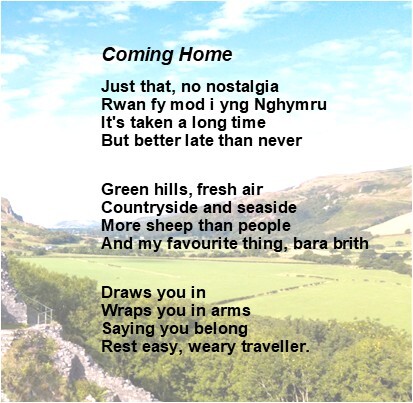
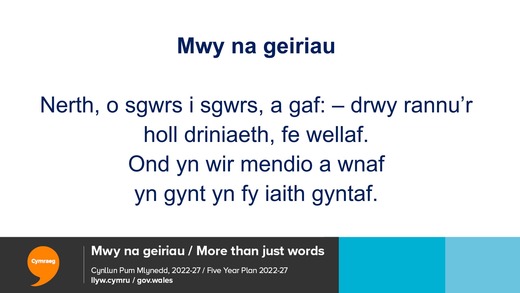
To finish I'd like to read my poem, my way of saying thank you to Wales, and why I'm Welsh now:
|