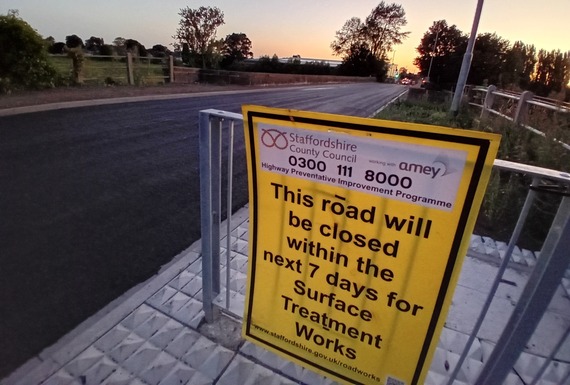
 A34 scheme progresses on schedule as latest bridge works completed
A major improvement scheme on Stafford’s A34 Weeping Cross to Riverway section has progressed on schedule with latest bridge works completed this week.
Overnight closures on Queensville rail bridge took place from Monday to Wednesday.
This section of road is currently under a one-way traffic order in an out-of-town direction until mid-October from Riverway to Queensville roundabout. The out-of-town direction has been chosen to reduce the impact on affected businesses on the route and emergency services.
The scheme has included improvements to two roundabout junctions, road and footway reconstruction, new pedestrian crossings and cycleways and strengthening of the two bridges.
Resurfacing of Radford river bridge was completed the previous week (pictured).
People can find out more on the scheme webpage.
Peter Mason, Staffordshire County Council’s cabinet member for strategic highways, said: “The A34 scheme is hugely significant for Stafford, bringing much-needed improvements to the corridor.
“This is the final phase from Queensville to Riverway which is due to be completed on time in October. We understand the one-way order has brought some disruption, but it means the team can complete the job as quickly as possible, and has been implemented following consultation with the emergency services and businesses.
“We’ll continue to update people until the scheme completion.”
Work needs to take place now due to national funding requirements. Once completed the road surface will last for between 20 and 30 years.
Staffordshire highways chief sets out plans to tackle network disruption
Plans to tackle disruption caused by roadworks in Stafford and across the county have been set out by the county council.
Peter Mason, Staffordshire County Council’s Cabinet Member for Strategic Highways, has written an open letter to residents in Staffordshire detailing how he aims to change the way works are programmed in, to minimise disruption.
For the next three months, the county council will refrain from adding any new non-essential works in heavily disrupted areas, unless it can be shown that the works will not further impact key routes.
Emergency works such as water/gas leaks will still go ahead as these cannot be stopped, the authority will be asking utility companies to reduce how long they take in repairing them.
In addition, specific urgent repair works to Corporation Street in Stafford has been approved to be completed in August during the school holidays.
Peter said: “Since taking on the role of cabinet member for highways, it is very clear to me that we need to do more to improve the condition of Staffordshire’s roads. This does come with inevitable disruption which is to be expected, but we must do everything we can to minimise this. This includes changing how we programme these works, so not so many are done at the same time.
Added to this, he wants to impose stricter rules on utility companies who need access to the road network, and use fines to encourage their compliance.
Peter continued: “A lot of works on Staffordshire’s roads are done by utility companies. With central government legislation prioritising utility works and third-party access to road networks, the county council is limited in its control of some works. Utility companies can and do often give very little notice of works, and we want to change this where possible.
“Ultimately, the solution to these issues is a revision of the current legislation, so powers are rebalanced in favour councils and road users. This is for central government to action, and I will be lobbying and seeking the support of all Staffordshire MPs to take this forward and to get the changes needed.”
Peter has also pledged to work with district and borough councils to amend their current environmental rules, so working hours can be extended to get projects finished sooner.
 Figures reveal pothole progress in Staffordshire
Highways crews in Staffordshire filled more potholes last year than each of the previous four years.
New figures reveal that more than 37,000 potholes were filled in 2024/25, after the county came out of the wettest winter for more than 100 years.
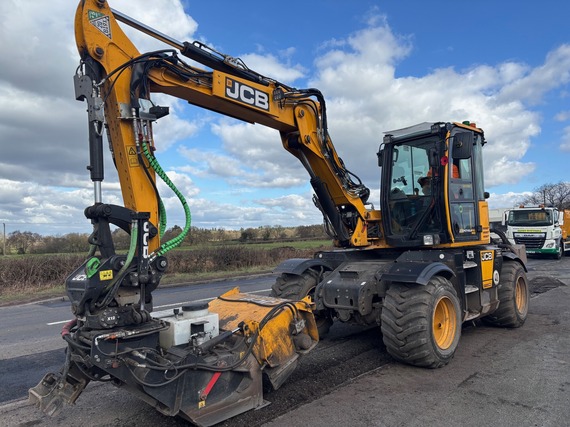
The progress has been made by utilising more crews, and new equipment such as the JCB Pothole Pro to speed up defect repairs.
Added to this, new AI technology has meant the county council has been able to assess the condition of its 4,000 mile highway network, to create a complete picture of highways across the county.
The figures have been published as part of a government requirement to publish road maintenance data.
They also reveal how the county council has been concentrating on its preventative maintenance programme, to help prevent potholes and other defects from forming in the first place.
And, with this year being warmer, highways crews are getting on with repairing as many defects as possible.
Potholes and other defects can be reported via the county council’s ReportIt website.
You can find out more about how the county council fixes potholes here.
|