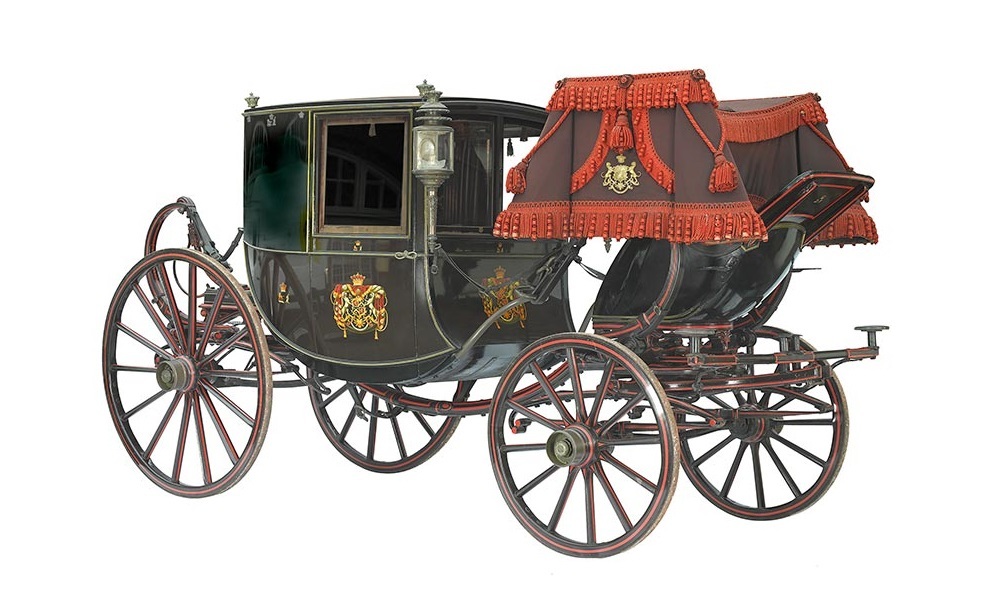
 The State Chariot used by the Earl of Shrewsbury at the Coronation in 1953
Spotlight on the Coronation
The Archives and Heritage Service holds a number of items within the collections that relate to the monarchy. The Earl of Shrewsbury's State Chariot was built in the late 19th century by Hooper & Co. Ltd. of London. Also known as Dress Chariots these vehicles were used for court and formal occasions by royalty and families of high rank. The State Chariot was taken to London for the Coronation in 1953.
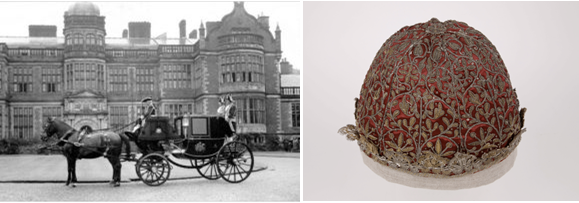 The State Chariot outside Ingestre Hall in 1953. The richly embroidered cap belonging to Charles I.
The embroidered cap dates from the 1630s and belonged to Charles I. It came to Staffordshire via the Bagot family. It was given to loyal Royalist supporter Colonel William Salisbury together with 6 gold sovereigns which are also in the collection. When William’s descendant married Sir Walter Bagot in 1670 the cap made its home at Blithfield Hall in Staffordshire and was proudly kept as part of their family treasures.
Charles I is shown in the colourful Royal family tree below which probably dates from the 17th century.
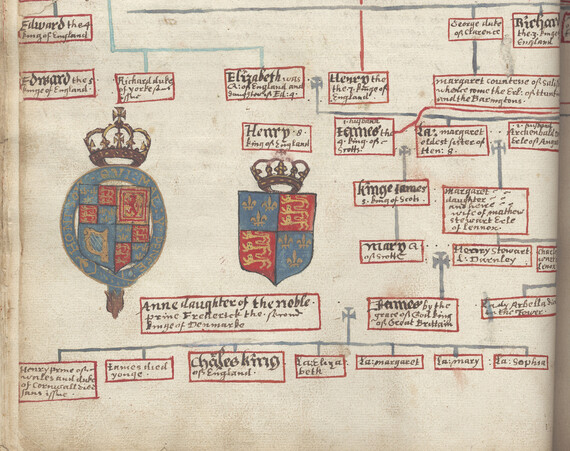 D(W)1721/1 (the Stafford Manuscripts)
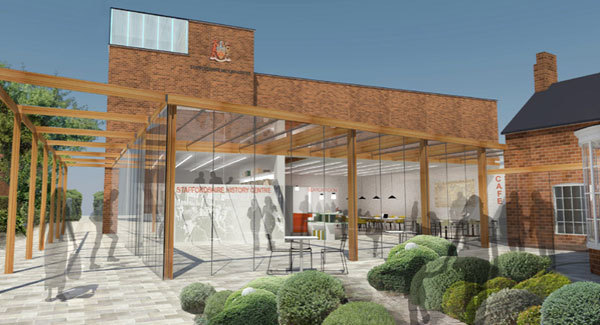
Together with updates on the progress on the Staffordshire History Centre project our new microsite enables users explore highlights from the archive, museum and William Salt Library collections, find out about our events and activities and get information about our restricted public service. The site will be updated with regular posts about our work as the project develops.
 Pen and wash drawing of Stafford Asylum, about 1830 (G94.023.0001)
Researching Margaret Bowers
Sydney Betts recently joined the Archives and Heritage team for a period of work experience. While she was with us she worked alongside the volunteers researching Staffordshire's asylums. Sydney chose to research and write about Margaret Bowers from Fair Oak in the parish of Eccleshall, who was admitted to Stafford Asylum in 1857. She writes
"This case gives us an insight into the life experience of a regular older women of the period, whose story we would never hear about without the asylum records. Margaret’s case notes tell a sad story of a woman struck by dementia and lupus. It does not particularly stand out as there were countless similar cases across Staffordshire asylums. Furthermore, dementia is still a prevalent issue that affects many families today. I chose this case because I believe it holds relevance to today's society.
Margaret Bowers was a housewife from Fair Oak, admitted to Stafford asylum on January 22nd 1857 at the age of 67. Her case notes show that she was short, thin and had a ruddy complexion, with grey hair and eyes. She was fairly healthy, apart from having lupus which had partially eaten away the cartilage of her nose. Lupus is an autoimmune disease in which the body’s immune system mistakenly attacks healthy tissue and is shown to resemble wolf bites on the face (lupus is the Latin word for wolf). Research into the disease began in the 19th century, it was found that in addition to classic symptoms such as fevers and aching, the central nervous system, muscles, skeleton, heart and lungs could potentially be part of the disease. There has been a recent study in Korea that has found a link between Lupus and developing dementia later on in life.
Along with the lupus, Margaret’s dementia worsens as the case file goes on. We are given a snippet into her life before she was admitted, she would put potatoes into the teapot and her husband would find clothes and belongings strewn about the house when he got home from work. It is stated that she had been suffering two years before being admitted, being cared for at home. It must have been too difficult for her family and herself. The cause given for her disorder is ‘grief, consequent on her two sons having enlisted’ and ‘there is hereditary predisposition, as her mother is stated to have been insane’. From further research we can see that two men with the same names as Margaret’s sons were involved in the Crimean War, which would have had a huge impact on her. We are not aware of what happened to them, but there was a riot in Trafalgar Square in 1855 because of how the war was being handled. Clearly the country was dissatisfied with the war, and this could have affected Margaret too.
The asylum only seems to treat Margaret with medication for lupus and gives her a special diet of meat and wine, which then changes to arrowroot soup because she started losing the ability to swallow due to the lupus. She passed away May 5th 1857 at the age of just 67. It is overall a sad end for a wife with a caring family. Reading the case notes evokes a sense of sorrow and sympathy for Margaret, but I feel honoured to be able to share her otherwise unknown story."
 Aerial view of Rugeley Power Station
Keeping the lights on
Keeping the lights on: A history of Rugeley Power Station
Museum of Cannock Chase
Have you ever wondered about Rugeley Power Station? What it was like to work there, what the cooling towers were for, or why it was located there? ‘Keeping the Lights On: A History of Rugeley Power Station’ marks the end of a twelve-month project researching the history of this local landmark. Using company archive material and stories from former employees, the exhibition explores all aspects of power station life, from its creation through to future development.
A family-friendly exhibition that is free to enjoy until 18th June 2023.
Staffordshire History Day - places still available
Saturday 13 May 2023
Online
10am - 3pm
Join us for our free Staffordshire History Day on Saturday 13 May. Our packed programme will include news on the new Staffordshire History Centre where construction work is well underway. There will be updates on the Victoria County History project and the County's archaeology programmes. We also welcome our keynote speakers. Dr Imogen Peck, University of Birmingham, will explore the impact of the British Civil Wars in Staffordshire. Dr Mark Knight, Staffordshire Wildlife Trust, looks at the 'Stop line' along the Trent Valley during the Second World War.
Full details of the programme are on our Eventbrite website.
|