Welcome to Adult Social Care Practice

View as a webpage / Share

Adult Social Care - Can Do

Tuesday 13 June 2023

Welcome to June's Adult Social Care Practice 

A

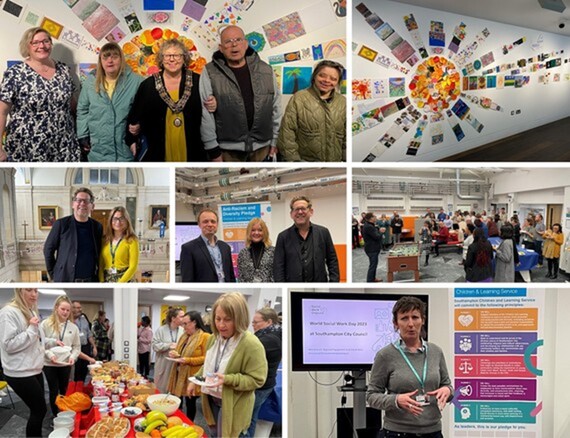
Were you one of the 4,515 people who visited our ‘What Does Working Together Create?’ art exhibition at the John Hansard Gallery? It featured a large mosaic created by people working in Adult Social Care and the people they work with and support. Over 200 individual pieces of art had been collated to form a sun and represent life, hope, energy and positivity. The artwork was about inclusivity and aimed to show what could be achieved when people joined together.

You can listen to a podcast about it with Mel Dalwood-Jellinek, one of our Adult Social Care social work apprentices by clicking here


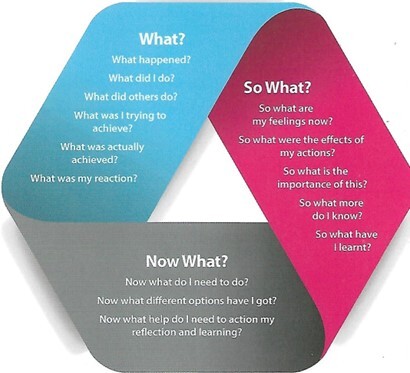
What? So What? Now What?

What tool

This tool was originally developed by Terry Borton in 1970, a teacher from America. Although created for an educational setting, it can also be used in a social work environment to guide reflection.

This tool has often been criticised as being too simple; however, sometimes the simplest of tools can bring out the deepest of reflections, if the right questions are asked and explored. This tool helps us to move away from ‘storytelling’ and towards analysis and future planning.

This was further developed by Driscoll (2000) and Rolfe et al (2001) adapting the model to better fit different professional settings.

The diagram above shows examples of questions you can ask to aid reflection. This diagram was taken from Siobhan Maclean’s reflective practice cards and has been put together using Borton’s, Driscoll’s and Rolfe’s development of the tool.


Becoming trauma informed

Trauma

“Trauma-informed practice is an approach to health and care interventions which is grounded in the understanding that trauma exposure can impact an individual’s neurological, biological, psychological and social development.” (Gov. UK, 2022)

This month we will look at the six principles of Trauma Informed Practice in more detail, and how we can apply this strengths-based and person-centred approach in our everyday work.

Safety TI Practice recognises the importance of creating an environment where people feel physically and psychologically safe by establishing trust through respect, consistency, acceptance, and congruence.

Trustworthiness This can be achieved by having clear and transparent objectives, policies, and procedures; clear explanations and expectations; and by staff doing what they say they are going to do.

Choice This identifies the need for collaboration, co-production and shared decision making; listening to the needs of both staff and the people we support; and recognising that those who have experienced trauma may feel they lack autonomy and control over their lives.

Collaboration This considers the need for an organisational approach that asks staff and service users what they need, and proactively works to meet these needs. This also focuses on co-production and the active involvement of service users in service delivery.

Empowerment This recognises that those who have experienced trauma may feel powerless, isolated and have low self-worth. TI practice seeks to share the balance of power by listening, validating, and respecting people’s feelings and views, and by supporting decision making.

Cultural consideration Challenging stereotypes and bias and offering services and support that are responsive to the cultural needs and identity of the individual.

Find out more below.

Person-centred care: Prevention practice examples and research - SCIE

Strengths-based approaches | SCIE

SWU Blog: Intersectionality is a valuable tool for Social Work Practice | www.basw.co.uk

Working definition of trauma-informed practice - GOV.UK (www.gov.uk)


Star of the month award

Star of month Christina

June's star of the month award goes to Christina Maple.

"Christina has consistently gone above-and-beyond in her work supporting both her team and the clients open to them. She has become incredibly knowledgeable in all things relating to council process and practice, and has supported colleagues in their use of CareDirector. Christina is always willing to go the extra mile in her work and is a true credit to her team.

Christina is our Guru in CareDirector, adding so much value to our team and to the work that we do. She is always kind and approachable, and I feel so privileged that we have Christina in our team!"

Well done, Christina!


Rsearch in PracticeCarers

Dementia and Hope 

An upcoming webinar will examine our power to change and minimise the societal and environmental factors that disable people living with dementia. Philly Hare, Co-Director of Innovations in Dementia, outlines their vision to recognise dementia in terms of disability rights and citizenship, and to empower and give hope to those who are diagnosed and their families.

In the webinar Dementia and Hope: Addressing societal and environmental barriers affecting people with dementia | Research in Practice Philly will be joined by adults living with dementia to summarise and discuss important messages from their recent report, Dementia and Hope. They will share their vision to recognise dementia in terms of disability rights and citizenship, and to empower and give hope to those who are diagnosed and their families. 

Social work with carers: Supporting excellent practice

We are updating the DHSC funded resources Social Work Practice with Carers | A range of resources to support excellent social work practice with carers (ripfa.org.uk) that supports social work practice with carers. An upcoming session will ask for your input into new learning resources to support social work with carers. The interactive webinar will share the latest research and explore the capabilities social workers use in practice to ensure carers receive their Care Act rights and the support they need.

Date: 12.00pm - 1.00pm, Thursday 29 June, online. View details

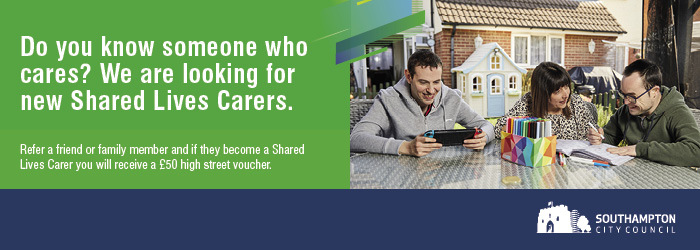
Shared Lives footer A