|
21 September 2020
Message from Ruth Harrell, Director of Public Health

You may be aware that we are seeing a steady increase in the number of confirmed cases of coronavirus (COVID-19) in Plymouth.
While the number of cases in the city is still below the national average, the rise is a concern and we need to work together to stop it.
In recent weeks there have been more cases across our community, including in a number of schools and care homes.
Now is the time for us to redouble our efforts to keep Plymouth safe and work together to avoid having to introduce the additional measures that have been necessary in some other towns and cities.
Below you will find updates and guidance on what we can all do to control the virus in Plymouth.
It is important that everyone in our community is clear about what they need to do to stay safe and I would appreciate your support in helping get these messages out by sharing with your networks.
We’ll keep you updated as the situation develops.
Our public health team is here to support you. If you have any queries please email us at: covid19@plymouth.gov.uk
Ruth Harrell, Director of Public Health for Plymouth
|
Check the number of cases in Plymouth
We publish the number of coronavirus cases in Plymouth on our COVID-19 website every Wednesday. This shows the number of cases during the last week compared to previous weeks, as well the number of cases per 100,000 people compared to the national average.
It also shows the number of coronavirus related deaths in Plymouth.
How we can help manage the high demand for tests
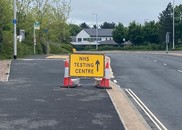
People with symptoms of coronavirus must come forward to get a test as this will help stop the virus spreading.
There is currently high demand for tests and limited availability nationally due to a shortage of laboratory capacity. As we manage this period of high demand, it is very important that you only arrange a test if:
- You are showing the symptoms of coronavirus
- You are asked to get a test by NHS Test and Trace or a public health practitioner
The main symptoms of coronavirus are: a high temperature; a new, continuous cough; a loss or change to your sense of smell or taste.
Those who are isolating because they have been in close contact with a confirmed case do not need a test unless they have symptoms. A negative result would not mean that they could return to normal life earlier than the 14 day isolation period.
If you have symptoms and need to book a test, you can do this online or by ringing 119. Please do not ring 111 about testing as this number is for people who are ringing about other medical and health issues.
You may be told that there is currently no testing availability locally. You should keep trying every few hours until a slot becomes available. Do not go to the testing station without a booked appointment, or to a GP surgery, pharmacy or hospital.
We understand how frustrating this situation is and are pressing for it to be resolved as quickly as possible.
|
Tell us if you've had problems with testing
Along with other local authorities, we are pressing for the Government to resolve the national issues with testing as quickly as possible. To help us do this, we want to hear about your testing experiences so we can pass them on to the Government.
Please tell us about your experiences by emailing: Covid19TestFeedback@plymouth.gov.uk
Businesses must now display codes for new NHS app
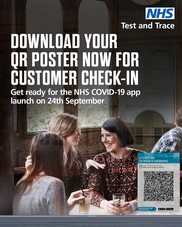
Businesses are being urged to get ready for the launch of the NHS COVID-19 app on Thursday (24 September) by downloading unique QR code posters to display.
By law, businesses such as pubs, restaurants, hairdressers and cinemas, visitor attractions and libraries now have to keep a record of who is coming in, and when.
From Thursday they will need to display QR code posters that work with the new app to record contact details of customers. This will ensure that NHS Test and Trace teams can get in touch with people who have recently been in close contact with someone who has tested positive for coronavirus.
The app makes it easier for businesses to record who is coming in, as well as for customers who visit those places as they simply have to use their smartphone to scan the code as they go in.
Businesses and other venues need to ensure that they have NHS ‘QR’ code posters visible on entry.
Places of worship and community organisations with a physical location that is open to the public must also display a QR code.
Information and advice is available on the NHS app website.
|
 Keeping up the simple rules for staying safe
Surveys are showing that many people admit to not being as stringent with the basic measures to stay safe as they were a few months ago. For example, not washing their hands as often, or every time they arrive home.
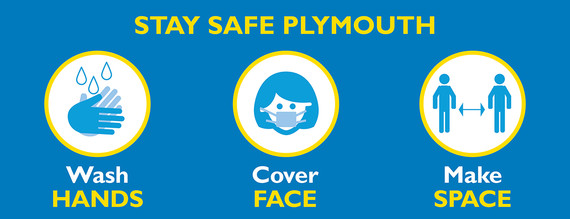
Now is not the time to relax on the simple measures that will reduce the risks to you and your family. These are:
-
Wash hands – keep washing your hands regularly
-
Cover face – cover your face if you are likely to be close to others in an enclosed space; doing this protects each other.
-
Make space – keep your distance from everyone except your household contacts, or those people who you consider to be your ‘support bubble’. Limit your contact to all others, preferably keeping your distance; if you do meet with others it must be in groups of six at the most.
- If you have the symptoms, isolate yourself and your household and book a test.
Advice for parents of children at school
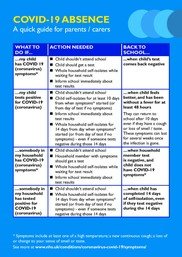
There have been a number of confirmed cases of COVID-19 in schools over the last week. This has meant some pupils at the schools have been asked to self-isolate at home for 14 days in line with Public Health England guidance.
All schools have carried out risk assessments and put measures in place to reduce the risks from COVID-19. In the event of a suspected or confirmed case in a school, they are supported by Public Health England, the City Council's public health team and the Department for Education.
We have published information for parents to help answer questions, including when children should and shouldn't attend school.
|
What the new 'rule of six' means
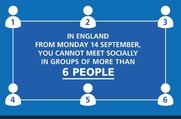
On 14 September the Government made it illegal to gather socially in a group of more than six people.
This limit applies to people of all ages – in private homes and gardens; public outdoor spaces like parks; and venues like pubs and restaurants.
Those caught breaking the law will face £100 fines, doubling on each repeat offence up to £3,200.
The six people can be from any number of households, although people from different households should still socially distance from each other.
If your household or 'support bubble' has more than six people, you're still allowed to be in a group together.
A support bubble is where one single-adult household has joined up exclusively with another household.
There are a number of exceptions. You can still go to work and school, send your child to a playgroup, do organised exercise classes or sport, hold a small wedding or funeral and use public transport.
There is full guidance on meeting others safely on the GOV.UK website.
|
|