Latest news from Essex Police in the Southend district
News 19 October to 26 October
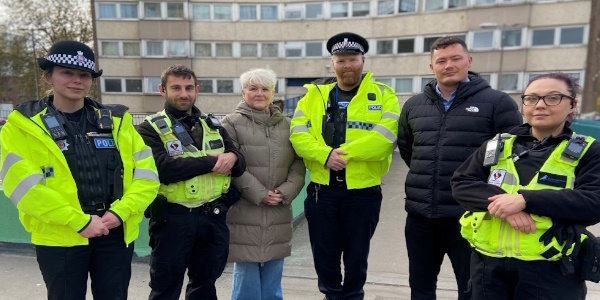
Officers from Southend Community Policing Team with community safety officers, and representatives from South Essex Homes and South Essex Property Services.
Crackdown on ASB in the city’s tower blocks
An operation to combat anti-social behaviour (ASB) in the tower blocks in the Queensway area of Southend has resulted in people being issued criminal protections notices, evicted and jailed.
The joint initiative by Southend Community Policing Team, South Essex Homes, South Essex Property Services (SEPS), and Southend City Council’s community safety team was launched in February to stop street drinkers, drug users and the homeless from gaining access to Chiltern, Malvern, Pennine and Quantock blocks.
Hotspot policing and strong partnerships between the public services have been crucial in driving down incidents of anti-social behaviour (ASB) in Essex say Police, Fire and Crime Commissioner Roger Hirst and Deputy Chief Constable Andy Prophet – the national lead for ASB.
Anti-social behaviour has fallen by 65% across Essex in the past five years, with the police working alongside local councils, the fire service, the NHS, the Probation Service and charities as part of community safety partnerships to reduce offending and tackle the underlying causes.
In October, the PFCC revealed that a further £1.6m had been secured to combat ASB in 15 areas of Essex, known as Operation Dial. The first phase of operation led to 101 arrests and the issuing of 112 fixed penalty notices across 13 zones.
Op Drive Insured sees 130 uninsured vehicles seized
30 uninsured vehicles seized as part of Op Drive Insured, a national road safety initiative to target uninsured driving.
Between 11 and 17 November, our Roads Policing Unit (RPU) officers supported Operation Drive Insured, a national campaign to target uninsured driving through policing activities focussing on detecting and seizing uninsured vehicles using roads in Essex.
As part of our continued commitment to road safety, we worked alongside our partners MIB (Motor Insurers’ Bureau) who led the week-long campaign to get uninsured drivers off our roads. MIB supported operational activity via its enforcement services and running a public awareness campaign throughout the week.
In just seven days, a total of 130 uninsured cars, vans and motorcycles, were seized as part of enforcement work.
In particular, our Roads Policing Unit were conducting patrols in the west of the county and held a static site at Thurrock on two days.
On Tuesday 12 November, RPU officers seized 22 uninsured vehicles and reported six drivers for a variety of road offences, including no MOT.
And on Sunday 17 November, RPU officers were joined by Southend Special Constables to carryout enforcement work, seizing a further 27 uninsured vehicles. Furthermore, the team issued over 50 traffic offence reports and arrested three people including a driver on suspicion of drug driving which shows that stopping an uninsured car can also identify other offences.
Protect your motorcycle, moped or scooter from theft
Thieves only need a matter of seconds to steal a moped, scooter or motorcycle - especially if they are left with poor security - but our tips will help reduce the chance of theft.
Lock, chain, cover
Reduce your risk of becoming a victim by taking steps to layer your security.
Lock
Use a disc lock to help secure the front brake disc, or a grip lock to secure the brake and throttle controls. You could also use a D lock on the front wheel to stop it being wheeled away.
Chain
Thieves often steal a bike by breaking the steering lock and wheeling it away. Use a chain lock through the back wheel (the front wheel can be removed). Secure your bike, with the lock taut to an immovable object such as a ground anchor or street furniture. This will stop thieves from cutting a lock trailing on the ground using an angle grinder. If this isn’t possible, thread the chain through your bike frame and back wheel.
Cover
Thieves often ‘shop’ for particular bike models. Using a cover instantly makes it less attractive to them. A cover also provides another time consuming obstacle for the thief.
Unfortunately security measures can’t guarantee your bike won’t be stolen but, by using multiple security measures, you can make it harder and less attractive for thieves.
If you’ve been the victim of a scam, fraud or online crime (cybercrime) you can report it to Action Fraud.
Action Fraud is the national reporting centre for fraud and cybercrime. It collects reports about fraud on behalf of the police in England, Wales and Northern Ireland. For fraud in Scotland please report it directly to Police Scotland.
Can you tell me about the Domestic Violence Disclosure Scheme, also known as Clare's Law?
The Domestic Violence Disclosure Scheme gives members of the public a formal mechanism to make enquires about an individual who they are in a relationship with or who is in a relationship with someone they know where there is a concern that the individual may be violent towards their partner. This information may be disclosed via a request from a member of the public (Right to Ask) or be initiated by the police where a proactive decision is made to disclose information in order to protect a potential victim (Right to Know).
When and how to contact the Police
We're offering more ways of reporting non-emergency crime and anti-social behaviour through the digital 101 service on our website.
You can also use the service to contact your local policing team, tell us about something you have seen or heard, or request information.
We also have our Live Chat service which is available on our website 24 hours a day, seven days a week. You can send and receive real-time messages with an online operator.
We still have our 24-hour 101 service which people can call if they feel it is more appropriate to speak to us or don't have access to the internet.
Always call 999 if a serious offence is in progress or has just been committed, someone is in immediate danger or harm, property is in danger or being damaged, or a serious disruption to the public is likely.
If you have a hearing or speech impairment, use our textphone service 18000.
British Sign Language (BSL) users please use our video relay service where an interpreter will help you report the crime to us.
If you're in danger but you can't talk on the phone, you should still call 999, then follow these instructions depending on whether you're calling from a mobile or a landline.