United Nations Statistical Commission endorsement
On 4 March 2026 the United Nations Statistics Committee (UNSC) - the governing body for global statistics, officially agreed to incorporate our proposed indicators into the Global Set of Climate Change Statistics. This means a major milestone has been achieved for the Standards for Official Statistics on Climate-health Interactions (SOSCHI) project.
The Global Set provides a standardised statistical framework to member states to produce and disseminate climate change statistics to inform adaptation and mitigation actions. The decision to adopt SOSCHI indicator methodologies into the Global Set will aid standardised reporting on climate-health interactions globally.
A huge thank you to all those who have contributed to the SOSCHI project. This achievement reflects the collective effort and expertise across all partners.
As noted by Emil Ivanov from the United Nations Statistical Division (UNSD), there is still much work ahead. It is vital that countries adopt and use the Global Set of Indicators and continue to strengthen collaboration across national statistical offices.
Learn more about the proposed indicator update and watch a short video of James Benford from the Office for National Statistics (ONS), highlighting the SOSCHI project at the 57th Session of the UNSC.
Climate and health open-source R package release
The SOSCHI project team will soon be releasing the first official version of the open-source climate-health R package. The package will be available through both the SOSCHI GitHub repository and the Comprehensive R Archive Network (CRAN).
This package will provide a set of ready to use analytical functions for each priority indicator within the SOSCHI framework, to support the production of climate-health statistics.
All functions are fully configurable, allowing users to adjust parameters and tailor analyses to different contexts, datasets, and methodological needs. Full instructions will be provided in the accompanying guidance. Updated indicator methodology and guidance documents will also follow soon.
Once available, we encourage users to explore and test the package on their own datasets once released. For feedback or queries, please contact climate.health@ons.gov.uk.
Please follow our SOSCHI Project UK LinkedIn page for an update on when this package is released.
Revised online platform
The climate-health platform has been updated to include revised branding, navigation and content. Further developments are underway on the final topic documents, which will be made available on the relevant topic pages on the platform and on Zenodo
57th Session of the United Nations Statistical Commission virtual side event
On 20 February 2026, we presented at the side event during the 57th Session of the United Nations Statistical Commission. These events allow countries and partners to showcase new data approaches, share experiences and discuss emerging topics in global statistics.
Our session brought together over 100 participants from around the world. Key highlights included:
- showcasing progress on the SOSCHI indicators and methodologies
- presenting a case study of SOSCHI malaria indicator
- sharing an example of national implementation plan from Ghana
District Health Information Software 2 Kigali workshop
SOSCHI contributed to the recent District Health Information Software 2 (DHIS2) workshop on Spatiotemporal Modelling of Climate-Sensitive Diseases, held in Kigali between 23 and 27 February. The event brought together over 60 participants from more than 15 countries for hands-on learning in analysing and modelling climate-sensitive diseases.
Using SOSCHI indicators on waterborne diseases, we demonstrated how extreme temperatures and rainfall drive diarrheal incidence in Ghana. We also showcased a dashboard integrating climate and health data to support public health decision-making. Our contribution highlighted the practical application of our modelling approaches for climate-informed surveillance and preparedness. The workshop strengthened collaboration and skills across researchers, country teams, and DHIS2 implementers.
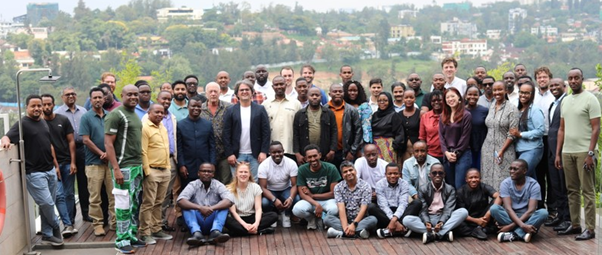 Caption: Participants of the DHIS2 Kigali workshop
Thank you to partners
The SOSCHI project has been strengthened by the dedication, expertise, and shared commitment of our partners across regions and disciplines. We are deeply grateful for the energy and insight each partner has brought to the project.
As we approach the conclusion of our four-year collaborative effort, the ONS-SOSCHI team would like to extend our special thanks to all our partners who made this journey possible:
- our partnership with Regional Institute for Population Studies (RIPS), University of Ghana and African Institute for Mathematical Sciences, Research and Innovation Centre (AIMS-RIC), Rwanda. We acknowledge their leadership in developing and implementing key indicators in collaboration with the Ghana Statistical Service and National Institute of Statistics Rwanda, and many other stakeholders in their respective governments
- the UN Global platform (UNGP) team’s support and expertise in developing the Climate-Health platform
- our colleagues in the UK Health Security Agency have supported in various ways including representation at COP and other global events, and will no doubt continue to be engaged
- the Cochrane Planetary Health Thematic Group provided valuable expertise in literature reviews
Upcoming events
-
The final version of the framework and topic documents will be published on our Zenodoplatform by June.
- Our partner, RIPS Ghana, are hosting the 8th International Climate Change and Population Conference on Africa (CCPOP – Ghana 2026) between 16 and 18 June 2026. For more information and registration details, please visit the conference page.
- RIPS are also hosting a national dialogue later in March, convening stakeholders from across Ghana to discuss implementation of the SOSCHI framework.
- We are planning more dissemination activities over the coming months, keep an eye on our SOSCHI Project UK LinkedIn page for more updates.
|