The Standards for Official Statistics on Climate-health Interactions (SOSCHI) team held its SOSCHI conference in Kigali, Rwanda, between 3 to 5 December 2025.
. Delegates met to progress a unified approach for national statistics reporting on the impacts that climate hazards are having on human health.
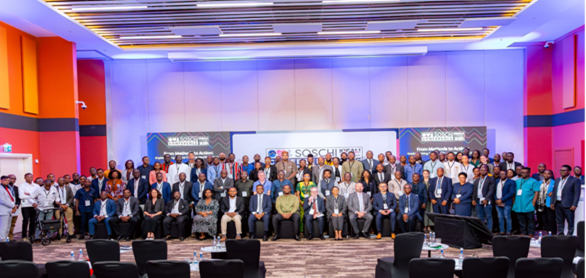 Photo: SOSCHI conference attendees – Kigali, Rwanda
A memorable agenda
This was not you average conference of consecutive slide shows. The project's partners and conference hosts at the African Institute of Mathematical Sciences Research and Innovation Centre (AIMS RIC) team put together a memorable agenda including fireside dialogues, simulation labs, lightning talks, and more.
The variety of sessions meant that each attendee had the opportunity to actively contribute and have their voice heard. Participants were engaged and conversations flowed – their drive was truly inspiring.
Photo: Left to right - Joseph Ndiritu, Program Manager, AIMS - Rwanda, Myer Glickman, SOSCHI Project Lead, Office for National Statistics (ONS) - UK and Professor. Daniel Twerefou, SOSCHI Topic Lead, RIPS - Ghana
The theme of day one was "From Evidence to Mandate: Embedding Climate-health Indicators into Policy and Governance". The team focused on introducing the SOSCHI framework and platform, and setting the stage to advance beyond research and become official policy-grade tools.
Day two was "Bridging Science and Policy: Advancing Climate-health Research and Implementation". The team dived into the technical detail of the SOSCHI indicators and heard scientific evidence from fellow researchers in the field.
Day three was "Sustaining the Climate-health Agenda: Future Research, Investment and Partnerships". Breakout groups created roadmaps for embedding the SOSCHI indicators into national statistical systems, including overcoming collaboration challenges. The day featured inspiring and heartfelt speeches on the challenges faced, whilst acknowledging the impact when teams work together.
Highlights for SOSCHI
 Photo: SOSCHI topic indicators Q and A
The team presented six priority indicators highlighting statistical approaches, data requirements, and results. This was followed by Q and A session providing opportunity for discussion and feedback on the indicators.
 Photo: Storytelling session lead by the Ghana team
Storytelling sessions included the Regional Institute for Population Studies (RIPS-Ghana) team sharing the qualitative research findings on how climate hazards affect health care workers and systems.
An interactive session focusing on applying these indicators in real-world contexts. These sessions highlighted the barriers and opportunities for implementation.
Key issues identified
Conversations during the conference highlighted some of the key issues across the climate and health space. These include that:
- there is a need to recognise the strengths across projects and organisations, set key roles and responsibilities and work together.
- data sharing should be made easier to collaborate more effectively and strengthen the indicators.
- there is a need to strengthen communication strategies to engage and influence stakeholders outside of the climate-health space.
What SOSCHI is doing about it
During the conference and beyond, the SOSCHI-ONS team is utilising its role as a leading national statistics office (NSO). Using its knowledge and experience of developing systems for official statistics production, it can facilitate implementation plans across the three project team countries. This encourages collaboration by linking academics with data owners and emphasising that combating the impacts of climate change is a collective endeavour.
The SOSCHI project bridges the gap between academics and the public. Complex methods are translated into accessible and usable code for NSOs to implement to produce their own indicator metrics. It also allows policy makers to advise on climate and health-related societal decisions.
 To find out more about SOSCHI’s plans for working with national statistical systems to integrate climate and health statistics, please register for our side event at the 57th session of the United Nations Statistical System.
What’s next for SOSCHI
The focus for the remainder of the project is:
- securing future external funding to continue this important work – keeping climate and health on the global agenda.
- strengthening relationships with NSOs and wider stakeholders to assist with the global implementation of the SOSCHI indicators into official statistics - supported by the UN-ECCS' recommendation endorsement.
- publishing the final project documents, R package which will be accessible via the Climate-health platform, ensuring SOSCHI's work is appropriately disseminated and accessible to the inquiring user.
- publishing analysis articles drawing on partner‑country data to demonstrate proposed indicators and methodologies, share important results, and foster a peer‑review process in line with open‑access policy for wider reach.
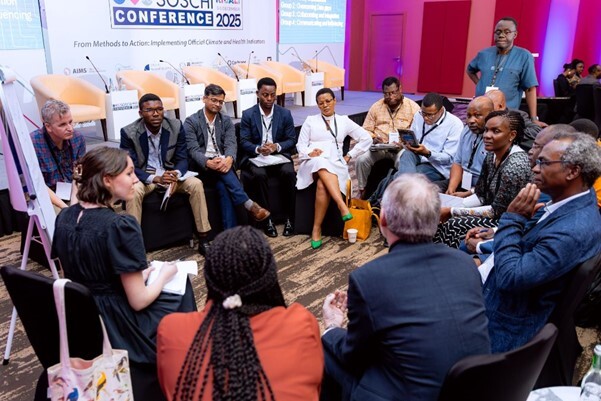 Photo: Breakout group for the ‘SOSCHI indicators in practice’ session
Full report now available
This special issue captures select insights from the project conference. For an in-depth analysis with details of research, presentations and conclusions, please refer to the conference report paper.
Upcoming events
Get involved
Visit the Climate-health platform for more information on the project and indicators, or to provide feedback. You can email the team at climate.health@ons.gov.uk.
You can also follow the teams on LinkedIn to get the latest updates:
@SOSCHI project UK
@SOSCHI Ghana
@AIMS Research and Innovation Centre
 Photo: Day three closing session
|