|

Welcome to the latest update from the Standards for Official Statistics on Climate and Health Interactions (SOSCHI) team at the Office for National Statistics (ONS). We are delighted to share some exciting updates and news from this project with you and appreciate your interest and support.
The project has made significant progress in the first quarter of this year, deploying new updates on its platform, organising a side event at the 56th Session of the Statistical Commission, and preparing for the UK Civil Service Climate and Environment Network conference.
|
|
|
On 28 February 2025, we published a series of project papers adding to the SOSCHI framework, released at the end of 2024. These releases were developed in collaboration between the SOSCHI team at the ONS, the African Institute for Mathematical Sciences (AIMS) and the Regional Institute for Population Studies (RIPS).
The following topics have published indicator methodologies and metadata:
-
heat and cold: mortality attributed to non-optimal temperature
-
waterborne diseases: diarrheal disease incidence attributable to extreme precipitation and extreme temperature
-
vector-borne diseases: malaria cases attributable to extreme precipitation, and extreme temperature
The following topics have published topic introductions:
-
extreme weather events: flooding
-
healthcare systems and facilities
The following topics have published indicator methods reviews:
-
airborne diseases: confirmed cerebrospinal meningitis morbidity cases attributed to high temperatures
-
undernutrition: the incidence of stunting linked to extreme temperature
We invite users and stakeholders to give feedback which will help us to further develop methods for the proposed topics and overall framework. You can also volunteer get involved in topic expert groups.
|
|
We are continuing to progress the development of our online knowledge-sharing platform, with two new indicator tools ready for user testing and early feedback. These provide functionality to measure statistics related to mental health outcomes and wildfire smoke health impacts.
The mental health indicator tool measures suicide-related deaths associated with exposure to extreme temperatures. The wildfires indicator tool measures health impacts (all-cause mortality) attributable to wildfire smoke PM2.5.
All recent publications and indicators tools can be found on the updated version of the platform. You can also complete a feedback form to tell us how you have used the platform, or other features you would like to see included.
|
|
 |

On Friday, 21 February, we hosted a virtual side event at the 56th Session of the United Nations Statistical Commission (UNSC). The event, "Indicators on climate and health: developments, opportunities and challenges", was designed to inform delegates about the progress of the SOSCHI project towards a global statistical framework for official reporting on climate and health interactions.
-
outlined the proposed indicator set, which is crucial for tracking and understanding the climate-health interactions, and the rationale behind its selection
-
demonstrated case studies of topic development (water-related health impacts)
-
demonstrated a pilot of the platform online tools (wildfire smoke PM2.5 related health impact)
Our team were also involved with another side event on climate change statistics, "Consolidating the UN statistical programme on climate change and environment", as part of the events expert panel. This event presented and discussed revising the work programme on the environment and climate change statistics.
|
|
|
|
The Expert Group on Environment Climate Change Statistics (EGECCS), originally established in 2014, has been a key collaborator with the UN Statistical Division (UNSD) in developing methodological tools, hands-on guidance, and training materials.
At the 55th session of the UN Statistical Commission, we presented our work, which is significant as it focuses on understanding the climate impact on health outcomes for international comparison. The EG-ECCS reviewed the work and recommended further testing of the methodologies and data availability.
We are are now working with UNSD to set up a sub-group on health with experts from countries and international organisations who have expressed interest in joining the group. If you would like to be involved with this group, please contact us. We would be grateful for your input.
|
|
Colleagues from our team and the UK Health Security Agency (UKHSA) will participate in a panel discussion titled "Weathering the storm: tackling climate health impacts", at this event in March.
We will also have a dedicated stall, where we will be chatting with attendees about the project and demonstrating the platform functionalities. If you are attending, why not stop by our stand and say hello. You can also attend virtually for free.
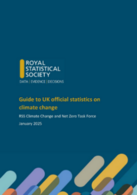
The Royal Statistical Society (RSS) Climate Change and Net Zero Task Force has released a guide to help navigate the UK official statistics on climate. It includes everything from weather events to renewable energy usage.
This guide focuses on official statistics, and data on climate change.
|
The ONS’s annual stakeholder survey looks to understand your satisfaction with and use of ONS statistics. Your responses help us improve what we do, including how we communicate and disseminate our statistics.
As a result of last year’s survey, we created a monthly webinar series to better explain our regular outputs, streamlined our external newsletters, and implemented measures to better coordinate external stakeholder relations. This year’s survey also asks about your experience of using national and local statistics. It takes under 20 minutes to complete, and you can respond anonymously if you prefer.
Please complete it by 11 March 2025. Contact external.affairs@ons.gov.uk if you have any questions.
|
|
|
|



