
Research Excellence Awards 2022
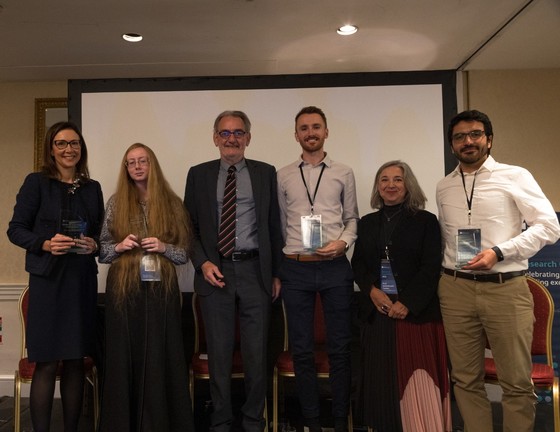
Our annual Research Capability 2022 event took place in London on Tuesday 11th October, which featured the ONS Research Excellence Awards presentation and panel session. The awards - presented by National Statistician, Sir Ian Diamond - promote greater awareness and understanding of the data available and the public good achieved by statistical research. We are delighted to announce this years award winners:
-
ONS Research Excellence Award - Professor Sinead Langan
-
ONS Cross-government Analysis Award - Dr Becky Arnold
-
ONS Linked Administrative Data Award - Miss Georgina Eaton
-
ONS Early Career Research Award - Dr Nicolas Libuy
-
ONS People's Choice Award - Professor Sinead Langan
Change to methodology in RAS
You may have noticed a change to the methodology question in the project application form on RAS. In order to support research innovation and improve the efficiency of the research accreditation process, the focus is now on the extent to which the method will lead to valid conclusions that will realise the public benefit of the research. Researchers are also required to identify potential bias in and limits of the method and explain how this will be mitigated.
Although we still require information about the methods you will use in your research project to provide assurance that they will realise the public benefit of the research, this change is expected to be beneficial to research applicants as it limits discussions on the merits of research methods.
For more information, please contact SRS.Project.Applications@ons.gov.uk.
New SRS Output Guidance and Output Form from Monday 31st October
The SRS Statistical Support Team have produced new Output Guidance which focusses on the procedural side of outputs from the SRS. The guidance covers the output process and clarifies the intention and use restrictions. Accompanying the guidance is a new Output Form which will replace the existing from Monday 31st October.
The new Output form will be available in your SRS project space, in the SRS Libraries, on the SRS website, and on request from SRS Customer Support (srs.customer.support@ons.gov.uk). The Output Guidance will be available in the SRS Libraries, on the SRS website, and on request from SRS Customer Support (srs.customer.support@ons.gov.uk).
Please note that the output rules have not changed but, though outputs considerations remain principle based, greater justification for any exception or atypical action will be required on the new output form.
SRS Christmas Hours – advanced notice
Limited service over the holidays
We will be operating with reduced support for the Secure Research Service (SRS) from 4pm Thursday 22 December. Our full support service will reopen at 8am Tuesday 3 January.
Users with Assured Organisational Connectivity (AOC) access to the SRS will be able to access their projects as normal, and researchers can continue to use the Research Accreditation Service (RAS).
Our customer support email service will have limited cover during this period, and other customer-facing teams will only be operating with a skeleton staff. This means we cannot guarantee that outputs will be cleared within our usual service levels and anything submitted in RAS will not be actioned by our team until full service resumes in January.
If you require a saferoom booking, the request needs to be with SRS Customer Support before 4pm Wednesday 21 December. If you require a Safepod booking, please contact the institution directly.
Should you have any questions regarding the holiday closure, please contact SRS Customer Support.

GUIE Publication
The Office for National Statistics (ONS) Growing Up in England (GUiE) publication was released on Tuesday 18 October. GUiE is an Administrative Data Research UK (ADR UK) flagship dataset, and the project represents a collaboration between the ONS, the Department for Education (DfE) and ADR UK. The de-identified GUiE dataset links ONS 2011 Census data with DfE educational attainment data and data on vulnerability characteristics.
This publication is the result of a culmination of efforts across multiple teams both internal and external. The publication details the linkage methodology used to link census data to education data, and contains data tables which demonstrate the types of analysis that can be conducted using the GUiE dataset. We hope this will aid researchers in making informed decisions about the utility of GUiE and how it may align with their research goals.
On 6 October, ADR UK launched a fellowship call inviting researchers to apply for funding to use the GUiE data (see article below on fellowship call). Alongside this new publication, a user guide and data quality manual have been produced to support researchers applying to use the GUiE data.
We are delighted to announce that Digital Object Identifiers (DOI) have now been rolled out for the new SRS Metadata Catalogue.
The availability of DOIs enables a range of benefits, including:
-
Reducing time spent locating data sources that have been used, cited, or quoted, providing insight on the provenance of data.
-
Helping to avoid ‘link rot’ by registering metadata about data assets in a repository maintained by a trusted external organisation, such as the British Library.
-
Giving credit to data owners for publishing data and enabling robust citation and referencing (useful for Data Availability Statements requested by journals).
-
Supporting tracking to find out who has used sources and where, thus supporting longer-term monitoring and evaluation of goverIDS.Impact@ons.gov.uknment data and publications.
The work leading up to the roll out has included:
-
Setting up a cross ONS working group to appraise and discuss business and user needs for DOIs within the organisation.
-
Assessing the use of DOIs by other research data publishing organisations and data repositories, such as the UK Data Service.
-
Assessing the suitability of British Library DataCite membership for minting DOIs as persistent identifiers. In October 2021 we joined the DataCite Consortium, led by the British Library, to start out pilot work.
-
Agreeing a versioning strategy for publishing SRS datasets so that that DOIs reflect true versions of data, and users are made aware of significant changes to data.
-
Leading on a submission, with the support of DataCite at the British Library, to the Cabinet Office Open Standards Board (OSB) for the DOI system to be recommended as an open standard across UK government. The recommendation is under consideration, with the SRS Metadata Catalogue is being used as an early pilot to help examine the scope of any future implementation.
A DOI and citation for an SRS dataset looks like this:
|
Dataset
|
Dataset name
|
|
DOI name
|
10.57906/0y39-4s34
|
|
ONS recommended citation
|
[Data controller], released [Release date format XX Month 20XX], ONS website, dataset, dataset name [dataset landing page URL link embedded]. DOI
|
|
Example: ONS data owner /controller
|
|
|
Example – non ONS data owner/controller
|
|
Your help in citing data
Now that DOIs are available for the secure data assets we manage, we would like to remind researchers and communicators to use them! You can add the DOI to your data citation in any published work from your research, from published papers and reports to pieces in the media, social media and wider internet. Those writing about or promoting data can also cite the DOI, so that mentions can be picked up for impact tracking.
Help on using our DOIs and catalogue can be found in our FAQs.
New datasets in the SRS
COVID-19 Infection Survey linked to Mortality
The COVID-19 Infection Survey was launched in England in mid-April 2020. Working with the University of Oxford, University of Manchester, Public Health England, Wellcome Trust, IQVIA and the Lighthouse Laboratories at the UK Biocentre Milton Keynes and Glasgow, its aim is to provide information on how many people across the UK have COVID-19 infection at a given point in time, either with or without symptoms and how many are ever likely to have had the infection.
This dataset contains information on mortality, taken from the national Deaths Registration data for England and Wales, for CIS participants only. Deaths information includes date and registered cause(s) of death, attached to CIS IDs.
Find out more on the Metadata Catalogue.
ADR UK
ADR UK (Administrative Data Research UK) is a partnership transforming the way researchers access the UK’s wealth of public sector data, to enable better informed policy decisions that improve people’s lives.
|
|
 |
ADR UK annual report: a year of achievements and development in 2021-22
ADR UK have published its annual report for 2021-22, showcasing a range of achievements and developments from right across the partnership.
The report details ADR UK’s successes this past year and how they are progressing in their mission to transform the way researchers access the UK’s wealth of public sector data.
To find out more, please visit the ADR UK website.
Funding opportunity: Research using ADR England flagship datasets
ADR UK is inviting applications for Research Fellowships to conduct research and analysis demonstrating the policy impact potential of key ADR England flagship datasets. Applications close 24 January 2023.
Applicants must use key ADR England flagship data for their fellowship. For this round, ADR UK are prioritising funding for applications using Longitudinal Education Outcomes (LEO), Growing Up in England (GUIE) & Annual Survey of Hours and Earnings (ASHE) - 2011 Census.
To find out more, please visit the ADR UK website.
From 26 – 27 October, ADR UK is holding webinars for prospective applicants to their Research Fellowship opportunity using ADR England flagship datasets. This round will prioritise funding for three of the datasets, with each webinar focusing on a different one. Sign up for a webinar to hear more about the data available and the application process:
Data Insight from ADR UK - Ethnic Inequalities in Sentencing in the Crown Court
This Data Insight draws on Data First magistrates’ and Crown Court datasets to examine ethnic disproportionality in court outcomes and the extent of ethnic disparities in imprisonment for defendants sentenced in the Crown Court after adjusting for defendant and case characteristics.
To find out more, please visit the ADR UK website.
Data linkage project to increase understanding of the employment experiences of migrant workers
ADR UK is funding University of the West of England initiative, Wage and Employment Dynamics, to link HM Revenue & Customs (HMRC) data on migrant workers to a dataset on employees’ wages, occupations and hours. The linked dataset will make it possible to better understand the working experiences of migrants compared with the rest of the population in Great Britain.
To find out more, please visit the ADR UK website.
ONS Covid Infection Survey transition
The ONS Covid Infection Survey (CIS) has recently made a successful transition from a from a face-to-face survey to a digital-first design. Testing kits are now posted out and returned by participants, with questionnaires online or telephone based. This is a huge cost saving and the dedicated from the team has earned them a nomination for the “Programme of the Year” category at the upcoming Civil Service Awards 2022.
CIS on the metadata catalogue
Integrated Data Service
We were pleased the Integrated Data Service (IDS) team joined us at Research Capability 2022 where they hosted the IDS Workshop - The future of data.
|
|
 |
|
Also running Workshops were ADR UK - Give and Take: Community approaches for administrative data, Census 2021 - The journey from design to dissemination, SRS & IDS Impact team - Getting your research closer to policy.
To find out more, please read the IDS Newsletter.
|
|
 |
Dataset of the Month
The ONS Longitudinal Study (LS) contains linked census and life events data for a 1% sample of the population of England and Wales. The LS currently holds data relating to 1.2 million people making it the largest longitudinal data resource in England and Wales.
The LS has linked records at each census since the 1971 Census. New LS members enter the study through birth and immigration (if they are born on one of four selected dates in a calendar year). All information collected on the census is included e.g., age, sex, marital status and many other socio-demographic topics which is then linked to life events data that has happened up to 2017 such as: birth to sample mothers, deaths and cancer registrations.
The LS has a very large sample size and low levels of attrition, allowing for extensive research into subgroups of the population. The linked census data enables researchers to examine change by investigating the same people through two or more censuses. The LS Data Dictionary provides a full list of the data and variables available to researchers using the LS.
The LS can be used for several types of analysis, over many different research areas such as:
- Health and mortality
- Family formation
- Ethnicity and religion
- Migration
- Educational and professional activity
If you would like to learn more about the LS dataset, please contact: longitudinalstudy@ons.gov.uk and celsius@ucl.ac.uk.To access this dataset within the ONS SRS, please contact the SRS Customer Support team: srs.customer.support@ons.gov.uk
Case Study of the Month
Secondary school accountability in England
This work presents a comprehensive statistical evaluation of the Progress 8 school accountability measure in England, identifying its strengths and weaknesses. This enabled the researchers to make six recommendations to policy makers. Progress 8 is a secondary school accountability measure for state-funded schools first implemented in 2016.
To find out more, please visit the ADR UK website.
|







