Red heat-health alert issued by UK Health Security Agency
The UK Health Security Agency (UKHSA) has issued a red heat-health alert (HHA) across the Midlands and other parts of the country from 1am on Wednesday 24 June until 11pm on Thursday 25 June. This is only the second time a red HHA has been issued, the first was in July 2022.
A red HHA is the highest level of alert and indicates a risk to life for even the healthy population so we’re sending this special edition of our bulletin with advice on how to stay safe.
Keeping yourself cool and sun safety
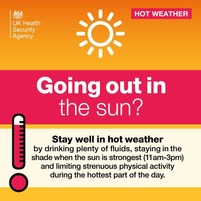
It might seem obvious but the best thing to do in hot weather is to stay out of the direct sun, especially during the hottest part of the day, as UV rays are strongest during these hours. This is usually between 11am and 3pm but it’s important to check local forecasts.
When out and about, walk in the shade whenever possible, apply sunscreen, wear a suitable hat, sunglasses, and light, loose-fitting, light-coloured clothes.
Apply sunscreen frequently of at least SPF 30 (SPF 50 offers higher protection) and 4 or 5 star ultraviolet A (UVA) protection.
Drink plenty of fluids and avoid excess alcohol during the hot weather. Also try to avoid extreme physical activity or do it during cooler times of the day.
|
Keeping your home cool
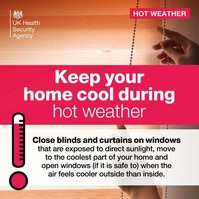
Close blinds and curtains in rooms that face the sun, move to the coolest part of your home and open windows (if it is safe to) when the air feels cooler outside.
Use electric fans if the temperature is below 35°C but do not aim the fan directly at the body.
Ensure that fridges, freezers, and fans are in working order and check that medicines can be stored at the correct temperature.
|
Keeping vulnerable people safe and well
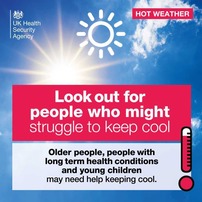
Anyone can become unwell in hot weather, but some are at higher risk. Look out for older people, people with long-term health conditions and young children who may find it more difficult to stay cool and hydrated. Check in on older friends, family, and neighbours, particularly those who live alone.
Babies and young children are more likely to become unwell from hot weather, and they are particularly at risk of sunburn. The NHS recommends that babies under 6 months old are kept out of direct sunlight throughout the day. Babies over 6 months old should be kept in the shade during the hottest times of the day and must wear at least SPF 50 sunscreen.
Small, closed spaces can get dangerously hot very quickly. Make sure that babies, children, older people, and pets are not left alone in stationary cars or other closed spaces.
Keep children in prams or pushchairs shaded using a parasol. Don't cover them with a cloth or muslin and make sure there is adequate air flow. Remove excess clothing and check on them regularly to make sure they don’t overheat.
Pets also need extra protection from the heat. Make sure they have access to fresh drinking water and keep them in a well-ventilated space shaded from direct sunlight. Use pet-safe sunscreen for cats and dogs with lighter fur and never leave your pet inside a car, caravan or conservatory. Make sure it’s safe to walk a dog by doing the 5-second tarmac test – if it feels too hot for your hand, it’s too hot for your dog’s paws. Walking in the early morning or late evening is the safest time for you both.
|
Symptoms of heat related illness and how to respond
If you or others feel dizzy, weak, sick or intensely thirsty during hot weather, this may be heat exhaustion. Move to a cool place, rehydrate and cool your body down by removing excess clothing. Spray yourself with cool water or use a sponge on exposed skin. Cold packs wrapped in a cloth and put under the armpits or on the neck can also help.
If you have painful muscular spasms or muscle cramps, rest immediately in a cool place and drink plenty of cool drinks.
Anyone affected should start to cool down and feel better within 30 minutes. If you are concerned about symptoms or they are getting worse, call NHS 111.
A high temperature, confusion and breathing fast can be symptoms of heat stroke,
which is a medical emergency. Other serious symptoms include skin that is no longer
sweating and seizures.
If you suspect someone has heatstroke, call 999, put them in the recovery position and keep trying to cool them down.
|
Open water safety
Swimming in lakes, rivers and reservoirs can be tempting on a very hot day but entering open water can be deadly.
Even on a hot day, the water can be extremely cold and cause cold water shock. There may be unexpected currents that can be fatal, even if you are a strong swimmer, and you might not be able to see dangerous obstacles beneath the surface that could trap or injure you.
Advice from Notts Fire and Rescue is to only enter water in areas staffed by lifeguards.
|
|





