 Welcome to HRA Latest with news and updates for those working or involved in health and social care research.

You can read more about our response to the Infected Blood Inquiry and how our work will support people to know what they can expect when they take part in research.
In this edition, we also share more about our work to build trust and transparency in health and social care research, and welcome the report on the National Commission into the Regulation of AI in Healthcare. There's also the results of our site set-up satisfaction survey.
We invite you to meet Research Ethics Committee (REC) Chair Sheila Maclennan, who shares how her role shapes research in a way that supports patients and the wider health research system.
And I'm also delighted to announce we've appointed a new Director of Approvals for the HRA. Keep reading for more information.
For regular updates and the latest news, you can also follow us on LinkedIn.
Matt Westmore, Chief Executive
|
 We will make sure that people have a clear understanding of how they can expect to be treated if they are part of a research study, and the safeguards in place to ensure this is the case.
We're working on new resources in response to recommendations from a workshop informed by the Infected Blood Inquiry, and are looking for people to help.
We're setting up an advisory group that will include people with relevant lived experience as well as representatives from organisations that support and do health and social care research, and there's still time to tell us if you’d like to be involved.
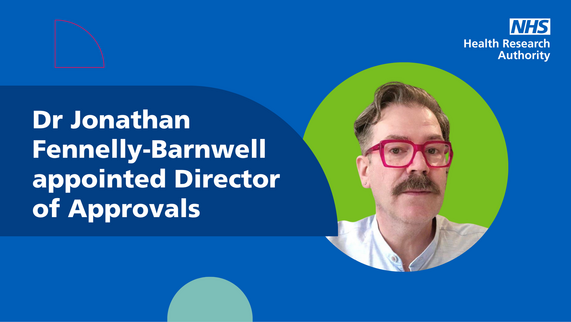 Introducing our new Director of Approvals
We are delighted to announce that Dr Jonathan Fennelly-Barnwell has been appointed Director of Approvals at the HRA.
Jonathan has been interim Director of Approvals since January this year. He has significant experience in research ethics, collaboration, and operations and has worked at the HRA since 2011.
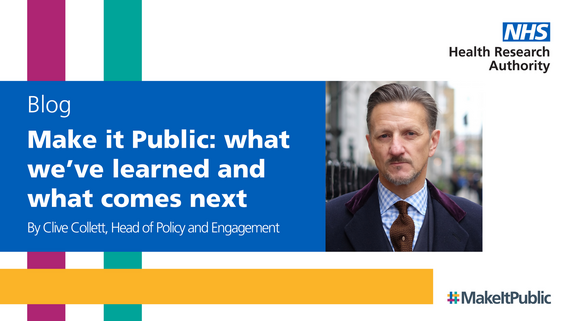 Trust and transparency in research
Trusted information from health and social care research studies should be publicly available for the benefit of all.
We're reviewing and refreshing our Make it Public strategy, drawing on what we've learned over the last 6 years and listening carefully to the views of people who do research, take part in it, or use its results.
Read more about the 5 priorities that are shaping this review in this blog from Clive Collett, Head of Policy and Engagement.
 Site set-up satisfaction survey 2026 results
Earlier this year we asked people working across health and social care research in the UK to tell us their experience of study set-up.
The survey focused on 6 key themes of study set-up: ease, clarity, consistency, expectations, efficiency and speed.
The results have given us a baseline of satisfaction which we can track to make sure that our work in this area is making a difference.
 Supporting safe artificial intelligence (AI) regulation
Earlier this month, we welcomed the publication of the National Commission into the Regulation of AI in Healthcare report, which sets out recommendations to support the safe, effective and proportionate adoption of artificial intelligence across health and care.
We worked closely with the Commission throughout the development of its recommendations bringing expertise on research governance and regulation, public trust and public involvement.
 We've published our annual reports for our Research Ethics Committees (REC) in England and the Confidentiality Advisory Group (CAG).
The reports include information on the number of health and social care research applications reviewed, and the time taken to provide a final outcome, as well as key achievements. We're really proud that they show that both REC and CAG continue to provide a high quality service that protects research participants and supports the safe use of confidential patient information.
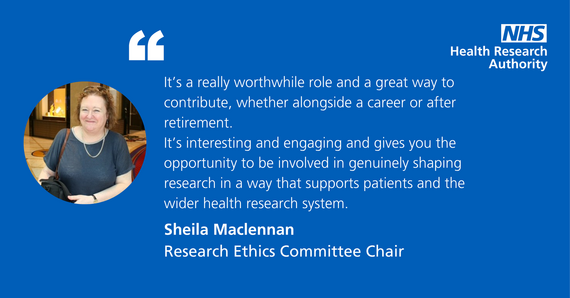 Meet our volunteers: an interview with Sheila Maclennan
In the latest in our series of interviews with our volunteers, we spoke to Sheila Maclennan.
Sheila is a former consultant haematologist who spent the last 30 years of her career working with NHS Blood and Transplant, specialising in blood transfusion.
During her career, she led the committee responsible for developing UK transfusion guidelines and played an active role in teaching and training. Now retired, she continues to use her extensive clinical and leadership experience in her role as a Research Ethics Committee (REC) Chair.
 A tribute to Dr Vasee Moorthy
We were saddened to learn of the death of Dr Vasee Moorthy. Through his work at the World Health Organization, Vasee was a tireless advocate for ethical, high-quality research and for ensuring that research responds to the needs of patients, communities and public health.
He was a compassionate and influential voice in strengthening clinical research systems globally and in supporting countries to develop the capacity to lead and deliver research that matters to their populations.
He championed integrity, transparency, equity and partnership, believing that research should be both scientifically rigorous and responsive to the needs of the people it is intended to benefit. His commitment helped shape health research internationally and will leave a lasting legacy across the global research community.
 MHRA pilot to accelerate assessment timelines
Earlier this month the Medicine and Healthcare products Regulatory Agency's (MHRA) 14-day Phase 1 clinical trials pilot launched. The pilot is designed to reduce assessment timelines for eligible low-risk phase 1 clinical trials involving healthy volunteers.
This sits alongside work already underway at the HRA, including our fast-track research ethics review service, which offers accelerated ethics review for eligible global clinical trials and phase 1 studies.
Together, these initiatives support a more efficient and trusted clinical research environment while maintaining robust protections for research participants.
 Below are some updates you may have missed about health and social care research in the UK:
-
the Association of the British Pharmaceutical Industry (ABPI) has published its annual UK Pharmaceutical Investment Competitiveness Report 2026, which highlights growing confidence in the UK's life sciences sector and the progress being made to strengthen the UK's competitiveness as a destination for research and investment
- scientists from UK Health Security Agency, the University of Oxford and a collaboration of academic institutions have used bacterial genome sequencing to understand why the meningococcal disease outbreak in Kent earlier this year was so severe. The research underlines why the UK’s world-leading genomic surveillance and rapid outbreak response capabilities are more important than ever
- 4 new Centres of Excellence for Regulatory Science and Innovation are being developed through a partnership between the Medicines and Healthcare products Regulatory Agency, the Medical Research Council and the Office for Life Sciences
- Pathways to Antimicrobial Clinical Efficacy (PACE) and the UK Health Security Agency have released 5 new contemporary antimicrobial resistance (AMR) strain panels, giving innovators worldwide a resource to test novel therapeutics and diagnostics against today’s resistance patterns
- applications to join the NHS Patient Entrepreneur Programme (PEP) open on 19 October 2026. PEP is a free 12-month learning and development programme designed for patients, service users and carers who have used their lived experience to develop a healthcare innovation
|