|
Your HRA Public Involvement Newsletter
July 2025
|
|
 Welcome
Your public involvement newsletter shares news and information for people who are interested in and planning public involvement in health and social care research.
Anyone can subscribe, just share this link.
By public involvement in research, we mean research that is done ‘with’ or ‘by’ the public, not only 'to', 'for' or 'about' them. This includes patients, carers, advocates, service users, and other members of the community.
If you’re reading this, you’ll know that public involvement is important, expected and possible in all types of health and social care research. There are many ways that people with relevant experience can contribute to designing, carrying out and sharing research. And there is a wealth of information about how to do this well, so research is more inclusive, relevant and impactful.
We hope this newsletter:
- makes that information easier to find
- shares useful learning and reflections
Let us know how we’re doing! Complete this quick survey to tell us if the newsletter is useful. And email the HRA’s public involvement team if there’s something you’d like to share or know more about.
Make sure you’re also subscribed to HRA Latest for:
- invitations to get involved in the HRA’s work
- HRA news and developments
In this month's newsletter
Accessing the newsletter
To change the size of the newsletter, click on the link at the top and zoom in using the ‘Ctrl’ and the ‘+’ symbols. To listen to the content, you can use a screen reader or the ‘read aloud’ function often found within the ‘accessibility’ features of many devices.
For support with this, or if you need the newsletter in a different format, you can read our guidance, email the public involvement team at public.involvement@hra.nhs.uk or call on 0207 104 8161.
|
|
|
In this section, we share updates from the HRA, and organisations in our networks.
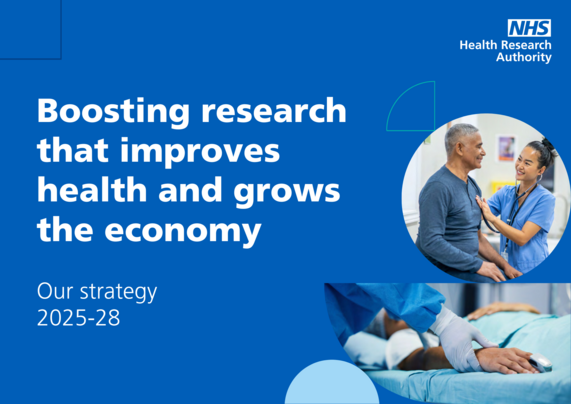 We're proud to share our new strategy with you. It sets our focus for the next three years to make it easier to do research that people can trust.
Our strategy will be important for everyone who has an interest in health and social care research, and we know that the public involvement community will take a particular interest in our ongoing commitment to embedding meaningful public involvement in health and social care research, and in the HRA's own work.
We’re very thankful to the members of the public who helped to shape and develop our new strategy. Trust is at heart of our new strategy and increasing public involvement in health and social care will be fundamental to getting this right.
 This month, the government published the 10 Year Health Plan for England: fit for the future, an ambitious plan to transform the NHS over the next decade.
The plan was co-developed with members of the public, health and care staff and partner organisations. It sets out an ambition for the UK to be a world leader in patient involvement in research.
Our Chief Executive Matt Westmore welcomed this ambition, commenting:
'This is something that we have championed through our Shared Commitment to Public Involvement, and we look forward to seeing this ambition become a reality.'
|
|
|
In this section, we share reflections and learning from public involvement activities.

In a recent opinion piece, Health Data Research UK (HDR UK) explore the value and challenges for Early Career Researchers involving the public in their work.
HDR UK are the UK's national institute for health data science. Their Patient and Public Involvement and Engagement vision is for all health data research to deliver benefits to diverse people, research and innovation by listening to the needs and concerns of patients and carers, and by enabling shared decision-making throughout the research process.
In the opinion piece, Aisha Kekere-Ekun, a member of HDR UK's Public Advisory Board recognises opportunities for organisations to support Early Career Researchers, and flags how important it is for researchers to listen, learn and adapt:
'There’s no one-size-fits-all approach. You may need to adjust your methods based on who you’re working with’, she advises. Gathering feedback and refining approaches over time is also crucial: ‘Small details - like the timing of activities or how much time people need to review materials - can make a big difference.'
Early Career Researcher, Breeshey Roskams-Hieter, notes the specific challenges faced by people at the start of their career and also encourages colleagues to support each other:
'Start the conversation! Reach out to mentors, colleagues, or management at your institution to see what resources they offer.'
Despite the challenges, the over-riding message from the piece is to get started, learn from your experiences, and support others.
|
|
|
In this section, we aim to address frequently asked questions, and make it easier to find information that supports public involvement. You may also find the resources page of our website a helpful starting point.

No. You do not need to submit an application to a Research Ethics Committee in order to involve the public in the planning or the design stage of research, even if the people involved are NHS patients.
If you want to check that you're involving people well, the UK standards for Public Involvement are a framework for what good public involvement in research looks like. The standards are designed to encourage reflection and learning and can be used by people and organisations to identify what they are doing well, and what needs improving.
|
|
|
|
|