|
 Light Night at Nottingham Castle
Friday 10 February 2017
6-9pm (last entry 8pm)
Bring the whole family to Nottingham Castle, where entry will be FREE. The grounds will be illuminated and you can try your hands at glow in the dark tennis, as well as archery, basketball and football. Come and soak up the party-like carnival atmosphere!
Experience the art installations in the Castle grounds by artist Andy McKeown. In the Castle bandstand, Light Rain promises 50 brightly coloured umbrellas suspended and illuminated by constantly falling rain to the sound of a traditional music box.
Brewhouse Yard will also be offering FREE entry on the night and there will be exciting activities taking place across the city. Last year over 18,000 people visited Nottingham Castle and Brewhouse Yard alone.
Read more about Light Night
Back to top
|
 Scott's Findings
City Archaeologist, Scott Lomax is back for the New Year with his eleventh column. This month, he explores caves in wartime.
"75 years ago caves at Nottingham Castle were specially modified to help defend the citizens of Nottingham from falling bombs.
In May 1941 the German Luftwaffe carried out an air attack on the city in which
159 people were killed during an intensive bombing campaign."
Campion's suggestions - "The amateur archaeologist George Campion who excavated caves across the city
and has been mentioned in previous newsletters, suggested at this time that an
underground city should be created, big enough for the whole population, so the
city's residents could live and work in safety for the duration of the war."
Caves as shelters - "The authorities chose not to follow Campion's suggestion but during 1941 and
1942 the Air Raid Precautions (ARP) did record all rock-cut caves being used
as shelters, and made changes to a number of other caves to make them suitable
as shelters during air raids. Often carved deep into the ground, these man-made
chambers provided protection, in some cases for thousands of people."
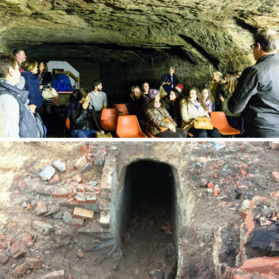
Cosmic Ray Cave (pictured above) - "The caves cut into the Rock beneath Nottingham
Castle were among those
modified for this purpose. Caves at Brewhouse Yard were intended to be used by
staff at the Waterworks Company, and the cave known as the Cosmic Ray Cave was used as a Emergency
Administrative Office for the Air Raid Precautions (ARP). Office facilities
were installed, as were emergency phone lines. A number of bunk beds provided
somewhere for the staff and volunteers to rest."
Sleeping room only - "New caves were also hewn into the Castle Rock during the war, probably in 1942,
to provide sleeping accommodation for the ARP, with 132 bunk beds. Emergency
equipment was held here so that it was on hand in case of bombs causing
destruction within the city.
Being centrally located, and protected within the base of the 30m high Castle
Rock, the caves here were among the most suitable for emergency workers to be
based."
Visit the caves in question - "At the Museum of Nottingham Life, at Brewhouse Yard,
visitors can still see and explore some of the caves that were used as air raid
shelters. Others exist beneath private properties and pubs, and some unfortunately
no longer exist or are inaccessible.
A cave was recently rediscovered just outside the city centre, revealed for the
first time in decades. The cave was created in the 18th or 19th century as a
pub cellar but was modified in the Second World War so it could be used as an
air raid shelter for up to 50 people. Corrugated iron, put in place to
strengthen the cave, is still there.
Nottingham's caves represent important parts
of the city's history from the medieval period through to the modern day and they
have important stories to tell."
Cave stories - get in touch - If anyone has any recollections of having sheltered in any of Nottingham's
caves during the Second World War, or has any stories they have been told by
friends or relatives about the use of caves in the Second World War, or even
during Zeppelin raids in the First World War, please get in touch.
You can
contact Scott at: scott.lomax@nottinghamcity.gov.uk
Back to top
|
 Bob Dylan's 1966 visit - A detective story
It turns out that Nobel Prize Winner Bob Dylan made a visit to the Castle in the Sixties. Read about how our team helped researcher Marie Fontini put the pieces together from a photograph of the singer spotted in Barry Feinstein's book REAL MOMENTS which consists of many pictures of Dylan during his 1966 European tour.
Perhaps he will visit again when his tour reaches
Nottingham on May 5
Read more about the project
Back to top
|
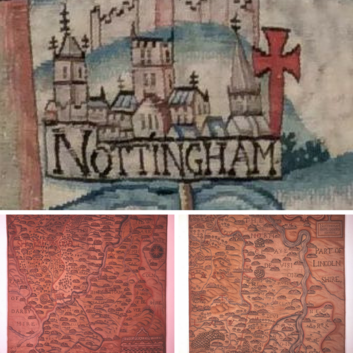 Object of the month
What is it?
We have
selected our 'Tapestry Maps of North and South Nottinghamshire' as January’s
Object of the Month.
Why are they significant?
These large
tapestries were based on Christopher Saxton’s map of Nottinghamshire in 1576 and
John Speed’s map of 1616. They give a detailed representation of the landscape and
architecture of the county before the English Civil War.
Tell me more
The maps
depict North and South Nottinghamshire respectively. They were commissioned by
Mistress Mary Eyre of Rampton and Grove. The tapestry of the North bears an
inscription “At Rampton made wee were by Mistress Mary Eyre” and is dated 1632.
The panels
are woven in multi-coloured wool on linen warps (vertical threads) and were
made by a well-known Flemish tapestry making family, the Hyckes, who worked for
the Sheldon Family tapestry weaving business based at Barcheston in
Warwickshire. The looms would have been
set up at Rampton and the tapestries made there.
In our opinion
"These map
tapestries of Nottinghamshire are not only huge; they are extremely attractive
and endlessly fascinating offering a bird’s eye view of early 17th century
Nottinghamshire. The detail is astounding, with virtually every settlement in
Nottinghamshire represented by buildings and landmarks. Market towns are shown with red crosses,
there are beacons, a water mill, deer, waterways – but no roads - and even
gallows just north of Nottingham." (Judith Edgar, Curator
of Lace, Costume and Textiles Collection)
The Tapestry
Maps will feature in the new Rebellion Gallery currently being designed by
exhibition designers Casson Mann.
To learn more about tapestries please visit these web links:
Hyckes
Sheldon business at Barcheston on Wikipedia.
The Bodleian Museum
Back to top
|
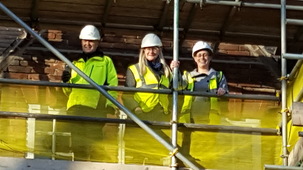 Up on the roof
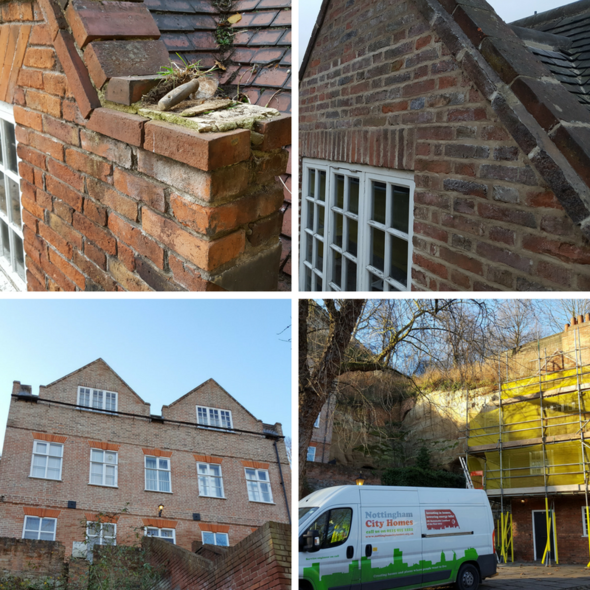
The team recently went on a high level visit to inspect some of the restoration work being undertaken by the team from Nottingham City Homes to restore and repair brickwork at Brewhouse Yard Museum and Rock Cottage.
The team met the site manager to inspect new pointing
and roof repairs at close quarters. Some of the work on the cottages is already
complete and the images below really show the difference. Further
work over the next few weeks will include repairs to the windows and guttering
as well as decoration to doors and frames.
It is great to see Brewhouse Yard looking so good, even more so as
plans for the design and interpretation of the interior are also progressing
rapidly.
Back to top
|
|
|