|
Welcome to the fifth update on our Digital Mental Health Technologies (DMHT) programme, delivered by the MHRA in partnership with the National Institute for Health and Care Excellence (NICE) and funded by Wellcome.
This edition comes at a key point for the programme. Phase 1 has now concluded, providing a clearer understanding of current practice and key gaps. The programme is now moving into Phase 2, with a focus on implementation, AI and international collaboration.
This update brings together the latest progress across the programme – alongside reflections from our latest engagement with partners across the system.

We have secured a £2 million funding boost from Wellcome to continue our joint work on clearer, more consistent regulation and evaluation of DMHTs. Running to Autumn 2028, the renewed support builds on activities already underway to help people across the UK access safe and effective DMHTs.
The next phase will build on current work already completed by the project team, including:
- Establish a DMHT AI airlock – a regulatory sandbox to test approaches to managing AI-related risks in DMHTs- which lets companies test new evaluation tools with the regulator, NICE and an expert network
- Drive increased quality and evidence to support risk-proportionate management of DMHTs on the UK market
- Strengthen international regulatory relationships and undertake knowledge sharing activities regarding regulatory and evaluation approaches for DMHTs
- For the public and clinicians, this will support better access to high quality, safe and effective DMHTs and clearer information about what they do, how they have been assessed, and the evidence behind them. For developers, this will support a clearer framework that considers both innovation and safety.
 Thank you to everyone who braved the heatwave to join us in person at the beautiful Glazier’s hall for yesterday’s Connect event, the energy and engagement in the room was fantastic, bringing together stakeholders from across regulation, health technology assessment, clinical practice, research, policy, industry and lived experience at an important milestone for the DMHT programme as we consolidate Phase 1 activity.
Across the day, we heard powerful reflections from both the DMHT and MHRA AI Airlock programme teams, and importantly lived experience advisors, industry colleagues and AI Airlock candidates on the practical realities of regulating Software and AI as a medical device including DMHTs. The session provided an opportunity to share learning from across the programmes, reflect on progress to date, and highlight priorities for the next phase.
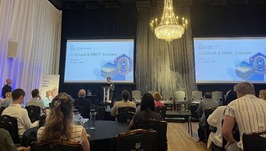
We focused on some of the difficult questions facing the digital health ecosystem: how we evaluate safety and effectiveness, where regulatory boundaries sit, AI-related risks, how we manage change over time, and how we build trust without slowing responsible innovation. The discussions were constructive, open and thought‑provoking, reflecting the complexity of this evolving space. They reinforced that safe, effective innovation depends on collaboration and shared responsibility across the digital health ecosystem.
We look forward to continuing this work – including through the DMHT Airlock, proactive industry engagement, international collaboration and regulatory mapping – and sharing further progress at future Connect events.
|
We are working with the British Standards Institution (BSI) to develop a new standard that will guide how clinical evidence is generated for DMHTs.
It covers factors such as: controls, sample characteristics, study safety, effectiveness and engagement end points, and follow up periods.
We encourage input from across digital health, research and patient communities before the consultation closes on 23:59 Monday 29 June 2026.
In January we published online learning resources to help professionals (health, social care and education) and the public make informed choices about digital tools for mental health support.
The resources were developed with NHS England’s MindEd Technology Enhanced Learning programme and include:
Please disseminate these resources amongst your networks to support our mission to ensure users of these technologies are aware of how they are regulated and how to reports concerns to the Yellow Card scheme.
We also hosted a webinar bringing together system partners to share learnings and answer questions related to the learning resources.
As MHRA Chair Professor Anthony Harnden explained: “This guidance supports better conversations between clinicians and patients and helps everyone ask the right questions about whether a tool is right for them.”
For those of you short on time, access the short animations which condense the resources into brief overviews of the content.
Zooming out, it’s important to place the work of the DMHT programme into the broader context of regulatory change that the MHRA is driving for AI medical devices. The National Commission into the Regulation of AI in Healthcare has brought together cross-ecosystem experts to advise the MHRA on the development of a new regulatory framework for AI in healthcare.
The National Commission is advising on how to develop a regulatory framework for this rapidly moving technology space that will be patient focused, risk-proportionate and fit-for-purpose, so that it can support rapid and responsible innovation across the product lifecycle. AI-driven DMHTs are a growing proportion of these products, and the National Commission is helping to set pace and direction for the regulatory approach in this space.
The National Commission has recently published research and engagement reports as well as call for evidence findings. The work brought together evidence from patients and the public, healthcare professionals, industry, academics and wider health system stakeholders through a diverse set of engagement opportunities, including insights from the MHRA’s AI Airlock programme.

Engagement remains a core part of the programme. These engagements help ensure our work remains grounded in real-world use and shaped by diverse perspectives. The team has been actively sharing insights and learning at national and international events, including:
Stay connected
You can find all programme outputs and resources on our DMHT project webpage.
Sign up for email updates and follow MHRA on LinkedIn to stay informed
|