|
 |
Climate newsletter |
|
|
Issue 123 | 14 October 2026 |
|
|
On 5 October, the Nature’s Changing Seasons in National Parks project shared findings on how nature’s rhythms are shifting due to climate change. A partnership between the Woodland Trust, National Parks and the Met Office, the pilot project is investigating how climate change is affecting the rhythms of nature across the New Forest and South Downs National Parks.
|
|
At the start of this month, we published our provisional figures on September weather. These indicate that the UK had its joint-fourth warmest September on record in a series which dates back to 1884, continuing the run of above-average months for mean temperature through much of 2026.
Met Office Climate Information Scientist Mike Kendon said: “While the month itself was unexceptional overall, when putting it into the context of the warm year we’ve had so far, this fits with the general pattern that we’re seeing of more frequent above average temperatures in the UK as our climate continues to change.”
|
|
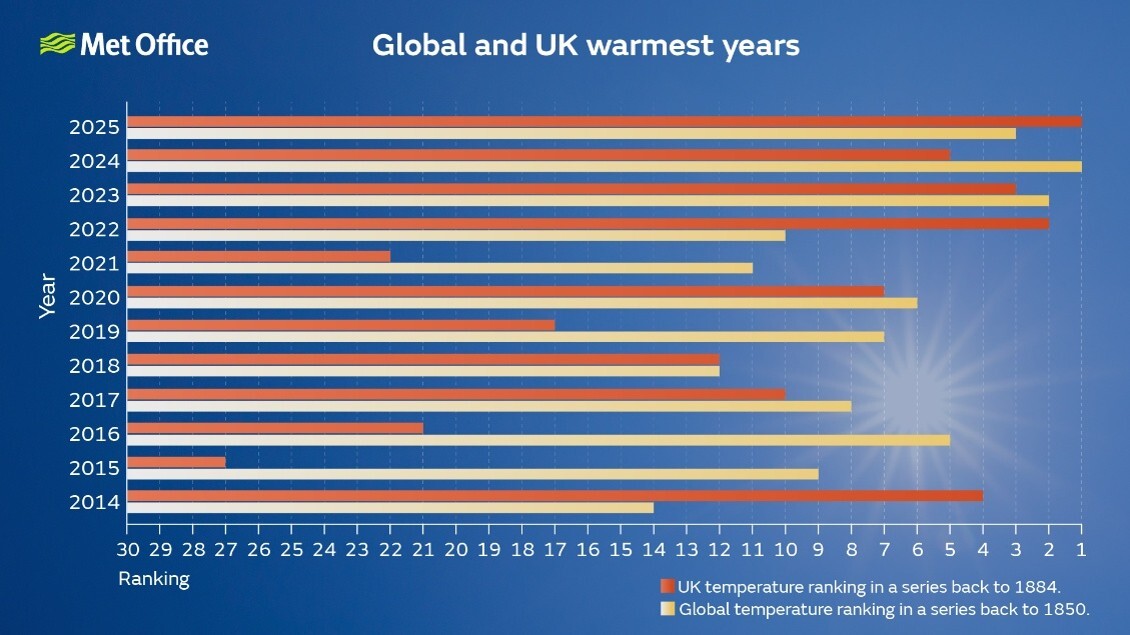
According to a paper published earlier this month, 2025 ranked as the third warmest year globally, but in the UK it moved to the top of the record. That contrast tells only part of the story: record ocean heat, declining sea ice, regional droughts and episodes of extreme rainfall all contributed to a year in which the warming climate was expressed in markedly different ways around the world.
Caroline Sandford, Senior Scientist at the Met Office, said: "What really stands out about 2025 is that, even without the influence of El Niño, global temperatures were almost as high as the record-breaking years of 2023 and 2024. We can see how the long-term warming trend is continuing to raise the baseline for what we expect in any given year.
|
|
|
An article published in The Conversation this month shares recent polling information that indicates that around 74% of people in the UK say they’ve directly experienced extreme heat, up from 46% before the summer of 2026. And 62% now say extreme heat is the most pressing climate impact, up from 36% in October 2024.
|
|
|
Providing you with evidence-based information on climate science.
Weather forecasting is a complex science, shaped by the chaotic nature of the atmosphere and the limitations of observations.
Ensemble forecasting is a cornerstone of modern weather prediction at the Met Office. By embracing uncertainty and using advanced modelling techniques, we provide forecasts that are not only more accurate but also more informative. Whether you are a forecaster, emergency planner or member of the public, ensemble forecasts help you make better decisions by revealing the range of possible outcomes and the confidence we have in our predictions.
|
|
|
On Thursday 22 October, 12-1pm, we'll be joined by Dylan Pritchard (Mott MacDonald) and Thomas White (Severn Trent) to explore how climate change can be considered within asset management decision-making.
The UKCP18 webinar will introduce approaches to assessing and quantifying climate impacts and demonstrate their application within the water sector, with lessons that may be relevant to a range of other sectors.
|
|
|
Our Climate Conversations series covers the latest research and real-world impacts of climate change. Topics have included record-breaking marine heatwaves, the future of UK sporting events and sustainable education. Stay tuned, as there are more episodes coming up. You can watch all previous episodes on our playlist and subscribe to our YouTube channel or Spotify to keep up to date.
|
|
|
Follow us on our social media channels to join the conversation. Look out for our hashtag - #GetClimateReady - on X (formerly Twitter), and follow our climate channels on TikTok and Instagram.
You might also be interested in our new Government and Industry Newsletters. Subscribe here.
|
|
|
To subscribe or unsubscribe please visit our email updates page to access your preferences.
The Met Office is not responsible for the content of external internet sites.
|
|
|
|