|
Issue 9 | 07 October 2026 |
|
|
Welcome to the autumn edition of the Met Office Industry Newsletter.
This summer has once again highlighted the growing importance of trusted weather and climate intelligence. Summer 2026 is provisionally the warmest UK summer on record, while scientists have confirmed that the developing El Niño in the Pacific has surpassed previous records and become the strongest event in the observational record. Together, these events demonstrate how weather and climate risks continue to evolve, creating new challenges and opportunities for organisations across industry.
As businesses look to improve resilience, support sustainability goals and make smarter operational decisions, access to reliable weather, climate and environmental intelligence is becoming increasingly important. From helping aviation explore ways to reduce its climate impact, to unlocking historical weather records that strengthen climate understanding around the world, innovation and data continue to create new possibilities.
In this edition, we explore how organisations are using weather and climate intelligence to improve efficiency, manage risk and build resilience for the future.
Steve Calder, Chief Customer Officer
|
|
The developing El Niño in the tropical Pacific has now exceeded all previous observed events, making it the strongest El Niño in the observational record.
Despite being centred thousands of miles from the UK, El Niño can influence weather patterns worldwide, affecting rainfall, temperatures, agriculture, energy demand and supply chains. As it approaches its winter peak, the likelihood of wetter, stormier conditions across north-west Europe, including the UK, increases during autumn and early winter. El Niño is only one of many influences on UK weather, but it may increase the chance of unsettled conditions in the coming months and is also associated with an increased risk of cold snaps later in the season.
Scientists are closely monitoring the event as it approaches its seasonal peak later this year.
Understanding large-scale climate drivers can help organisations make more informed decisions, strengthening planning, preparedness and resilience.
An average mean temperature of 16.5°C makes Summer 2026 provisionally the warmest UK summer on record.
The season has highlighted how climate extremes are becoming an increasingly important consideration for organisations across a wide range of sectors. Understanding how climate risks are changing can help inform resilience planning, operational decision-making and long-term investment strategies.
We are supporting Operation Blue Skies, the world's first large-scale oceanic airspace trial exploring how weather intelligence could help reduce aviation's climate impact.
Led by Google UK and supported by the UK Government, the £5 million programme will test whether small adjustments to aircraft altitude can help avoid atmospheric conditions associated with the formation of persistent contrails and their possible climate impacts. The trials will take place in the Shanwick Oceanic airspace over the North Atlantic during winters 2026/27 and 2027/28.
As part of the programme, Met Office scientists are developing a new global contrail impact forecasting capability, designed to identify atmospheric regions where persistent contrails are most likely to form. This will combine world-leading numerical weather prediction with aviation expertise to support operational decision-making and scientific evaluation throughout the trials.
The programme demonstrates how advanced weather intelligence can support innovation within aviation, helping the sector explore practical, evidence-based approaches to reducing environmental impact while maintaining safe and efficient operations.
|
|
|
By creating a consistent picture across the country and through time,
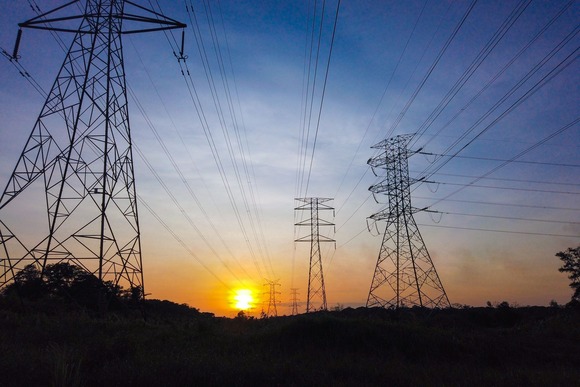
As the UK transitions to a low-carbon energy system, electricity networks are becoming increasingly important in connecting renewable energy and supporting growing demand.
The Met Office is working with SSEN Transmission, which operates the electricity transmission network across the north of Scotland, to demonstrate how high-resolution weather and climate data can improve the planning, design and operation of critical infrastructure.
Together, the organisations are applying advanced meteorological modelling to challenges including ice accretion (the buildup of ice on surfaces), asset corrosion and network capacity optimisation. Projects include a layered ice mapping model, high-resolution corrosion mapping and the innovative REVISE programme, which uses granular weather data to support smarter investment and operational decision-making.
The impact is already significant. The ice mapping tool alone is forecast to save around £125 million across SSEN Transmission's current portfolio, while supporting faster project delivery and reducing unnecessary modifications. The wider programme is helping improve resilience, unlock network capacity and support the UK's clean energy ambitions.

Released in cinemas on 09 September, PRESSURE tells the true story behind arguably the Met Office's most important forecast: the weather briefing that helped inform the timing of the D-Day landings. The film follows Group Captain James Stagg, the Met Office meteorologist responsible for coordinating British and American forecasting teams and presenting weather advice to Allied commanders ahead of one of history's most significant military operations.
Drawing on research from the Met Office Library and Archive, the film is a broadly accurate retelling of the scientific debates, forecasting challenges and operational pressures faced by meteorologists in June 1944. At its heart is the role that trusted weather intelligence played in identifying the narrow weather window that made the invasion possible.
While forecasting technology has transformed dramatically since then, the principles remain the same today. More than 80 years on, science, expertise and informed decision-making continue to underpin the Met Office's work, helping people make better decisions to stay safe and thrive in a radically changing world. The film serves as a powerful reminder of how weather intelligence can help organisations manage risk, strengthen resilience and make better decisions when the stakes are highest.
|
|
 TEXT FROM IMAGE:
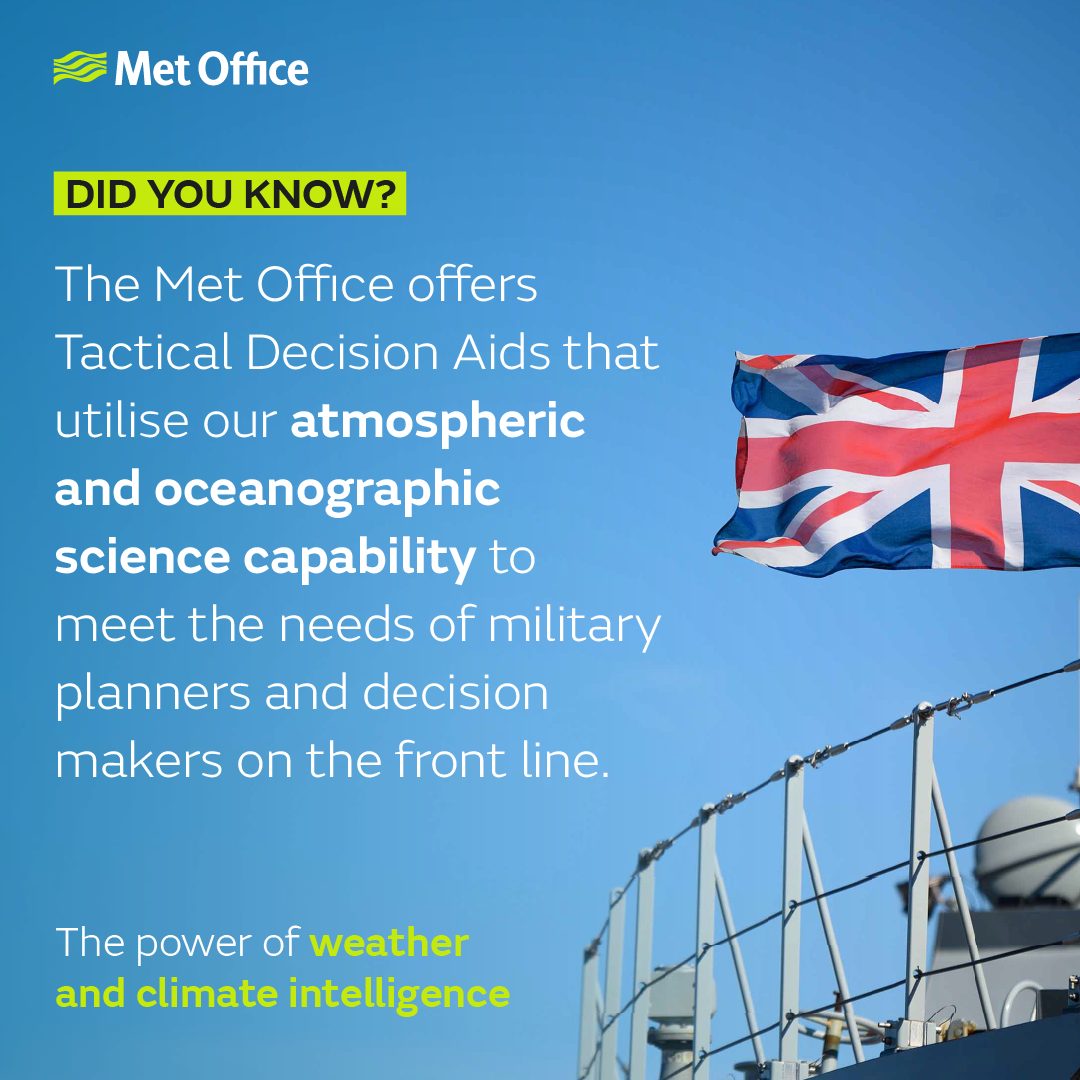
Did you know? The Met Office offers Tactical Decision Aids that utilise our atmospheric and oceanographic science capability to meet the needs of military planners and decision makers on the front line. The power of weather and climate intelligence.
|
|
Infographics and case studies |
|
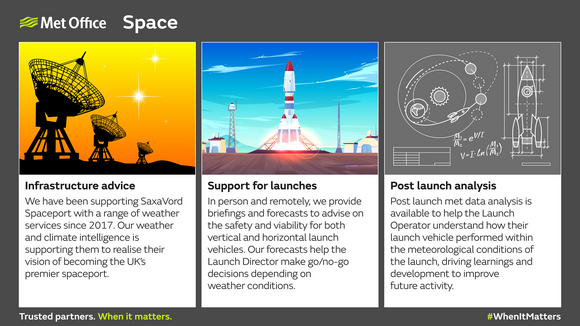
We have been supporting SaxaVord Spaceport with a range of weather services since 2017. Our weather and climate intelligence is supporting them to realise their vision of becoming the UK's premier spaceport.
In person and remotely, we provide briefings and forecasts to advise on the safety and viability for both vertical and horizontal launch vehicles. Our forecasts help the Launch Director make go/no-go decisions depending on weather conditions.
Post launch met data analysis is available to help the Launch Operator understand how their launch vehicle performed within the meteorological conditions of the launch, driving learnings and development to improve future activity.
|
|
New guidance from the Met Office and the Department for Transport is helping organisations better understand and prepare for the potential impacts of severe space weather on communications, navigation and other critical technologies. The guidance is available free through a Met Office space weather account and brings together specialist forecasting expertise with practical transport-sector knowledge.
Designed for operators across aviation, maritime, rail and road, the resource explains space weather terminology, outlines potential impacts and helps users interpret Met Office space weather alerts and warnings. It also includes real-world case studies from recent events and guidance to support operational decision-making and resilience planning.
Potential impacts include disruption to high-frequency communications, GNSS/GPS positioning errors and, in extreme circumstances, localised power outages. While severe events are rare, understanding the risks can help organisations take proportionate action when periods of heightened space weather activity occur.
As highlighted in the Government's UK space strategy, launched in September, space-based capabilities are playing an increasingly important role in supporting weather forecasting, climate monitoring and national resilience. Through its role as the UK's space weather forecasting centre, the Met Office continues to provide trusted intelligence that helps organisations understand, prepare for and respond to potential space weather impacts.
To mark World Space Week (4-10 October), a new Met Office blog highlights some of the most remarkable weather phenomena across our Solar System, from planet-wide dust storms on Mars to extreme winds on Neptune. The article also explains how the Met Office Space Weather Operations Centre (MOSWOC) monitors solar activity around the clock, helping organisations understand and prepare for potential impacts on critical infrastructure, satellite communications and other technologies here on Earth.
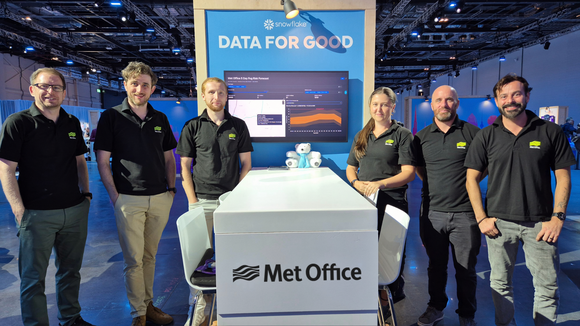
We recently attended the Snowflake World Tour in London, which provided us with the perfect opportunity to introduce our new weather data product.
Met Office Weather Insights transforms our trusted weather data into insights people and businesses can act on to make decisions with confidence.
Drawing on our world-leading science, operational expertise and national infrastructure, Weather Insights brings together forecast and observational data from multiple Met Office sources to provide flexible outputs aligned to the individual needs of users, so they can focus on the weather data that matters most to their organisation.
Met Office Weather Insights is available through Snowflake Marketplace.
Climate risks are becoming an increasingly important consideration for infrastructure owners and operators.
Join our October UK Climate Projections (UKCP) webinar on 22 October, 12-1pm, to hear experts from Mott MacDonald and Severn Trent discuss approaches to understanding and quantifying the impacts of climate change on assets.
The webinar follows the introduction of UK Climate Information (UKCI), a new national climate service being developed to support climate adaptation decision-making across the UK. Building on the foundations of UKCP, UKCI will provide broader and more usable climate information to help policymakers, industry and communities better understand climate risks and make informed adaptation decisions.
|
|
|
Follow us on the social media channels below to join the conversation.
#WhenItMatters
You might also be interested in our Climate Newsletter. Subscribe here.
|
|
|
To subscribe or unsubscribe please visit our email updates page to access your preferences.
Please note that you will need to use a government email address ending in gov.uk, gov.scot, gov.wales, sepa.org.uk, nhs.net, sch.uk, nationalhighways.co.uk or theccc.org.uk to sign up to the government newsletter.
The Met Office is not responsible for the content of external internet sites.
|
|
|
|
|