|
 |
Climate newsletter |
|
|
Issue 121 | 9 September 2026 |
|
|
On 1 September, we published the provisional statistics for summer 2026 in the UK, which had the warmest average mean temperature on record. The season’s mean temperature was made around 130 times more likely due to human-induced climate change.
Dr Amy Doherty, who leads the National Climate Information Centre at the Met Office said: “The conditions we’ve seen this summer have broken UK climate records once again. These records are now breaking with increasing frequency, reflecting the influence of human-induced climate change on the temperatures we’re experiencing in the UK.”
|
|
 Met Office climate scientists Dr Nick Dunstone and Dr Gillian Kay explain how climate modelling can provide context to this summer’s remarkable temperatures.
|
|
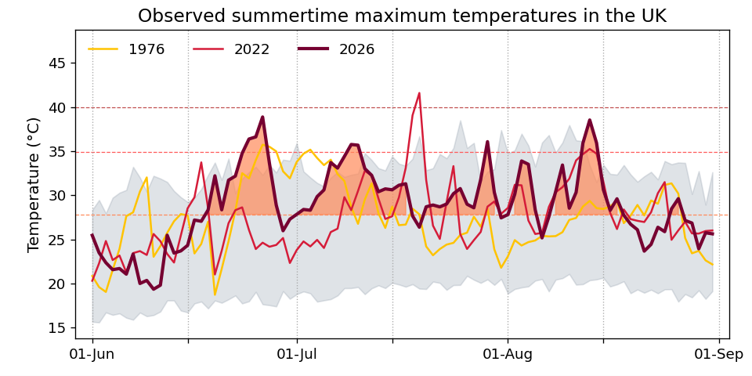
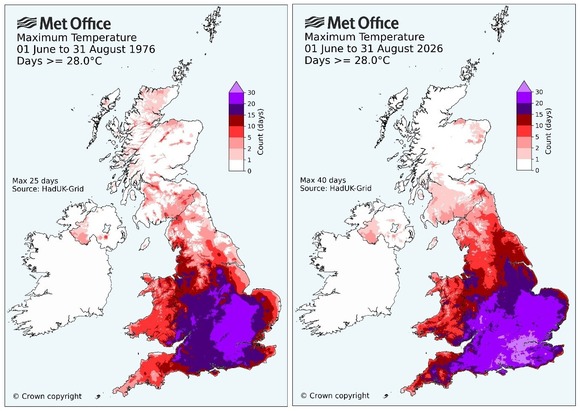 In our blog post, Professor Stephen Belcher, Met Office Chief Scientist, said: "For generations, 1976 has been remembered as the defining hot summer. Yet summer 2026 has shown how much the UK's climate has changed, setting new records for mean, maximum and minimum temperatures. Comparing these two remarkable summers, separated by 50 years, shows that while extremes have happened in the past, our warmer climate is making them even more extreme, increasing the risks and impacts associated with heatwaves."
|
|
|
Looking back at the last month of the summer, our regional breakdown indicates that August 2026 brought above-average temperatures to every region included in the data, although the size of the anomalies varied considerably.
|
|
|
The World Meteorological Organization (WMO) published a press release on 3 September explaining that “El Niño is firmly established and will intensify into a very strong event in the coming months”.
El Niño is a pattern of natural climate variability: it is not caused by climate change. However, El Niño will add a boost to the climate change impacts we are already experiencing.
“El Niño is being supersized before our eyes. The science leaves no room for doubt: the planet is in uncharted waters, and those waters are heating up. Sea surface temperatures are rising, temperatures keep climbing, and the world is in the danger zone of extreme weather. The race now is between rising risks and our commitment to take climate action and protect people. We must win that race,” said UN Secretary-General António Guterres.
|
|
|
In an article published in the Guardian on 27 August, experts consider the cause of the devastating floods in Nepal last month.
|
|
|
Using research from Ordnance Survey (OS), the Met Office and the data analysis company 4 Earth Intelligence, OS analysis has created a heat vulnerability index for all cities in Great Britain.
OS analysis finds that 83% of Britain's cities (59 cities) are already highly vulnerable to urban heat, with the remaining 17% (12 cities) classed as moderately vulnerable today. By 2040, rising summer temperatures are projected to push every city into the high vulnerability category, and by the turn of the century 63% (45 cities) are set to cross into severe heat vulnerability, the most serious level in the Index.
|
|
|
Our Climate Conversations series covers the latest research and real-world impacts of climate change. Topics have included record-breaking marine heatwaves, the future of UK sporting events and sustainable education. Stay tuned, as there are more episodes coming up. You can watch all previous episodes on our playlist and subscribe to our YouTube channel or Spotify to keep up to date.
|
|
|
Follow us on our social media channels to join the conversation. Look out for our hashtag - #GetClimateReady - on X (formerly Twitter), and follow our climate channels on TikTok and Instagram.
You might also be interested in our new Government and Industry Newsletters. Subscribe here.
|
|
|
To subscribe or unsubscribe please visit our email updates page to access your preferences.
The Met Office is not responsible for the content of external internet sites.
|
|
|
|