|
 |
Climate newsletter |
|
|
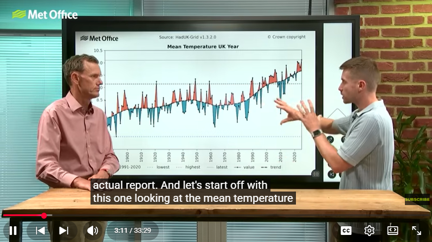
“What we used to think of as extreme, we increasingly consider as normal.” That is the summarising comment from Mike Kendon, the Met Office lead author of the latest edition of the State of the UK Climate report, which was published last week.
The report looks back at 2025, putting the year and decade into a historical context and telling us about the changes already seen in the UK’s climate. The key change is the ongoing rise in temperatures, with extremes particularly affected - the latest 10-year period (2016-2025) is 1.33°C warmer than the period from 1961-1990.
Key observations from 2025
-
2025 was the warmest year in the UK series from 1884, with the last four years in the top five warmest.
-
2025 included the UK’s warmest spring and summer on record, with the six months (March to August) all in the top ten warmest of their respective monthly series.
-
The number of days over 30°C and nights over 18°C has more than quadrupled for Greater London for the most recent decade, 2016–2025, compared to 1961–1990.
-
In spring 2025, most of England and Wales received less than half of the 1991-2020 average rainfall, and in some places less than one third. England had its driest spring for over 100 years.
-
The winter half-year (October to March) for the most recent decade, 2016–2025, has been 3% wetter than 1991–2020, and 13% wetter than 1961–1990, with little change for the summer half-year.
|
|
|
In the latest episode of Climate Conversations, Alex Burkhill speaks with State of the UK Climate report lead author Mike Kendon to discuss some of the key findings.
Our Climate Conversations series covers the latest research and real-world impacts of climate change. Topics have included record-breaking marine heatwaves, the future of UK sporting events and sustainable education. Stay tuned, as there are more episodes coming up. You can watch all previous episodes on our playlist and subscribe to our YouTube channel or Spotify to keep up to date.
|
|
|
A new study from the Met Office and the University of Reading has revealed that a prolonged heatwave in the North Sea played a significant role in intensifying the impacts of Storm Babet in October 2023.
The study provides the clearest evidence to date that marine heatwaves in the North Sea can act as amplifiers of UK storm hazards. Storm Babet was one of the UK’s most disruptive storms of that year bringing exceptional rainfall to parts of eastern Scotland with the Met Office issuing two red severe weather warnings for rain.
|
|
|
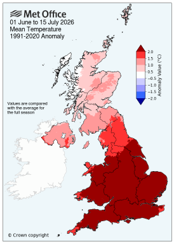
This map shows mean temperature compared with the average for the full season.
Last week, we published a blog post looking at the first half of the summer season. By 15 July, 2026 has already recorded more days above 30°C than the whole of 1976. It also became the first year on record to reach 35°C in May, June and July, while overnight temperatures have been running at record levels for this stage of the summer.
|
|
|
We were delighted to introduce UK Climate Information (UKCI) recently - our new major new programme that will shape how climate data is delivered, understood and used across the UK.
Building on more than three decades of world-leading science, UKCI will provide broader and more useable climate information for a wide range of users, including business, policy and decision makers.
At our kick-off webinar on 9 July, we explained how we’re developing UKCI, discussed the evolving climate science underpinning the service, and shared how users can engage with it.
|
|
|
Researchers from Imperial College London, the Met Office and the London School of Hygiene & Tropical Medicine shared findings last week on the estimated number of deaths from heat-related causes during the May and June heatwaves in England and Wales. They used historical mortality records and established peer-reviewed methods to model fatalities during both heat spikes.
|
|
|
Providing you with evidence-based information on climate science.
 Climate change refers to a large-scale, long-term shift in the planet's weather patterns and average temperatures. Since at least the mid-1800s, humans have contributed to the release of carbon dioxide and other greenhouse gases into the air. This causes global temperatures to rise, resulting in long-term changes to the climate.
|
|
|
Follow us on our social media channels to join the conversation. Look out for our hashtag - #GetClimateReady - on X (formerly Twitter), and follow our climate channels on TikTok and Instagram.
You might also be interested in our new Government and Industry Newsletters. Subscribe here.
|
|
|
To subscribe or unsubscribe please visit our email updates page to access your preferences.
The Met Office is not responsible for the content of external internet sites.
|
|
|
|