|
 |
Climate newsletter |
|
|
Yesterday marked 50 years since the first day of a heatwave with widespread 30 °C temperatures across the UK. 1976 saw a remarkable summer, which endures in the collective memory as notably hot and dry. This anniversary came as the Met Office issued a Red Extreme Heat National Severe Weather Warning – see more on that in ‘From the experts’ below.
Met Office scientists have highlighted how events similar to the 1976 heatwave could become significantly more intense in the future, with a plausible scenario showing UK temperatures reaching 45 °C by 2056.
To mark the anniversary, the Met Office has developed a plausible ‘2056 scenario’, based on around 2.5 °C of global warming, to show how a prolonged heat event similar to 1976 could evolve in the coming decades. It shows a prolonged heatwave lasting around two weeks, including nine consecutive days where temperatures exceed 40 °C somewhere in the UK.
Professor Ed Hawkins MBE, Professor of Climate Science at the University of Reading, said: “1976 was an extraordinary event, but it happened in a much cooler climate. As global temperatures rise, heatwaves like this are becoming more intense and more frequent.”
|
|
|
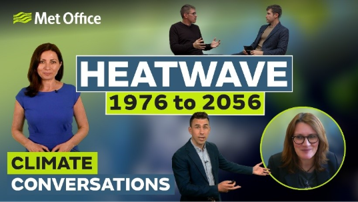
The latest episode of Climate Conversations combines what we know about the 1976 summer with our knowledge of our changing climate. This includes the look ahead to 2056 shared above. Our presenter Alex Burkill speaks to Met Office Science Manager Dr James Pope and Newcastle University’s Professor Hayley Fowler.
Our Climate Conversations series covers the latest research and real-world impacts of climate change. Topics have included record-breaking marine heatwaves, the future of UK sporting events and sustainable education. Stay tuned, as there are more episodes coming up. You can watch all previous episodes on our playlist and subscribe to our YouTube channel to keep up to date.
|
|
|
On Monday, the Foreign, Commonwealth and Development Office (FCDO) announced a new strategic partnership with the Met Office during London Climate Action Week. This collaboration brings together UK expertise in weather and climate science and global reach to help countries better predict and respond to extreme weather.
|
|
The Met Office is supporting LCAW by contributing scientific expertise across a range of events focused on climate resilience, adaptation and sustainable investment.
|
|
Key messages from the State of the Climate in Asia 2025 report included dangerous heat, devastating floods, severe drought and dust storms affecting millions, but it also noted that early warnings and coordinated action helped reduce disaster impacts.
Meanwhile, the State of the Climate in Africa 2025 report highlighted that Africa faces critical gap in early warning systems but is making progress. Extreme weather on the continent last year wreaked heavy economic and human cost, with floods the most common reported hazard.
|
|
On Monday, the Met Office issued a Red Extreme Heat Warning for Wednesday and Thursday, with June’s all-time daily record temperature forecast to be broken. Met Office Deputy Chief Forecaster Mark Sidaway, said: “Red warnings are reserved for the most severe events and we’re expecting severe and significant impacts from this heatwave, with health impacts likely for many, even beyond those who are normally more vulnerable to the heat.”
Professor Stephen Belcher CBE, Met Office Chief Scientist, said: “Human induced climate change has made events like this more likely and more intense. To see temperatures like this in the UK in June is sobering. Events like this bring home the implications of climate change, with very high temperatures and humidity bringing significant health implications from heat stress, as well as impacts to a range of sectors such as transport, energy and water supply.”
|
|
This week’s very high temperatures mean that our forecast maps show a great deal of dark oranges and reds. The scale for displaying temperatures in Met Office forecasts is static. We are often challenged that we – and others – are using different colours to be alarmist, but the same sliding scale is used no matter the time of year or region on screen.
You can find out more about the colour scale we use and why – including the importance of accessibility – on our website.
|
|
The Met Office is introducing UK Climate Information (UKCI) - a new national climate service which is being designed to support climate resilience and adaptation. To mark this, we are hosting a kick-off webinar on Thursday 9 July 2026.
UKCI will build on the legacy of UK Climate Projections (UKCP18), providing enhanced data, tools and engagement opportunities tailored to user needs across sectors. At the webinar attendees will gain insight into UKCI’s purpose, structure and development pathway. They will also hear from leading climate scientists on the underlying science and learn how climate information can be applied in real-world decision-making, as well as how they can contribute to and shape UKCI.
|
|
|
Follow us on our social media channels to join the conversation. Look out for our hashtag - #GetClimateReady - on X (formerly Twitter), and follow our climate channels on TikTok and Instagram.
You might also be interested in our new Government and Industry Newsletters. Subscribe here.
|
|
|
To subscribe or unsubscribe please visit our email updates page to access your preferences.
The Met Office is not responsible for the content of external internet sites.
|
|
|
|