|
 |
Climate newsletter |
|
|
|
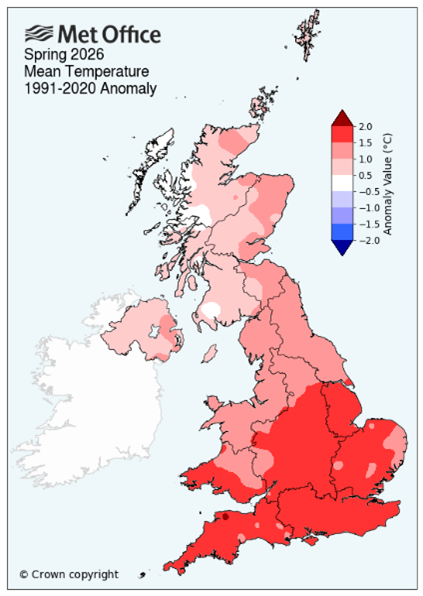
Our provisional statistics for the spring season, published last week, indicate that, for mean temperature, the season was the UK’s third warmest on record, and the warmest on record for England and Wales. All three months of meteorological spring - March, April and May - ranked within the UK’s top ten warmest since the series began in 1884, and the late-May heatwave saw six consecutive days above 30 °C in some areas, with both the spring and May maximum temperature station records exceeded by more than 2 °C, highlighting an exceptional end to the season.
|
|
|
At the end of May, we published the latest Global Annual to Decadal Update as the World Meteorological Organization’s designated Lead Centre for Annual to Decadal Predictions. The update looks at the earth's climate for the five-year period from 2026 to 2030, and indicated that the average temperature over the next five years is likely to exceed 1.5 °C.
Met Office Expert Scientist Dr Leon Hermanson is the lead author of the report. He said: “There is an El Niño predicted for the end of 2026, which increases the chances of the following year, 2027, being the next record-breaking year.”
|
|
|
As meteorological summer started last week, we took a look back at the remarkable summer of 1976, which endures in the collective memory as notably hot and dry.
Met Office Senior Climate Information Scientist, Mike Kendon, said: “The summer of 1976 is still talked about because of how unusual it was in both its intensity and duration. Fifty years on, it provides an important historical context for understanding how the UK’s climate can behave and how extreme weather can affect people, infrastructure and the environment.”
|
|
|
Providing you with evidence-based information on climate science.
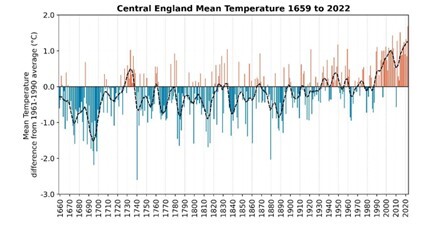
The Central England Temperature (CET) series is the longest-running instrumental temperature series in the world. By collating and combining early instrumental records, the series charts monthly temperature statistics from 1659. The series is representative of a region enclosed by Lancashire, London and Bristol.
The Met Office maintains the Central England Temperature series, and we have a process of continual review and improvement to ensure the dataset is robust. This can result in occasional updates to the series but we do this transparently by publishing our results.
|
|
|
Our next UK Climate Projections (UKCP18) webinar will be on Thursday 18 June. James Pope from the Met Office will speak about the Local Authority Climate Service. This is a tool providing local authorities with climate projections and information to help them understand climate risks and build resilience in their areas.
|
|
|
Our Climate Conversations series covers the latest research and real-world impacts of climate change. Topics have included record-breaking marine heatwaves, the future of UK sporting events and sustainable education. Stay tuned, as there are more episodes coming up. You can watch all previous episodes on our playlist and subscribe to our YouTube channel to keep up to date.
|
|
|
Follow us on our social media channels to join the conversation. Look out for our hashtag - #GetClimateReady - on X (formerly Twitter), and follow our climate channels on TikTok and Instagram.
You might also be interested in our new Government and Industry Newsletters. Subscribe here.
|
|
|
To subscribe or unsubscribe please visit our email updates page to access your preferences.
The Met Office is not responsible for the content of external internet sites.
|
|
|
|