|
 |
Climate newsletter |
|
|
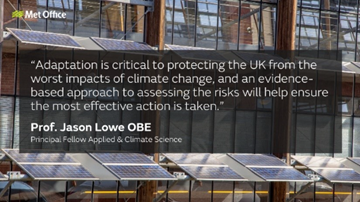
Last week, the Climate Change Committee (CCC) published the Fourth Climate Change Risk Assessment - Independent Assessment (CCRA4-IA) which consists of a Met Office-led Technical Report and a CCC-led Well-Adapted UK Report. The CCRA4-IA combines up-to-date evidence on the risks of climate change with advice on the actions UK governments can take to improve climate resilience.
"Global warming has accelerated since the Third Climate Change Risk Assessment Technical Report, which was published in 2021, and we are on the brink of seeing a rise of 1.5 °C above pre-industrial levels. We shall need to act now to adapt and build resilience to our current and future climate using the best available analysis and data," said Met Office Chief Scientist, Professor Stephen Belcher.
The Well-Adapted UK Report sets out a comprehensive package of solutions to address the growing impacts of climate change affecting every aspect of life in the UK, using findings from the Technical Report to provide a guide to setting targets and measuring progress in a complex area, for use by UK Governments and other organisations.
|
|
|
The Technical Report brings together the most up-to-date evidence on the range of risks facing the UK from climate change and the level of urgency required for additional policy to address them. Sections on infrastructure, built environment, economy and more, look in detail at the risks facing sectors such as transport and energy.
The landmark report brings together expertise from across academia, the public sector, the private sector and the third sector. The partnership model ensured that each chapter was developed by subject‑matter experts with deep domain knowledge, while benefiting from cross‑cutting input through science assurance, independent review, and ‘fresh eyes’ review groups.
|
|
Our Climate Conversations series covers the latest research and real-world impacts of climate change. Topics have included record-breaking marine heatwaves, the future of UK sporting events and sustainable education. Stay tuned, as there are more episodes coming up. You can watch all previous episodes on our playlist and subscribe to our YouTube channel to keep up to date.
|
|
|
Weather observations are critical to our understanding of weather and climate, and the Met Office has records going back to 1884. Consistency and standards are essential to ensuring accuracy for our weather forecasts and climate records, and in the articles and blogs below you can learn more about how we adhere to international standards.
You might also be interested in some previous articles from the World Meteorological Organization and University of Reading Climate Scientist Ed Hawkins.
|
|
|
Later this week, we will publishing the latest Global Annual to Decadal Update on behalf of the World Meteorological Organization. The update will look at the earth's climate for the five-year period from 2026 to 2030, including the chance of global temperature exceeding 1.5 °C above the 1850-1900 average.
|
|
|
Under the Horizon Europe ASPECT project, the University of Leeds are conducting research to test how people interpret certain prediction information. By completing this survey, you can help shape the provision of future climate information products and services. We welcome responses from people working in any sector who might find information about future temperature change useful in decision-making.
We also welcome responses to our climate information surveys for those working specifically in the Agricultural, Pension and Governance sectors.
|
|
|
Follow us on our social media channels to join the conversation. Look out for our hashtag - #GetClimateReady - on X (formerly Twitter), and follow our climate channels on TikTok and Instagram.
You might also be interested in our new Government and Industry Newsletters. Subscribe here.
|
|
|
To subscribe or unsubscribe please visit our email updates page to access your preferences.
The Met Office is not responsible for the content of external internet sites.
|
|
|
|