|
 |
Climate newsletter |
|
|
Issue 110 | 25 March 2026 |
|
On Monday - World Meteorological Day - the World Meteorological Organization (WMO) published their State of the Global Climate 2025 report, providing a comprehensive overview of key climate indicators, its impacts on health, food security, displacement and migration and this year, a special supplement on extreme weather.
“The State of the Global Climate is in a state of emergency. Planet Earth is being pushed beyond its limits. Every key climate indicator is flashing red,” said UN Secretary-General António Guterres.
“Humanity has just endured the eleven hottest years on record. When history repeats itself eleven times, it is no longer a coincidence. It is a call to act,” said Mr Guterres.
|
|
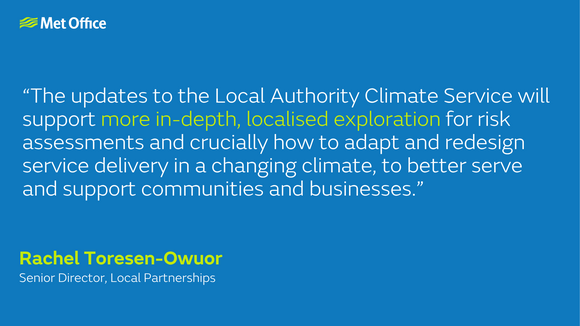
The Met Office LACS, supported by Defra, is designed to support decision-making and adaptation planning in Local Authorities, providing them with crucial information on climate change in their area. In response to user feedback, this month we have delivered several notable updates to the service.
• Higher resolution climate data
• Sub-local authority level information at different census geographies appropriate to each region
• UK-wide sea level rise information for non-coastal Local Authorities, providing information to those which depend on vital infrastructure at the coast
• New case studies demonstrating how Local Authorities have been using the LACS in adaptation planning.
|
|

Over the past year, the UK’s national weather and climate services have undergone one of the most significant technological shifts in their history. The first full year of operating a national-scale supercomputing system entirely in the cloud has now been completed, marking a major step forward in how critical forecasting and scientific modelling capabilities are delivered.
Charlie Ewen, Chief Data and Information Officer at the Met Office, said: “Rather than focusing on any single technology, whether that’s AI, cloud, or whatever the industry happens to be talking about, what matters is the broader combinational innovation that happens when infrastructure, data, skills, processes and governance all evolve together.
“At the Met Office, we work from pioneering research right through to critical operational services, so we’ve spent over a century converting research into practical, useful decision-making intelligence. That experience tells us that real progress comes from aligning whole systems, not chasing isolated breakthroughs. And that is very much the philosophy behind our partnership with Microsoft and the shift to supercomputing in the cloud.”
|
|
The current carbon dioxide concentration in the atmosphere is around 420 parts per million (ppm), roughly the same as two drops in a bathtub full of water. Even though there is a very low concentration, it can still have a large effect. A good analogy is to consider Chlorine in a swimming pool where just 3 parts per million is ideal, but 5 parts per million would be a hazard - if its powerful enough, tiny amounts can make a huge difference. We know that CO2 levels are now 50% higher than they were before the Industrial Revolution.
Plants also need carbon dioxide for photosynthesis, and many species can grow better when more CO2 is available. However, there are some limiting factors as the plants also need enough water and other nutrients as well as that CO2.The increased heat that climate change is bringing also impacts plants, affecting how well they can grow in certain areas.
|
|
|
Our Climate Conversations series covers the latest research and real-world impacts of climate change. Topics have included record-breaking marine heatwaves, the future of UK sporting events and sustainable education. Stay tuned, as there are more episodes coming up. You can watch all previous episodes on our playlist and subscribe to our YouTube channel to keep up to date.
|
|
Our next UK Climate Projections (UKCP18) webinar will be tomorrow, Thursday 26 March.
Duncan Ray from Forest Research will speak about using UKCP18 projections for climate matching and climate extremes in forest management.
|
|
|
Follow us on our social media channels to join the conversation. Look out for our hashtag - #GetClimateReady - on X (formerly Twitter), and follow our climate channels on TikTok and Instagram.
You might also be interested in our new Government and Industry Newsletters. Subscribe here.
|
|
|
To subscribe or unsubscribe please visit our email updates page to access your preferences.
The Met Office is not responsible for the content of external internet sites.
|
|
|
|