|
 |
Climate newsletter |
|
|
Issue 107 | 11 February 2026 |
|
|
This week, we launched our most significant scientific upgrade in more than three years, a major step forward for the UK’s weather and climate science capability. Met Office Director of Science, Professor Simon Vosper said: “This is the biggest positive step in our forecasting systems for many years. The improvements we’re introducing will make our forecasts more accurate, more useful and more reflective of real-world weather. It marks the beginning of a new era powered by our supercomputing investment and will deliver substantial benefits for the public, partners and sectors across the UK.”
The latest forecast from Met Office scientists indicates that the rate of atmospheric carbon dioxide (CO₂) increase this year will remain too fast to meet climate targets outlined for limiting global warming to 1.5 °C. Professor Richard Betts, who leads the production of the forecast, said: “…concentrations continuing to climb well above the trajectories required to cap global warming at 1.5 °C compared with the period 1850-1900.”
|
|
|
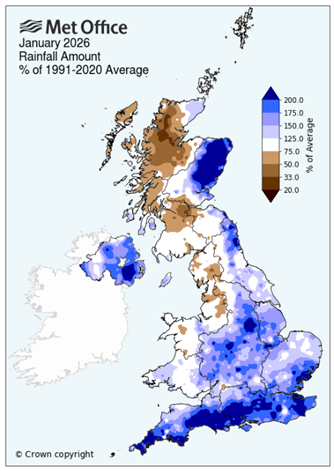
Provisional Met Office statistics show that Northern Ireland experienced its wettest January in 149 years – and second wettest on record – while southern England also recorded its sixth wettest January since the series began in 1836. The UK overall saw above-average rainfall, slightly below-average temperatures, and sunshine levels close to average for the month.
|
|
|
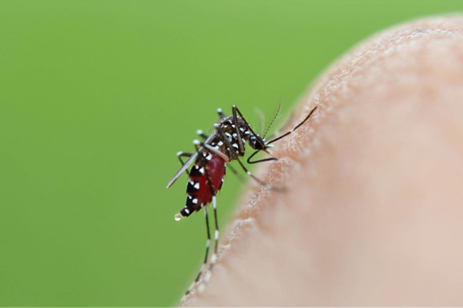
Newly-arriving pest species are a significant threat to UK agriculture, forestry and the wider environment. Dr Debbie Hemming is a Met Office scientist leading a team examining the interactions between climate and nature, including the climate responses of potential new plant pests to the UK. She said: “Many species are shifting their ranges into locations previously too cold. This includes pests that were previously unable to survive in the UK.” The UK Climate-Pest Risk web tool, developed by the Met Office scientists in collaboration with Defra’s plant health risk and horizon scanning team, helps pest risk experts to assess which species are likely to threaten the UK and develop effective management actions.
|
|
|
In a new blog post, we delve into some of the ways the Met Office is continuing to innovate in our commitment to providing trusted weather and climate services. Artificial intelligence (AI) and machine learning (ML) offer transformative potential across every stage of our work, from understanding the atmosphere to delivering actionable insights for government, businesses and the public.
|
|
|
At the end of January, Carbon Brief published a guest post from Dr Mark McCarthy, Met Office attribution science manager, looking back at 2025. This noted the fact that 2025 was the warmest years and sunniest on record.
|
|
|
A new study published last month presents the first detailed projections of how climate change may impact malaria transmission in Africa. The Met Office’s Dr Matt Palmer is a co-author of the study. He said: “Using 25 years of data and advanced climate models, the research finds that, in isolation, ecological changes will have a minimal overall effect on malaria risk by 2050 at the continental scale, though substantial regional shifts are expected.” Notably, warming is likely to increase malaria risk in southern and highland regions, while reducing it in the Sahel where temperatures may become too high for mosquito survival.
Our latest Climate Conversations looks at changes to UK rainfall with Met Office Chief Meteorologist, Dr Will Lang. Find out how the changing climate is altering rainfall patterns across the UK and what the expected impacts are.
Our Climate Conversations series covers the latest research and real-world impacts of climate change. Topics have included record-breaking marine heatwaves, the future of UK sporting events and sustainable education. Stay tuned, as there are more episodes coming up. You can watch all previous episodes on our playlist and subscribe to our YouTube channel to keep up to date.
|
|
|
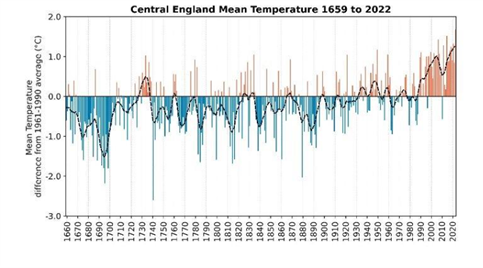
The Central England Temperature (CET) series is the longest running instrumental temperature series in the world, charting monthly temperature statistics from 1659 and representative of a region enclosed by Lancashire, London and Bristol. This forms part of our wider observational evidence for climate change.
|
|
|
The Knowledge Integration team at the Met Office is hiring a Senior Climate Science Communicator. The team, which focuses on understanding the climate information needs of stakeholders and delivering timely and useful information to inform decisions, is looking for someone with a strong background in science policy. The deadline is 23 February 2026. Find out more below and please share with your networks.
|
|
Our next UK Climate Projections (UKCP18) webinar will be on 19 February.
Jonny Casey, from Scottish climate charity Verture, will speak about making climate data accessible for communities, businesses and public bodies in Scotland. The talk may be of particular interest to those with an interest in providing climate data to a range of audiences.
|
|
|
Follow us on our social media channels to join the conversation. Look out for our hashtag - #GetClimateReady - on X (formerly Twitter), and follow our climate channels on TikTok and Instagram.
You might also be interested in our new Government and Industry Newsletters. Subscribe here.
|
|
|
To subscribe or unsubscribe please visit our email updates page to access your preferences.
The Met Office is not responsible for the content of external internet sites.
|
|
|
|