|
 |
Industry newsletter |
|
|
Issue 6 | 15 January 2026 |
|
|
Welcome to the first Met Office Industry Newsletter of 2026. As we look back at a record-breaking year for sunshine, we also look ahead to the opportunities and challenges the new year will bring. This edition highlights how our weather and climate intelligence is helping industry stay resilient, from powering the UK's clean energy transition to keeping roads safe and aviation moving.
Whether you're navigating winter conditions or planning for long-term climate resilience, discover how our partnerships, innovations, and trusted forecasts are supporting smarter decisions across energy, transport and beyond.
|
|
 |
|
The record-breaking sunshine in 2025 has seen benefits for Great Britain’s energy sector. Solar power provided over 6% of Britain’s annual energy needs so far this year - a 50% increase on recent years.
Weather is one of the most significant variables affecting both energy supply and demand. The Met Office provides a comprehensive range of forecasts and observation data to help energy companies understand how weather will impact their operations. |
|
|
 |
|
The transport sector faces challenges from a large variety of natural hazards including storms, flooding, and landslides, many of which will pose increasing pressures as the climate changes. The Department for Transport and the Met Office, together with other partners, have created a series of transport hazard summaries.
The new resource helps transport operators understand their specific risks and provides practical advice to help the transport sector to be more resilient to these hazards. Each summary addresses specific impacts across road, rail, aviation, and maritime transport sectors.
|
|
|
 |
|
Fifteen years ago, the eruption of the Eyjafjallajökull volcano on Iceland closed large amounts of airspace across Europe, disrupting flights and leading to widespread cancellations and delays.
The new Quantitative Volcanic Ash (QVA) forecasting provision launched in November 2025 and could halve the disruption and keep airspace open in the event of a similar eruption. QVA data will help airlines make more informed decisions to avoid higher concentrations of ash and minimise the airspace that needs to be closed in the event of a future eruption.
|
|
|
 |
|
Since the early 2000's, the Met Office has been providing embedded forecasters to National Highways following a major snow event that led to a unique partnership. Severe impacts from snow on the M11 in 2003 highlighted just how critical accurate, real-time weather information is.
The resulting partnership has continued through the creation of the National Traffic Operations Centre (NTOC) near Birmingham, where Met Office embedded forecasters provide specialist weather intelligence that directly influences how the country's motorways and major A-roads are managed.
|
|
|
 |
|
From severe weather that disrupts global air traffic to volcanic ash clouds that can ground entire fleets, meteorological data has never been more critical in keeping passengers and crew safe and supporting a sustainable long-term future for the industry.
To help the sector tackle these challenges, the Met Office offers regulated services to the aviation industry. As one of only two World Area Forecast Centres globally, we shoulder responsibilities that extend far beyond our shores.
|
|
|
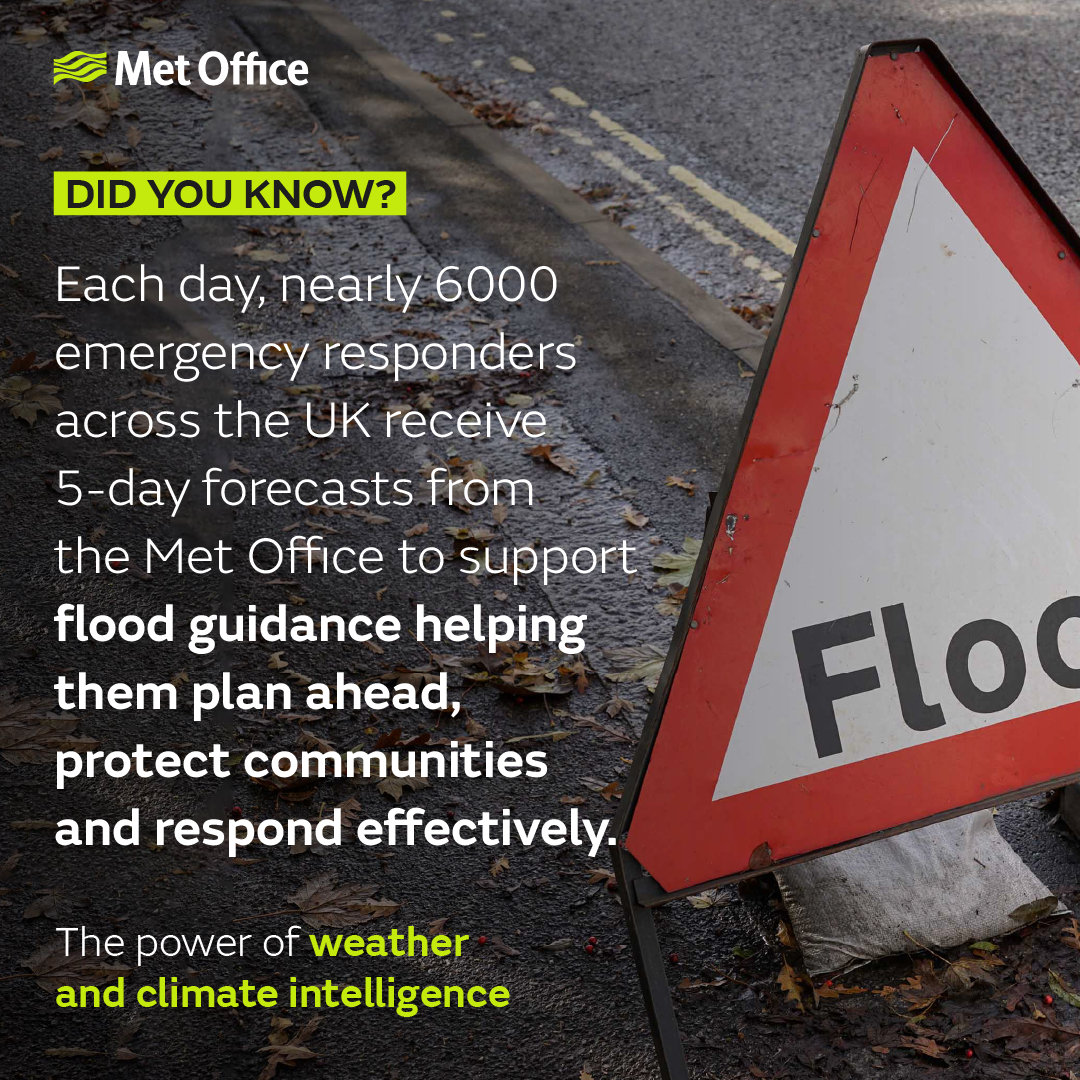 Did you know? Each day, nearly 6000 emergency responders across the UK receive 5-day forecasts from the Met Office to support flood guidance helping them plan ahead, protect communities and respond effectively.
Find out more about the flood guidance we provide:
|
|
Infographics and case studies |
|
|
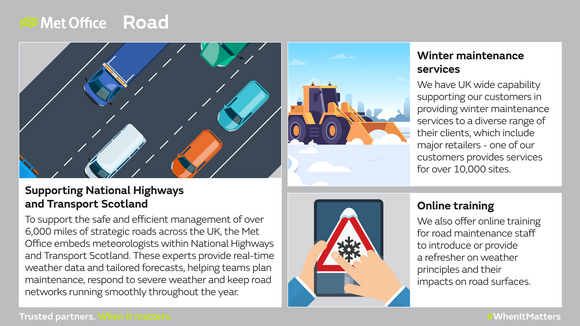
Text on image:
Supporting National Highways and Transport Scotland
To support the safe and efficient management of over 6,000 miles of strategic roads across the UK, the Met Office embeds meteorologists within National Highways and Transport Scotland. These experts provide real-time weather data and tailored forecasts, helping teams plan maintenance, respond to severe weather and keep road networks running smoothly throughout the year.
Winter maintenance services
We have UK wide capability supporting our customers in providing winter maintenance services to a diverse range of their clients, which include major retailers – one of our customers provides services for over 10,000 sites.
Online training
We also offer online training for road maintenance staff to introduce or provide a refresher on weather principles and their impacts on road surfaces.
|
|
|
In our latest case study, we explore how the company Met-Set utilises advanced Met Office forecasts to help energy companies anticipate weather-driven changes in supply and demand. Their daily, accurate insights support better planning, risk management, and trading decisions in the shift toward renewable energy.
Learn more how Met Office data supports balancing supply and demand:
|
|
|
As the UK works towards clean power by 2030 and with renewable energy increasingly powering our nation, accurate and trusted data has a crucial role to play. Collaboration between experts in forecasting and energy infrastructure will become increasingly vital, offering insight to mitigate risks and maintain network resilience during the energy transition.
The National Energy System Operator has signed a Memorandum of Understanding (MoU) with the Met Office, reaffirming their shared commitment to a clean, affordable, and secure energy future for Great Britain.
 |
|
Following the recent announcement of our new partnership, Clare Nasir hears how Met Office weather and climate expertise will help shape our future energy provision in our latest Climate Conversations episode: |
|
|
 |
|
The Met Office is pleased to introduce the new Met Office Aeronautical Visualisation Service (MAVIS®) - our new integrated, future-proofed aviation weather platform.
MAVIS is rolled out in stages to ensure continuity of service, which is critical when weather data directly impacts aviation safety. If you are currently a Met Office HeliBrief, ABS (Aviation Briefing Service), NWR (Network Weather Resilience) or OpenRunway user, we encourage you to explore MAVIS, share your feedback, and help us prioritise future enhancements. Legacy services will remain available until the end of March 2026 to support your operational needs during this transition.
|
Your feedback helps us make MAVIS better for everyone. If you’d like to share your experience via a quick chat and help shape future improvements, please complete the form:
|
|
|
The Met Office is seeking expertise from the finance sector to support the development of data requirements, training and user support related to assessing and managing physical climate risks. We would greatly value input to help shape the development of initial concepts developed from early insights. Our goal is to ensure any solutions make climate data as usable and decision-ready as possible, support the sector in assessing physical climate risks to both financial and business operations, and improve climate literacy and capabilities across the sector.
If you:
- work in the finance sector (particularly for a pensions company or building society),
- work with climate information as part of your role, or are wanting to enhance climate literacy within your organisation,
- you or a colleague are available for a one-hour informal conversation this month,
please contact us via email as soon as possible.
|
|
|
Follow us on the social media channels below to join the conversation.
#WhenItMatters
You might also be interested in our Climate Newsletter. Subscribe here.
|
|
|
To subscribe or unsubscribe please visit our email updates page to access your preferences.
You might also be interested in our Climate Newsletter. Subscribe here.
The Met Office is not responsible for the content of external internet sites.
|
|
|
|
|