|
On 5 December, the World Meteorological Organization (WMO) published their latest state of the climate report which indicates that 2011-2020 was the warmest decade on record. The Decadal State of the Climate 2011-2020 provides a longer-term perspective and transcends year-to-year variability in our climate, complimenting the WMO’s annual State of the Global Climate report.
On 3 December, the World Meteorological Organization (WMO) and the United Nations Office for Disaster Risk Reduction (UNDRR) published a report that found that Africa has doubled the quality of early warning systems coverage, but still falls below the global average. Less than half of the Least Developed Countries and only 40% of small island developing States have a multi-hazard early warning system. In the Arab States, risk knowledge to underpin early warning systems was found to be particularly low.
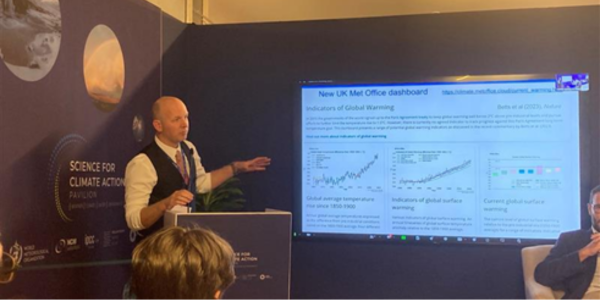
On 1 December, a team of Met Office scientists published a proposed solution to defining the current level of global warming relevant to the Paris Agreement. Lead author Professor Richard Betts said, “Today we are recommending an indicator combining the last ten years of global temperature observations with an estimate of the projection or forecast for the next ten years. If adopted this could mean a universally-agreed measure of global warming that could trigger immediate action to avoid further rises.”
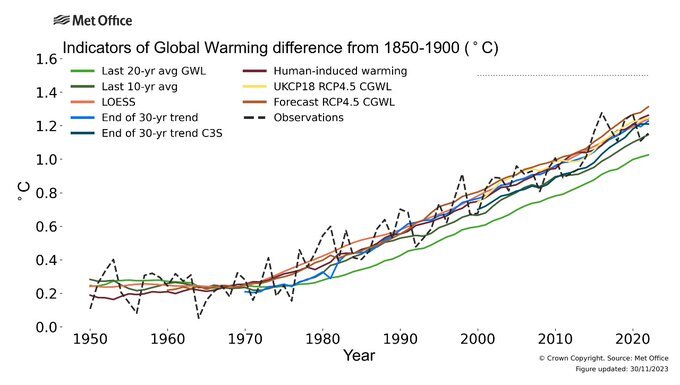 To complement the newly proposed indicators, a new section has been added to the Met Office Climate Dashboard to illustrate the current level of global warming. The ‘Indicators of Global Warming’ dashboard displays eight separate indicators as well as observed global mean temperature using Met Office HadCRUT5 data.
In our climate podcast, host Dr Doug McNeall talks to Climate Scientist Dr Matt Palmer, the architect of the new indicators of global warming dashboard, which displays eight separate global warming indicators providing real time insights on the status of our efforts to keep warming below 1.5 °C. They discuss the science behind the 1.5 °C temperature target and the challenges to limit warming to 1.5 °C to avoid the worst impacts of climate change.
On 1 December, the UK Prime Minister announced £1.6 billion in UK funding for climate projects. Ahead of COP28, Rishi Sunak said, “The world made ambitious pledges at previous COP summits to limit global warming to 1.5 degrees. But the time for pledges is now over – this is the era for action.”
On 30 November, the World Meteorological Organization (WMO) published their provisional State of the Global Climate report, which indicated that 2023 is set to be the warmest year on record. “Greenhouse gas levels are record high. Global temperatures are record high. Sea level rise is record high. Antarctic sea ice is record low. It’s a deafening cacophony of broken records,” said WMO Secretary-General Prof. Petteri Taalas.
A new report has been published today on climate tipping points. Earlier this year, we explored this topic considering what is meant by climate tipping points and what these mean for the UK. We also hosted a webinar during which we were joined by the World Meteorological Organization (WMO), Exeter University and Climate Sense.
|