|
 |
Climate newsletter |
|
|
Issue 58 | 22 November 2023 |
|
Spotlight on 'emissions trends and drivers' |
|
|
On 15 November, the World Meteorological Organization (WMO) published their latest Greenhouse Gas Bulletin which indicated that greenhouse gas concentrations had once again hit a record high. Global averaged concentrations of carbon dioxide (CO2), the most important greenhouse gas, in 2022 were 50% above the pre-industrial era for the first time.
WMO Secretary-General Prof. Petteri Taalas said, “The current level of greenhouse gas concentrations puts us on the pathway of an increase in temperatures well above the Paris Agreement targets by the end of this century.”
On 20 November, the UN Environment Programme (UNEP) published their latest Emissions Gap Report: ‘Broken Record – Temperatures hit new highs, yet world fails to cut emissions (again)’. The report is the 14th edition in a series that brings together many of the world’s top climate scientists to look at future trends in greenhouse gas emissions and provide potential solutions to the challenge of global warming.
“There is no person or economy left on the planet untouched by climate change, so we need to stop setting unwanted records on greenhouse gas emissions, global temperature highs and extreme weather,” said Inger Andersen, Executive Director of UNEP.
|
|
Developed countries have an obligation to provide detailed annual summaries of their emissions of the principal greenhouse gases. This official reporting process uses a bottom-up approach based on counting different emission activities (e.g., cars, trains, cows, landfill sites, industrial process etc.), multiplying them by the emissions per activity (e.g., number of cows multiplied by emissions per cow) and summing these numbers per gas to arrive at a country total.
The UK was the first country, in 2003, to independently compare their bottom-up emissions data with top-down methods. These use precise, high frequency, atmospheric measurements of the concentrations of each greenhouse gas combined with a computer model to represent the transport of the gas from source to measurement point.
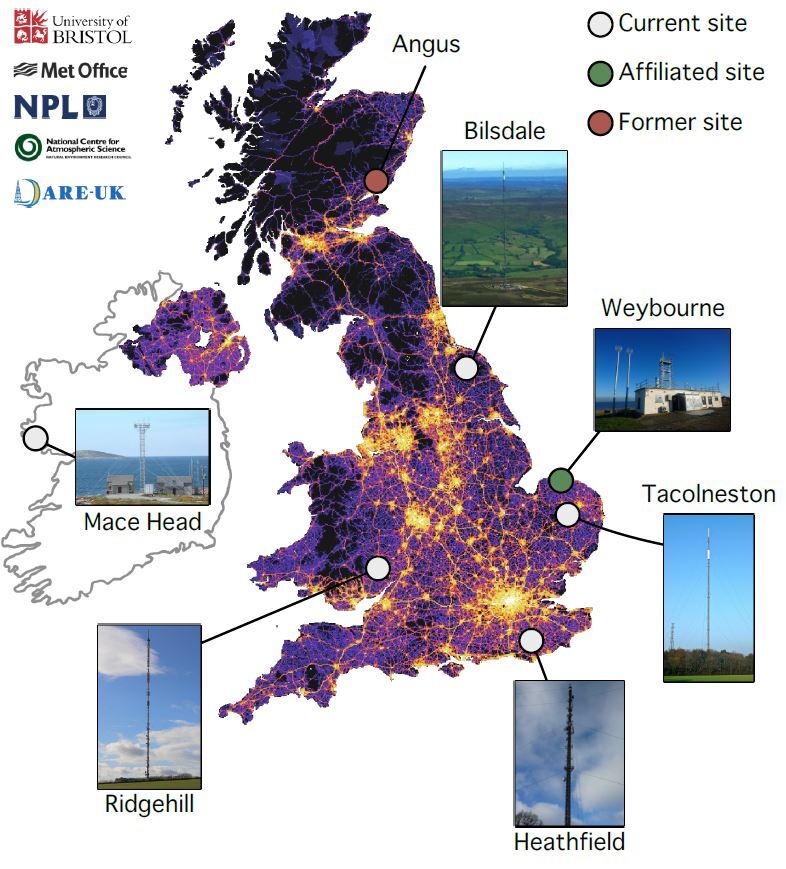 UK GHG tower observation network. The UK map shows the reported CO2 emissions from one year as an example. Brighter colours indicates larger emissions.
|
|
|
Carbon budgets? Emissions scenarios? Degrees of warming? What does it all mean? In this blog post, we provide an explanation of the differences between these tools and how they are used.
Devon County Council (DCC) has a plan to reduce its own emissions, while the Devon Carbon Plan acts as “Devon’s roadmap to net-zero by 2050 at the latest” to tackle emissions countywide. In a guest blog post, DCC explore how Local Authorities can take action to reduce emissions in their area, and how the Devon Carbon Plan is doing this.
Join us on Thursday 30 November, at 4pm for a Spaces live conversation on X (formerly known as Twitter) on this topic - Met Office meteorologist and presenter Alex Deakin will be speaking with colleagues and guests. Follow @metoffice to listen to their conversation which will also be available on-demand following the event.
|
|
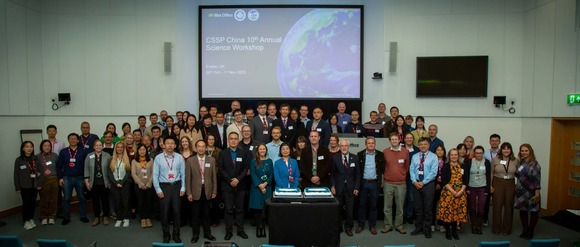
Launched in 2014, the Climate Science for Service Partnership (CSSP) China is a vibrant collaborative climate science and services initiative between research institutes in the UK and China. The project has delivered world-leading climate science research for services to support climate resilient economic development and social welfare around the world.
To mark 10 years of collaboration, a recent Annual Science Workshop was held with delegates across the partnership attending in person for the first time in 3 years. This comes after the release of the project’s special issue was published in the scientific Journal Advances in Atmospheric Science (AAS), highlighting the internationally collaborative research from the project with 13 papers on key research areas.
|
|
|
Earlier this month, the Met Office published information relating to global temperature trends. Every month of 2023 has so far has exceeded 1.2 °C above pre-industrial times, according to the HadCRUT dataset. Colin Morice is a Met Office Climate Monitoring and Research Scientist. He said: “Human influence continues to be the dominant driver of increasing global temperatures. 2023 has been further influenced by the onset of El Niño in the tropical Pacific and has seen notably warm temperatures over land and sea. 2023 is on track to be the warmest year on record if the current conditions continue to the end of the year.”
|
|
This week, Countryside COP brings together the rural community and businesses to set out the challenges and vision for farming and the countryside. Discussions are focused on how the industry can tackle climate change, improve sustainability and demonstrate its contribution to a resilient net zero economy.
The Met Office has been working with ADAS on improving climate resilience within the sector.
The final webinar the Met Office is participating in at COP3 takes place tomorrow and there is still time to register. ‘Supporting a resilient agri-food sector: What are the big questions decision makers face?’ takes place online from 3-4pm on Thursday 23 November.
From 30 November – 12 December, the UN Climate Summit, COP28, will take place in Dubai, UAE. Negotiations will take place between world leaders on the steps needed to tackle our changing climate. In his welcome address, COP28 President-Designate, H.E. Dr. Sultan Ahmed Al Jaber, said, “At COP21 in 2015, the world agreed to limit global warming to 1.5°C compared to pre-industrial levels by 2050. To remain on target, science tells us that emissions must be halved by 2030. We only have another seven years to meet that goal. COP28 UAE is a prime opportunity to rethink, reboot, and refocus the climate agenda.”
As well as the central negotiations, events take place throughout the two-week period, bringing together scientists and experts to discuss climate science and action. Met Office scientists will be involved in a number of events, details of which will be shared on X (formerly Twitter) via the @metoffice_sci account. Follow us to keep up to date.
|
|
|
Follow us on the social media channels below to join the conversation.
#GetClimateReady
You might also be interested in our new Government and Industry Newsletter. Subscribe here.
|
|
|
To subscribe or unsubscribe please visit our email updates page to access your preferences.
The Met Office is not responsible for the content of external internet sites.
|
|
|
|
|