|
 |
Climate newsletter |
|
|
Spotlight on 'Loss and Damage' |
|
|
This month we have been exploring the topic of Loss & Damage, which will once again be high on the agenda for Governments around the world as the next UN climate summit, COP28, approaches later in the year.
Losses and damages refer to the harm caused by climate change. Adverse impacts of extreme weather events and long-term climate changes create losses of human lives, land and loss of species. Damages from these events will affect, for example, livelihoods, infrastructure and ecosystems.
Loss and Damage refers to the political debate under the United Nations Framework Convention on Climate Change (UNFCCC) to address these adverse impacts.
In our series of blog posts, we have delved into this topic.
What is meant by Loss and Damage?
Learn more about why this topic is important and what the terminology refers to.
The science of linking climate change to extreme weather events
Climate attribution science plays a part in the evidence base needed in the complex area of Loss and Damage, and in this blog post the Met Office’s Dr Fraser Lott – a Climate Monitoring and Attribution Scientist – explains how attribution works and the challenges it presents.
|
|
How does climate attribution science relate to Loss and Damage?
In this blog post we explore the importance of climate monitoring and attribution science in the debates around Loss and Damage.
|
|
Talking Loss and Damage
Join us tomorrow, Thursday 29 June, at 4.30pm for a Twitter Spaces live conversation on this topic. Met Office meteorologist and presenter Alex Deakin will be speaking with colleagues and guests about Loss and Damage and how climate science can contribute to the debate. Follow @metoffice to listen to their conversation which will also be available on-demand following the event.
|
|
UK will have its hottest June on record
June 2023 is on track to be the hottest June on record in a series which goes back to 1884.
While the forecast for the next few days shows an unsettled picture with temperatures closer to average, this won’t be enough to prevent June 2023 being provisionally the UK’s hottest June on record, beating the previous record set in 1940, as well as June 1976 (part of the well-known summer of 1976), which is currently the second warmest June on record.
The Met Office’s Mike Kendon said: “With only a few days of near-average temperatures forecast for the remainder of the month, overall this June will turn out to be provisionally the hottest June on record for the UK for both mean and average maximum temperature."
WMO State of the Climate in Europe in 2022 report
On 19 June, the World Meteorological Organization (WMO) published their latest State of the Climate in Europe report, produced jointly with the European Union’s Copernicus Climate Change Service.
The report shows how Europe has been warming twice as much as the global average since the 1980s, with far-reaching impacts on the region’s socio-economic fabric and ecosystems. In 2022, Europe was approximately 2.3 °C above the pre-industrial (1850-1900) average used as a baseline for the Paris Agreement on climate change. But, for the first time, renewable energy generated more electricity than polluting fossil gas last year.
Tracking breaches of the 1.5 °C global warming threshold
On 15 June, the European Union's Copernicus Climate Change Service announced that their data records indicated that the global-mean temperature breached 1.5 °C in the first week of June. It should be noted that the 1.5 °C and 2 °C limits set in the Paris Agreement are targets for the average temperature of the planet over the twenty or thirty-year periods typically used to define climate.
The director of the Met Office Hadley Centre, Professor Albert Klein Tank, said: "It is vital to understand that a single exceedance does not imply a breach of the Paris Agreement as this will need to be a long-term average. However, the more times we temporarily exceed 1.5 °C the greater the chance of a permanent exceedance."
Sea surface temperature records
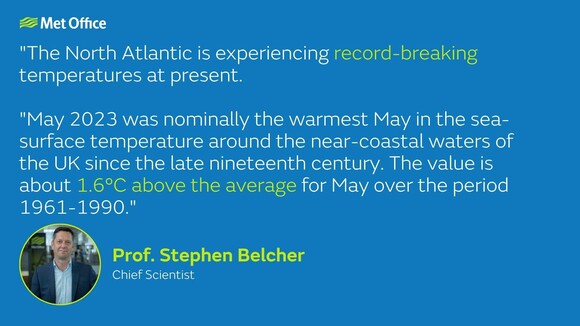
 According to a Met Office-complied dataset, the global sea surface temperatures for both April and May were the highest on record for those calendar months in a series stretching back to 1850. In our recent blog post, we examine why this might be happening and whether there is any implication for weather forecasts.
We also reported specifically on record-breaking sea-surface temperatures in the North Atlantic, including around the UK.
|
|
Exceptionally low Antarctic sea ice extent
Earlier this month, we published our latest briefing on Arctic and Antarctic sea ice. This indicated that Arctic sea ice extent is well below average for the time of year, whilst Antarctic sea ice extent is exceptionally low, following a second record low in as many years in Feb 2023.
Dr Ed Blockley is the lead of the Polar Climate Group at the Met Office. He said: “Over recent decades we have seen a sustained loss in Arctic sea ice extent in every month of the year, but especially in late summer to early autumn. Although the current Arctic sea ice extent is considerably higher than the record low for the time of year, it is still well below the long-term average. Antarctic sea ice has been at very low levels since November 2016. This year we have seen Antarctic sea ice shrink to a record low-point for the time of year, following a second successive annual record minimum sea ice extent in February.”
Co-benefits of the climate action imperative – written summary
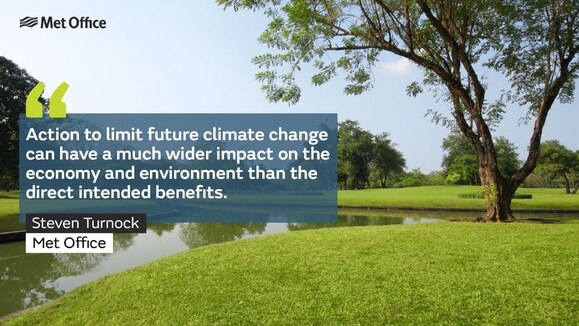 A written summary of our recent webinar on the co-benefits of climate change action is now available.
Alongside the University of Leeds, Ricardo Energy & Environment/the UK Department for Energy Security and Net Zero, and Belfast City Council, we discussed the co-benefits of climate action including those on health and wellbeing. In addition to science and policy perspectives, we also heard about how co-benefits are already being realised in some communities.
|
|
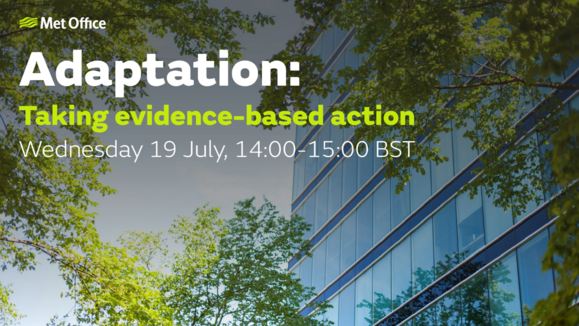
Adaptation: taking evidence-based action
The earth has already warmed by approximately 1.1°C compared to pre-industrial times, and we are already seeing impacts from this in all parts of the world. Even if all emissions stopped today, we cannot avoid further impacts. For example, sea level rise takes many years to respond to increasing global temperatures and we will therefore see our seas rise for many years to come.
Adaptation is therefore critical for our resilience to climate change. In this webinar on Wednesday 19 July from 14:00-15:00 BST, we will explore the importance of taking an evidence-based approach to adaptation.
Further details will be available shortly, but you can register now.
Climate Data Portal improves accessibility to UK climate data
Our country's climate is set to change over the coming years, with warmer winters and drier summers becoming increasingly likely. Organisations and businesses need to adapt to ensure business continuity and to minimise, or even take advantage of, these changes.
The Met Office's Climate Data Portal is publicly launching over the next two weeks, with a view to helping improve access to UKCP 18 climate data for organisations looking to understand the impact of climate change on their operations. Having run in Beta for the last 12 months, the Climate Data Portal will deliver geospatial climate data in easily accessible formats that will allow users to view and combine climate projections with their own organisations data. Keep an eye on upcoming newsletters to find out more about the platform and its imminent launch.
To find out more, or to sign up to use the portal, you can follow the link below.
|
|
|
Follow us on the social media channels below to join the conversation.
#GetClimateReady
|
|
|
To subscribe or unsubscribe please visit our email updates page to access your preferences.
The Met Office is not responsible for the content of external internet sites.
|
|
|
|
|