|
 |
Climate newsletter |
|
|
Spotlight on 'co-benefits' |
|
|
There are two strands of response to climate change - mitigation and adaptation. We know that we need to mitigate by reducing emissions to avoid the very worst potential impacts of climate change, but we also need to adapt to the impacts from the climate change we’re already seeing and committed to in the future. In some cases, actions can cover both responses, but taking action can also have additional benefits.
Climate action can also positively benefit people’s health, the economy, our delicate ecosystem or even our society and culture. These ‘win-win’ actions are known as co-benefits and they are scalable from small individual decisions, all the way to major infrastructure projects.
Climate action for greatest impact
In our new webpage, we look at some of the more significant actions that can be taken in people’s lives to help ensure a safer future for our planet. These sometimes come with an initial cost, but also have co-benefits such as reducing air pollution and saving money in the longer term. Our everyday actions webpage, meanwhile, considers cheaper (or even no-cost) options to reduce impact on the climate.
|
|
Co-benefits of trees and woodland
Mankind has used trees for millennia. But now humanity is using trees in a new way as tools to combat climate change. In an interview with the Woodland Trust’s Chris Nichols, we explore the vast array of co-benefits that we get from trees and woodland when using them to mitigate or adapt to climate change.
Co-benefits tool
At COP27 last year, the University of Leeds launched a new online co-benefits tool designed to raise awareness of co-benefits as well as trade-offs of taking climate action for policymakers, academics and industry. Developed by researchers at the University of Leeds and the Met Office, it synthesises the latest scientific evidence on the broader effects of climate change initiatives, enabling decision makers to explain how climate change action can not only help with reducing the physical impacts from global warming but can help achieve wider benefits such as improving air quality, health and wellbeing and boosting employment.
Talking co-benefits
To hear more about this topic, join us for a Twitter Spaces live conversation on 31 May 2023 at 4pm. Met Office meteorologist and presenter Alex Deakin will be speaking with colleagues and guests about their knowledge of this subject. Follow @metoffice to listen to their conversation which will also be available on-demand following the event.
TODAY - webinar - Co-benefits of the climate action imperative
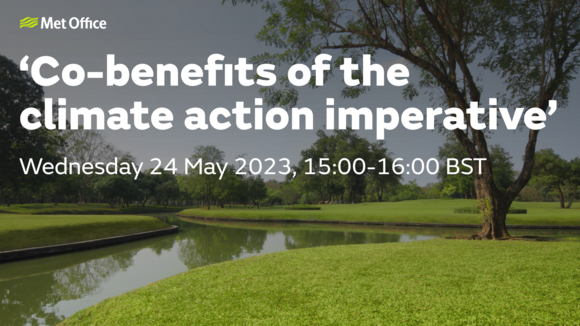 This afternoon from 15:00-16:00 BST, we will be hosting a webinar on the co-benefits of climate change action and there is still time to register. We will discuss the co-benefits of climate action such as those on health and wellbeing. We will consider the cost benefit of taking action as well as the fact that many co-benefits will be realised more quickly than the impact on our changing climate. In addition to science and policy perspectives, we will also hear about how co-benefits are already being realised in some communities.
We will be joined by speakers from the University of Leeds, the UK Department for Energy Security and Net Zero, and Belfast City Council.
|
|
New global temperature records on the horizon
According to a new report from the World Meteorological Organization (WMO), there is a 98% chance that one of next five years will be the warmest year on record for the globe. The Global Annual to Decadal Climate Update produced by the Met Office for the WMO and published last week, also cites there is a two-in-three chance that global average temperature in at least one of the next five years (2023-2027) will temporarily exceed 1.5°C above pre-industrial levels.
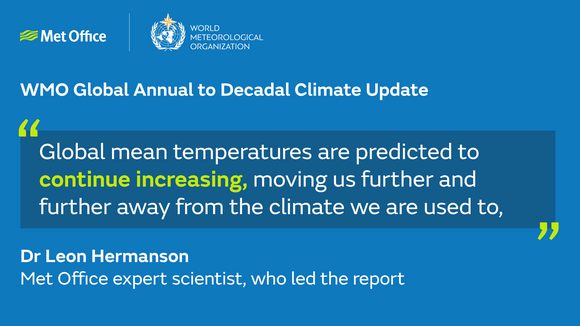
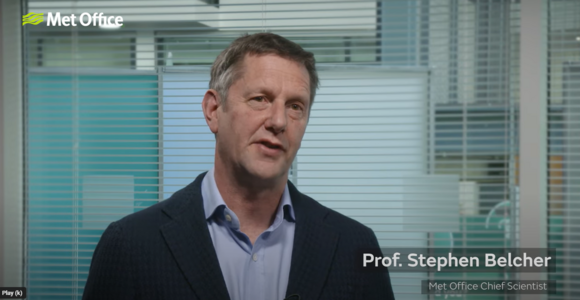
In our video, Met Office Chief Scientist, Stephen Belcher responds to the latest WMO report which predicts new global temperature records and puts this in the context of the Paris Agreement on Climate Change
|
|
World Environment Day
5 June 2023 is the United Nations’ World Environment Day. This year’s focus is on reducing plastic pollution with practical guides available for all parts of society.
World Ocean Day
World Ocean Day is on 8 June 2023 when people around our blue planet are encouraged to celebrate and honour our one shared ocean, that connects us all.
|
|
|
Follow us on the social media channels below to join the conversation.
#GetClimateReady
|
|
|
To subscribe or unsubscribe please visit our email updates page to access your preferences.
The Met Office is not responsible for the content of external internet sites.
|
|
|
|