|
 |
Climate newsletter |
|
|
Spotlight on 'Global State of the C' |
|
|
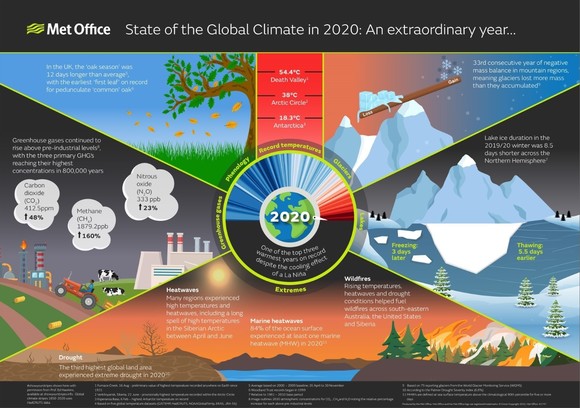
Today, the Bulletin of the American Meteorological Society (BAMS) has published its 31st annual State of the Climate report, covering 2020. This report is based on contributions from more than 530 scientists from over 60 countries around the world. It provides an authoritative and detailed update on the current state of the global climate, by analysing the key climate indicators and notable weather events from the previous year.
The report shows that 2020 (along with 2016 and 2019) was one of the three warmest years since 1850, with a record high temperature of 54.4°C recorded in Death Valley, in south-western United States. The average surface temperature over land areas in the Arctic was the highest since the series began in 1900, 121 years ago. Additionally, despite the transition in the tropical Pacific to a La Niña state in August, which has a temporary cooling influence on global temperatures, the average global temperature for the previous year was around 0.6 °C above the average for the 30-year period 1981-2010.
In addition to global temperatures, the report also published findings on a number of other climate change indicators, including concentrations of greenhouse gases, glacial mass, lake ice duration and phenology.
The Met Office’s Dr Robert Dunn, the lead editor for the global climate chapter of the report, said: “This report adds to all the other evidence that human-induced climate change is affecting every part of the globe, but not all regions are experiencing the change at the same rate. The Arctic is continuing to warm at a faster pace than lower latitudes, but Europe’s annual average temperature is also increasing quite rapidly, with the five highest annual temperatures all occurring from 2014.”
|
|
National Grid Dynamic Line Rating
Low carbon electricity will be a key enabler of the UKs transition to a net zero economy with demand expected to double due to transport and low carbon heat.
A key challenge for the energy sector in decarbonisation is expanding transmission capacity for wind and solar power. We have been working on an innovative project, in partnership with National Grid, that aims to do just that.
Dynamic Line Rating (DLR) allows National Grid to vary the capacity of an overhead transmission power line dynamically, depending on environmental factors such as wind speed, wind direction, ambient temperature, and solar radiation. If weather conditions cool conductors sufficiently, they can push more power through the lines, helping to meet the country’s energy needs.
The project looks at the feasibility of integrating a cloud-based weather forecasting service into National Grid’s present line rating calculation methodology. With more accurate and granular weather data, they can better determine where and when to boost capacity.
It also reduces reliance on fossil fuel-based generation, helping to reduce carbon emissions. This supports Governments goals of generating emission-free electricity by 2050 with a trajectory that will see us have overwhelmingly decarbonised power in the 2030s.
|
|
Europe needs to prepare for temperatures of 50°C in future
In response to new European temperature record of 48.8°C set in Siracusa, Sicily on 11 August, the Met Office’ head of climate attribution, Professor Peter Stott, stressed in a blog post that Europe will need to prepare for further records being broken, with possible temperatures exceeding 50°C in future.
|
|
Arctic sea ice
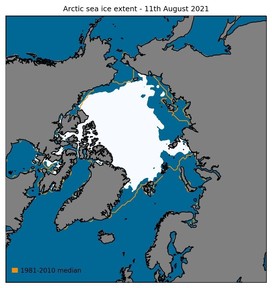
Arctic sea ice on 11 Aug was at its 10th lowest extent on record for the time of year, at 5.95 million sq km. Extent remained low north of Siberia, but was nearer normal around Canada and Alaska. Antarctic sea ice is slightly above its long-term average. This data is consistent with the IPCC’s latest report published on 9 August, which noted significant decreases in Arctic sea ice area and thickness since the 1970s.
The human influence on the climate is already affecting all regions of the planet. In the longer-term, rising sea levels and melting ice from glaciers and ice sheets are going to have even more profound impacts.
|
|
Mostly Climate podcast - Climate risk assessment
The latest episode of the Met Office’s Mostly Climate podcast series has been released, where Professor Richard Betts outlines the science and implications of the current UK Climate Risk Assessment, exploring the important question of, how does a nation prepare for climate change?
|
|
|
Reading University Climate Education Summit
Climate change is the defining crisis of our generation, and it will be the lived reality for generations to come. Yet, many people still do not understand the issue or feel able to respond to it adequately, including the very young people who will be most affected. Young people have told us they want to know more about climate change, yet most teachers say they are ill-equipped to teach it.
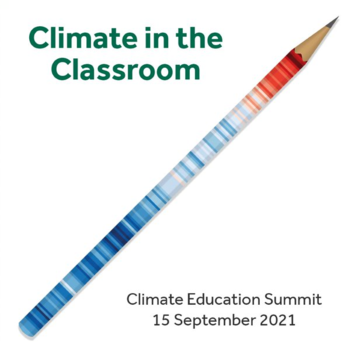
Working with the Office for Climate Education, Royal Meteorological Society, Met Office, EAUC and Ashden, the University of Reading will be running an online Climate Education Summit on 15 September 2021. It aims to bring together young people, scientists, teachers and educationalists, policymakers and campaigners to create a new, nationwide action plan for better climate education in schools and colleges.
The Summit will include keynote plenary sessions open to all – from teachers and their students to the general public – and closed roundtable discussions, with the aim of identifying and outlining how a step change in climate and sustainability education can be made so that young people have the skills and knowledge needed for the twenty-first century.
In the ‘race to zero’ the importance of climate data to inform climate reporting and decision-making has rapidly grown.
With the wealth of data out there it can be overwhelming, and difficult to know where to start when it comes to navigating, interpreting and communicating climate data with confidence, credibility and impact.
To support the business community, we have launched a new online course ‘Climate data for reporting and decision making’, starting this September.
This course is designed for consultants, analysts, or those in similar roles, who wish to be able to confidently use climate data, particularly UKCP18 data, to carry out climate change risk assessments either in-house or on behalf of customers.

Royal Meteorological Society event
The Royal Meteorological Society have announced the keynote speakers for their virtual meeting 'The 6th Major #IPCC Science Report and its Implications' which will take place on 15 September.
Leading scientists involved in the report as well as those who are actively involved with making decisions on climate change actions will review the main findings of the report and consider what it means for the ongoing development of our response to climate change ahead of COP26 in Glasgow.
Image: Changing by Alisa Singer. Source IPCC
|
The event is supported by Grantham Institute - Climate Change and the Environment, Department for Business, Energy and Industrial Strategy (BEIS), National Centre for Atmospheric Science and Met Office.
|
|
Met Office science at the heart of climate assessments
In our latest blog, learn about the history of the IPCC and how we have worked with their scientific advisory group since its inception in 2002, helping to shape their landmark reports.
|
|
In conversation on @TwitterSpaces - 'The urgency of the climate crisis’
Following the publication of the IPCC AR6 Report, we ran an audio discussion on Twitter Space about ‘The urgency of the climate crisis’. The session was hosted by Met Office Senior Presenter Alex Deakin, with Met Office Climate Scientist Doug McNeil and Ed Hawkins, Climate scientist at the University of Reading/NCAS and IPCC AR6 Lead Author.
|
|
The talk covered the headlines from the report but also some of the finer details perhaps overlooked by the media last week. We invited questions from the audience and got some real insight from the scientists on what’s actually involved in writing such a hugely important document. The discussions lead onto how the IPCC report will feed into what happens at COP26 in November.
Twitter Spaces doesn’t currently let you record the conversations, you had to be in the ‘Space’ to hear it, but in the run up to COP26 we will be hosting more of these discussions so make sure you are following @metoffice on twitter to be involved, ask questions and even suggest topics for the conversations.
|
|
|
Follow us on the social media channels below to join the conversation.
#GetClimateReady #MetOfficeCOP26
|
|
To subscribe or unsubscribe please visit our email updates page to access your preferences. |
|
|
|
|