|
Local Government Reorganisation (LGR) is set to be the biggest change to local councils in our generation and the UK Government wants to hear from you which model is best for Kent.
What is happening in Kent?
Right now, Kent County Council provides services such as education, social care and
highways, while district and borough councils are responsible for waste collection, housing and more. Under the proposed system, new unitary councils would deliver all local services within their area, similar to the model already used by Medway Council.
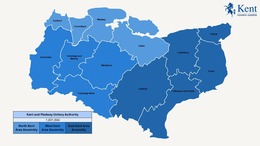
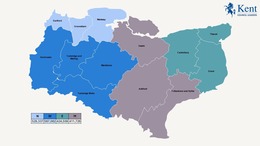
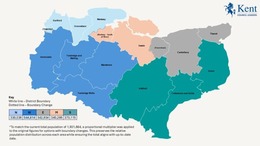
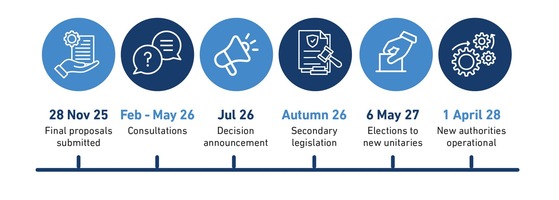
Councils across Kent and Medway have created business cases exploring the options for how LGR will look in the county. In total five, business cases were presented to
the government to consider at the end of 2025. These ranged from one single unitary authority for the whole of Kent, to the county being split into five unitaries.
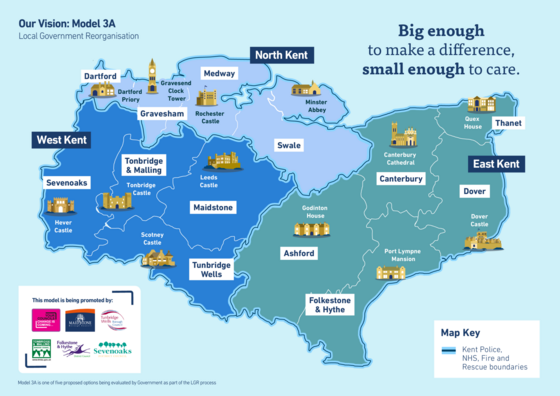
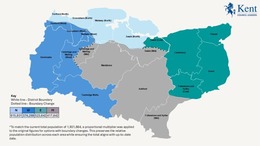
Five councils agreed that their preferred option for was a three-unitary authority model, known as 'Option 3a', which would be made up of Dartford, Gravesham, Medway and Swale in the north; Sevenoaks, Tonbridge & Malling, Maidstone and Tunbridge Wells in the west; and Ashford, Canterbury, Thanet, Dover and Folkestone & Hythe in the east.
Model 3a is one of five proposed options being evaluated by the UK Government as part of the LGR process
Five councils: Folkestone & Hythe District Council, Maidstone Borough Council, Sevenoaks District Council, Tonbridge & Malling Borough Council, and Tunbridge Wells Borough Council have chosen Option 3a as their preferred model for Kent.
Why Option 3a?
This model offers significant benefits that align with our vision for modern, responsive
local government.
The five councils believe that Option 3a is service and resident-focused, maintaining strong community identity and local accountability, with the lowest one-off implementation costs and the greatest savings potential, combined with one of the quickest payback periods.
This approach also aligns with the existing boundaries of Kent Police, Kent Fire and
Rescue, and the NHS, creating a more consistent and coordinated framework for
public services. By mirroring these established structures, Option 3a supports collaboration, reduces duplication, and ensures residents experience a seamless connection between local government and essential services.
The UK Government is currently considering all the options is carrying out consultations.
|