
Welcome to another bulletin from the Our Town Hall Project.
In this issue... how teams from the project have helped a north Manchester school, the delicate operation of moving two big statues inside the building, and our next Heritage Lecture at Central Library.
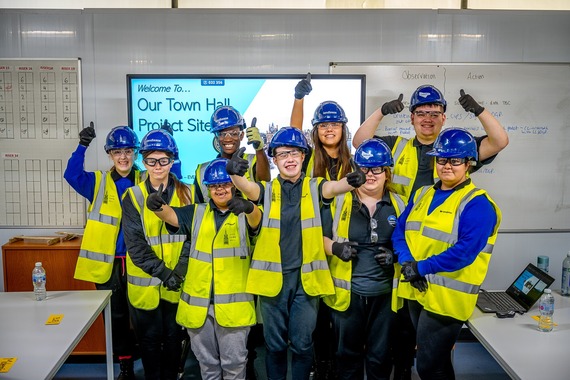 Some of the North Ridge School students preparing for their site visit
Supporting Manchester schools
Earlier this summer, several contractors from the Our Town Hall Project took the time to support staff and students at Manchester’s North Ridge SEN School. Lendlease, NG Bailey, Adana and Lyndon SGB collaborated on an innovative work experience based around the five Skills For Life.
Colleagues from the firms each attended the school for a full day and delivered Science, Technology, Engineering and Maths (STEM) activities such as bridge building and mock scaffolding. There was also a focus on employability-related activities to support the students in preparation for working life.
The experience culminated with a mock interview for each student, which they all passed with flying colours and finally, they were treated to a once-in-a-lifetime tour of the site to inspire them to think about the many possibilities of working in the Construction industry.
Rissia Gavriil from the school told us how much the students had enjoyed the experience, adding “Class Everest had been attending work experience lessons over two months. Led by companies from the Our Town Hall project, they’ve gained valuable life skills by engaging in a range of construction trade related activities, looking at PPE and tools. They’ve also taken part in mock interviews; a crucial skill for their future.”
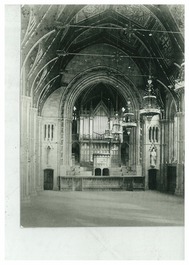
Restoring the organ - Heritage Lecture
Our series of Heritage Lectures aims to shine a light on some of the fascinating work that’s been going on behind the scenes. We’ve already heard about the work on our paintings, mosaic flooring, clock and stained-glass windows; now - in our final lecture date for 2023 - it’s time to turn our attention to the restoration of the magnificent organ in the Great Hall.
As an important part of the Our Town Hall project, the organ will be largely restored as its builder (Cavaillé-Coll) originally intended. The work will be undertaken jointly, by Nicholson & Co of Malvern, and Flentrop Orgelbouw, of the Netherlands.
Andrew Caskie, from Nicholson’s will deliver this lecture.
Join us in Central Library on Thursday 16 November to hear from Andrew about the delicate process of removing the instrument, what was found behind it and – most importantly - conservation progress to date.
The lecture is free to attend but please book your place - you’ll need to type in the word “MANCHESTER” to complete your booking.
More Heritage Lectures will take place in 2024 – watch this space!
|
Dalton and Joule on the move
We always like to bring you plenty of pictures that show progress on the project; we recently created an online album to show the incredible job that was completed earlier this year, which saw the repositioning of the two statues in the main Albert Square entrance of the building.
Dalton and Joule have sat in quiet contemplation since the late 1880s, but needed to be moved to make way for one of the new lifts that are being installed to improve the accessibility of the Town Hall.
Their new position, flanking the entrance of what will be the Town Hall Story Exhibition, is very appropriate but there was a lot of meticulous planning and manoeuvres on the day were painstakingly careful.
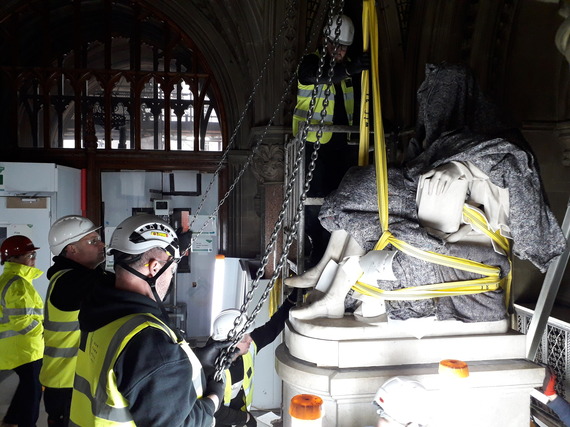 One of the pictures from the album, which shows how the statues were moved.
A long-read article: Inspiring the next generation to learn old-time artisan crafts and skills
A project as large as the Our Town Hall project gives time-served, traditional heritage craft businesses the chance to introduce their skills to a new generation of young people.
From mosaic floors and stained-glass windows to stonemasonry and clockmaking, the list reads like a 19th century census. But these are all modern-day trades that are vital to the upkeep of many UK architectural icons.
One of the OTH project’s aims has been to make sure that there are work and learning opportunities – particularly for Manchester residents – so the focus on apprenticeships and careers is an important part of the project’s legacy, inspiring a new generation and investing in these heritage skills by teaching and encouraging young people to see the value and benefit in keeping them alive.
The Town Hall itself stands as a beacon for these artisan skills: underneath the layers of wrapping and scaffold, the heritage craft skills the project is helping to stay alive are monumental – we’re lucky in this country to still have these skills available, but the reality is that they’re diminishing.
Manchester Town Hall’s clock, for example, is a Victorian masterpiece. Its mechanisms were built to – and will - last 1000 years. But there’s a real risk that – in future years - the clock could fall into disrepair simply because the skills to maintain it are lost. And educating the general public about the value of heritage craft skills comes into the equation too, highlighting the value of choosing restoration over modern replacement.
Keith Scobie-Youngs, from The Cumbria Clock Company, is keen to make sure that there is a steady stream of young people arriving to learn at his Cumbria workshops. While there are horology courses available, a university degree isn’t right - or within their financial reach - for everyone.
Roan MacKenzie is a good example: he joined Cumbria Clocks at the age of 18 as a general Workshop Assistant. Fast forward two years and he’s now a Trainee Horologist. His journey developed as he became aware of – and fascinated by - the work being undertaken all around him. Because they’ve had some longer-term contracts on large-scale projects such as Manchester Town Hall and Big Ben, Keith and the team were able to put together a pathway for Roan to start his horological training. Two years later, he's well on his way and recently completed an overhaul of a Victorian quarter-striking turret clock.
Keith considers that “passing on the skills and years of knowledge and experience is absolutely key. The best practical way to learn is the traditional method: do an apprenticeship and work at a firm where the knowledge can be passed down. It’s a well-trodden approach and a great alternative for people that don’t want to be in academic education.”
“In fact, it’s often the case that - once a young person has completed their initial apprenticeship - their academic skills increase because they’ve got involved in their practical journey and actively want to learn the history or the mathematics; both of which make them better prepared for the work they’ll have to do.”
We asked Keith to summarise the benefits of their work on the Manchester Town Hall clock. He said: “Being given the opportunity to undertake such an important conservation project to this magnificent Victorian clock installation has meant we can include the younger generation of clockmakers in the work and inspire them to appreciate the true value of heritage craft as an art - and also as a career choice.”
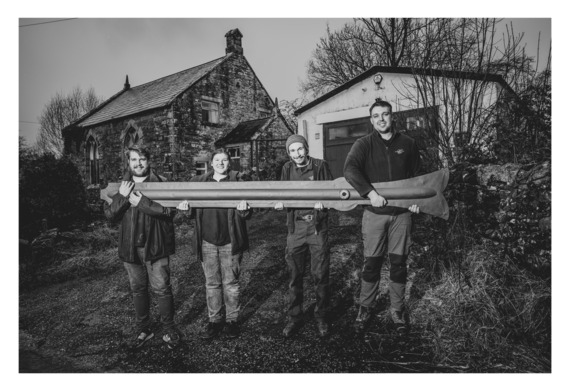 Roan (wearing the hat) with colleagues from Cumbria Clocks, holding one of the minute hands from the Town Hall clock.
Our Social Media channels
As well as the albums we've created on flickr.com, we're using lots of our photographer's work on our social media channels.
If you'd like to see more regular updates you might enjoy the posts we make about #OurTownHall on Instagram, for example.
|



