Moving area shouldn't mean gaps in support for service children

We recently upheld a complaint against Shropshire Council after an armed forces child was left without specialist education support for five months following a military posting, including during the critical start of their GCSE studies.
The case is a reminder that the Armed Forces Covenant is a legal duty. When a service child with an Education, Health and Care Plan moves into a new area, councils must act proactively to ensure provision is in place from day one. Families should also know they have the right to expect this, and they can complain to us if their council fails to put things right.
|
How We Handle Information Requests: What's New
We have made some important changes to how we handle requests for information, and we wanted to make sure you are aware of them.
A new email address and online portal
We have a new dedicated email address for subject access requests made under the Data Protection Act 2018 and UK GDPR: inforights@lgo.org.uk. We have also launched an online portal for Freedom of Information and Environmental Information Regulations requests, making it easier to submit and track your request. We are working towards opening a similar portal for Data Protection Act requests in the future.
Updated guidance on what we can and cannot share
We have updated the information on our website explaining what we are able to share and what we are not. It is worth being aware that the Local Government Act 1974 requires our investigations to be carried out in private. This means there are limits on our ability to share evidence gathered during an investigation, even in response to a formal information request. Our website sets out in plain terms what this means in practice and what routes are available to you.
Making the most of AI tools
We are receiving a growing number of information requests that appear to have been drafted using artificial intelligence tools. AI can be a genuinely useful aid when used in the right way. However, requests that use complicated formal language can sometimes make it harder for us to understand exactly what information you are looking for.
Our website now includes practical advice on how to use AI tools effectively when making an information request, so that we can give you the most helpful response possible. We would encourage anyone using these tools to take a look before submitting their request.
Rising to the Challenge: Reflections from the Ombudsman Association Conference
Last month, colleagues from across the UK's ombudsman community gathered in Glasgow for the annual Ombudsman Association conference. This year's theme, Rising to the Challenge, felt particularly timely, bringing together ombudsmen and their teams to explore how we continue to deliver meaningful redress and drive improvement as demand on our services grows.
For the Local Government and Social Care Ombudsman, it was an opportunity to both learn from peers and contribute to what proved to be a rich and honest conversation about pressures facing complaint-handling across the public sector.
Head of Policy and Communications, Cameron Black, delivered a session on Managing Complaints in a Broken System, drawing on research carried out by the University of Manchester and funded by the Nuffield Foundation. The research explored whether individual ombudsman decisions can still drive meaningful change when wider systems are under strain. Looking at evidence from the special educational needs sector, the findings are encouraging: even where national pressures exist, ombudsman decisions can and do drive local improvements. Individual cases, handled well, still have the power to change practice on the ground.
Beyond our own session, the conference was a valuable reminder of what the ombudsman community achieves when it comes together. Conversations ranged from managing rising caseloads to maintaining public trust in an era of increasing scrutiny of all institutions. We will be taking the learning from Glasgow into our work in the months ahead.
Become complaints confident
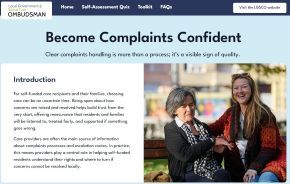
We receive fewer complaints from people – and their representatives – who “self-fund” their adult social care.
So, in recent months we’ve been running a campaign to highlight how people can complain about adult social care they pay for themselves.
This has involved us reaching out to care providers, to encourage them to become ‘Complaint Confident’. To become this, we recommend providers talking openly to the people they care for about raising any concerns they might have, whether this is in a residential care setting or in the persons home. We believe it is important providers tell people our service is available should they remain dissatisfied with a response.
To help care providers do this, we launched a new section of our website hosting guides and resources to download. It includes a self-assessment quiz, giving instant feedback on how complaints confident their service already is.
We have carried out a range of speaking events in the South East, talking to providers and care provider associations and have been pleased with the number of organisations we’ve seen using the resources.
|
Speaking up!

Our recent focus report on planning enforcement highlights the work we do to get our casework learning directly into the hands of people that matter.
For the report’s launch, we worked closely with a key industry body: the Royal Town Planning Institute (RTPI). They echoed our findings – that overlooking enforcement puts at risk the public’s faith in the whole planning system.
This work allowed us to present to the annual conference National Association of Planning Enforcement, in addition to a webinar we hosted for local planning authority officers. We also spoke to a Lawyers in Local Government-hosted learning webinar. In total we reached more than 300 planners, helping turn complaint findings into practical learning to improve services for all residents.
|
|