|
Wednesday 17 February 2021 (Update #182)
 I know that many of you are fed up with the COVID-19 restrictions.
The disruption to normal life, schooling for children, meeting relations, visiting loved ones in care homes, and the enjoyable things in life like meals out, watching live sport or holidays has been, and remains, painful.
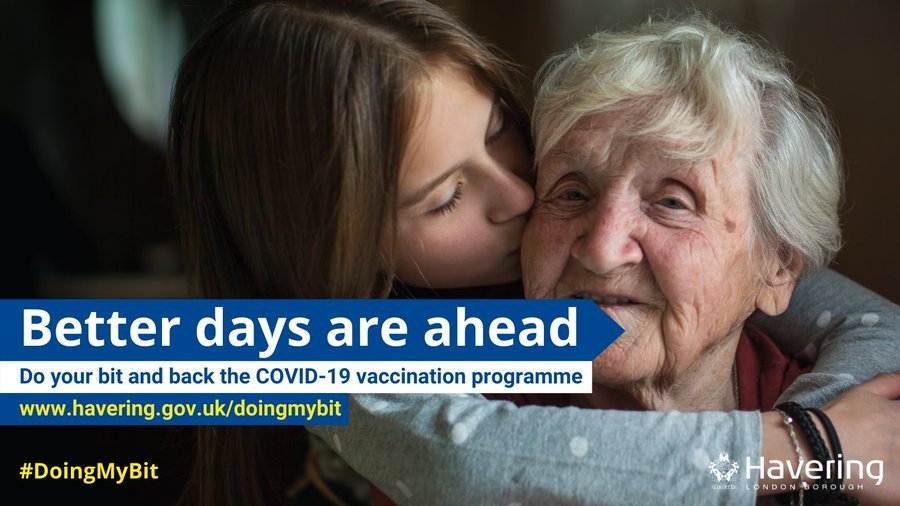
But better days are ahead thanks to the vaccination programme and your compliance with the restrictions the Government brought in to control the virus.
On Monday the Government will lay out its roadmap for the way out of lockdown. The Prime Minister says that it will be a gradual relaxation of the lockdown because so much still depends on the level of infection in the population, hospitalisations, the success of the vaccination programme, and the incidence of new variants of the virus.
The Governnment is right to resist the calls of some who want an accelerated relaxation of all restrictions. Move too fast and we risk a new spike in infections and a hugely damaging fourth lockdown.
Remember back to last summer? The Government was introducing controls on travel to various countries deemed too risky because of COVID-19 infection rates of more than 20 people per 100,000 of the population. The infection rate in Havering last week was 116 per 100,000. Yes it has come down significantly in recent weeks, but it is still much too high to risk an immediate loosening of all the coronavirus restrictions.
Our latest weekly COVID-19 report shows that the number of people being treated for COVID-19 in our local hospitals is rapidly falling, but is still higher than at any point during last summer. So please stay safe and continue to follow the rules, wear your face covering, keep your distance and stay at home as much as you can.
If you want to contact me directly, you can email me. However, please be patient as there may be a delay of a day or two in getting back to you due to the volume of messages I am receiving.
Cllr Damian White
Leader, Havering Council

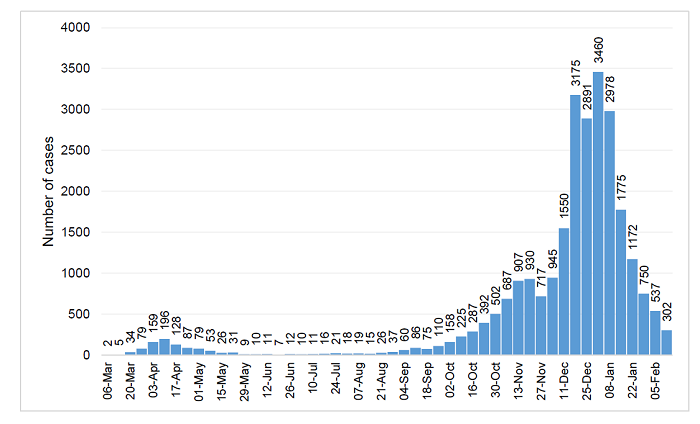 Every Wednesday Havering Council publishes a report on coronavirus in the borough on its website.
The graph above is taken from the report and shows the number of Havering residents testing positive for coronavirus each week since 6 March. Until 2 July the figures did not include widespread testing in the community.
There were 302 cases reported in the last week, 235 less than the previous week. This equates to an incidence rate of 116 new cases per 100,000 population which is the same as the London average (116/100,000) and lower than that for the whole of England (141/100,000).
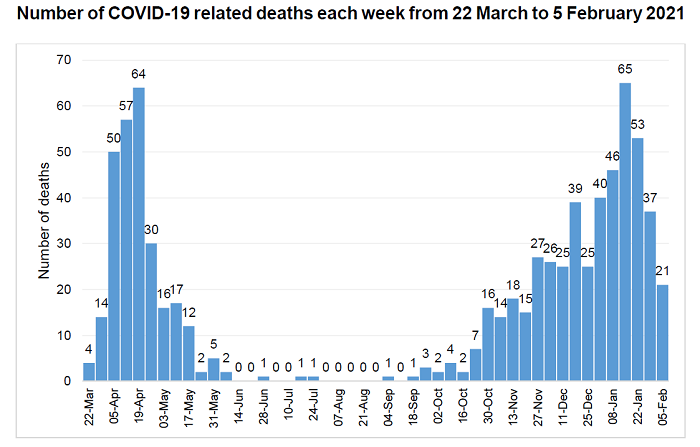
However, underscoring how dangerous this coronavirus pandemic remains, deaths in Havering remain high with 21 COVID-19 related deaths in the week ending 5 February, as the graph below shows.
 As of 15 February there were 183 inpatients admitted due to COVID-19 occupying beds at our local hospitals. The trust that runs those hospitals, BHRUT, also publishes weekly data on the number of patients it is treating.
 Research, commissioned recently by England’s Chief Medical Officer Chris Whitty, found that there are several health and personal factors, such as age, ethnicity and body mass index (BMI), as well as certain medical conditions and treatments, which, when combined, could mean someone is at a higher risk from COVID-19.
As a result, new technology has been introduced to help clinicians identify for the first time, a new group of people who may be at high risk from COVID-19. It was announced by the Government yesterday (16 February) that around 1.7 million adults are now being asked to shield; approximately 820,000 of those adults who were not previously in the top four priority groups for vaccination, will now be prioritised to receive a jab.
If you are in this group you will be sent a letter from NHS England in the coming days explaining that you will now be included within the support and advice for the clinically extremely vulnerable. You will be invited to receive a COVID-19 vaccine as soon as possible if you haven’t already had one, and will be given advice on precautionary measures, including shielding until 31 March. Your GP will also be notified.
Aged 16-64 with an underlying health condition
If you or someone in your family is aged between 16 and 64 years old and have an underlying health condition, you are now eligible for a vaccination. You must wait for your GP to contact you. You cannot currently book via the national NHS booking system.
Over 70 or clinically extremely vulnerable
If you or someone in your family is 70 or over, or defined as clinically extremely vulnerable, and you have not yet had, or been booked, for your first COVID-19 vaccination, you should take action now. Contact your GP for an appointment, or book your first vaccination online at one of east London's large-scale vaccination centres (including ExCel and Westfield), or call 119 to book.
If you have received a letter but not booked an appointment you may get a phone call from the NHS Immunisation Management Service. This call will be from the number 0300 561 0240. This will be a reminder to book your COVID-19 vaccination appointments. The person you speak to will see if you need any help and support.
Personal Assistants
If you are a Personal Assistant working in front line social care you are eligible for vaccination in national priority group two if you are caring for someone who is clinically extremely vulnerable to COVID-19, or is a person who has a defined underlying health condition leading to greater risk of disease or death from COVID-19, or is over 85 years old.
This is regardless of whether you are self-employed, employed privately, through
a social care direct payment, a personal health budget, or through a broker or payroll provider.
If this could be you, read more on our website.
Latest numbers
More than 15,000 people have now received a COVID-19 jab at the vaccine hubs at Queen's and King George's hospitals and, as of 11 February, in total over 50,000 Havering residents have now had at least their first dose of the vaccination.
Avoid scams
Please remember that contact from the NHS for COVID-19 vaccination may come by phone call, letter or text but there will be no request for any form of payment as COVID-19 vaccination is free.

Tonight (Wednesday 17 February) Havering Council’s Cabinet will hold an online meeting to consider the Council’s proposed budget.
You can see the agenda for this meeting on our website and watch it online if you wish.
The budget sets out how the Council will manage its finances for the next financial year starting in April.
The budget proposals include plans for investment in the borough’s roads, community safety and enforcement, and the borough's parks and leisure facilities. It includes an additional £10million of capital expenditure to make sure the road and pavement improvement programme continues over the next two years.
As part of the discussions the Cabinet will also have to consider a general Council Tax increase of 1.5 per cent. The proposal is that Council Tax in Havering will increase by a further 3 per cent specifically to fund social care which is how the Government has asked local authorities to bridge their funding gaps for this area.
Following Cabinet consent, this will go to the annual Council Tax setting Council meeting to be held on Wednesday 3 March for final agreement by councillors.
|

Havering Council is now consulting on a new Housing Allocation Scheme.
The new policy contains a range of measures that will help the Council best meet the housing needs of local people.
To acknowledge the duty we owe to our armed forces, the Council will make sure they are given priority in the scheme.
In addition, the priority given to disabled Havering residents has been increased. This is to ensure that those most vulnerable members of our community are provided with good-quality affordable housing.
The proposals also increase the amount of time applicants must have lived within the borough, from six years to 10 years.
The consultation is open until 4 April 2021. Have your say.
|

If you, or someone you know, has concerns around care, urgent issues with their health and wellbeing or lack of access to supplies, including food, please call our free to use helpline: 0800 368 5201.
It is open Monday to Friday 9am to 5pm, and between 11am and 4pm on Saturdays and Sundays for emergencies only.
You can also email us if you, or someone you know, needs help.
See a short video recorded by a member of our hotline team.
|
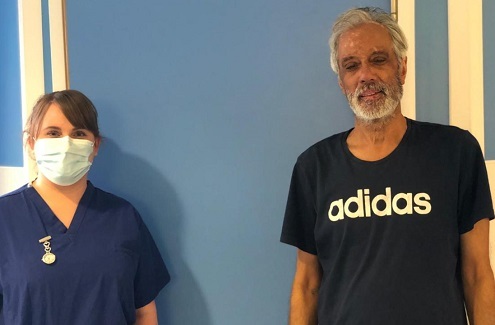
Teka Singh from Gidea Park (pictured) could not wait to get home to his family, after spending 10 days at Queen’s Hospital recently battling COVID-19.
He was discharged on 2 February and said: "I feel a lot better now but I do not think I would have survived if I had not come to the hospital.
“Other members of my family were recovering from COVID-19 but I felt like I was getting worse. I was conscious about coming to the hospital because I know how busy the staff are, but once I was struggling to breath, I knew I had to.”
|
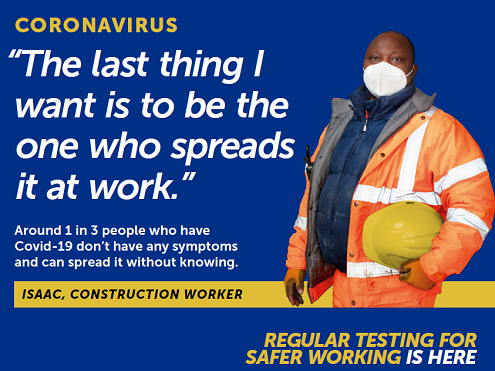
One in three people with COVID-19 have no symptoms, and can pass it on to others without realising.
If you cannot work from home please test twice weekly at one of our five lateral flow testing centres.
These centres are open from 7am to 7pm on weekdays and 10am to 7pm on weekends. The Government has also now introduced a postcode checker that you can use to find your nearest rapid testing site.
See our short video that explains the simple process.
Personal Assistants
Personal Assistants (PAs) in England are now entitled to regular weekly PCR COVID-19 testing. This applies to all PAs who provide care and support to individuals in their own homes, where they come within two metres of the person they care for.
This is in addition to the existing support available to PAs to keep themselves and those they provide care and support to as safe as possible. This includes guidance on infection prevention and control measures and the availability of free personal protective equipment.
PAs will also be able to order a month’s supply of PCR test kits every 28 days, delivered to their home address, enabling them to conduct weekly coronavirus testing at home. You can read more on the Government's website.
Have symptoms?
Of course, it also remains vitally important to book a test if you have COVID-19 symptoms. Click for details of booking procedures, and opening hours for all our local testing locations.
|
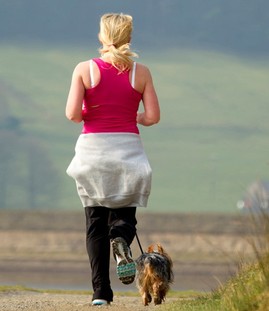
During this half-term school holiday some parks in Havering have been very busy.
If you’re visiting any of the parks for your permitted daily exercise, please remember that it should only be with members of your own household or social bubble - or with just one person from another household if really necessary.
If you can, please avoid busy times and follow social distancing guidelines when walking or jogging on pathways, and use bins for any masks, gloves or empty sanitiser bottles.
If you purchase food or drink from any of the takeaway kiosks or cafes in our parks, please maintain social distancing while queueing, and walk away to continue your exercise as soon as possible.
Children should use hand sanitiser after touching any play equipment or climbing frames.
|

Havering Libraries are holding Wiggle and Giggle sessions suitable for children over two years old.
This is similar to Baby Bounce sessions, but aimed at older children.
These will be active sessions where the children, parents and carers will be on their feet joining in with the singing and dancing.
The first session will be on Tuesday 23 February from 11am until midday. Email to register for these weekly sessions or for further details.
Havering Libraries are also arranging a number of activities during this school half-term week. Daily storytelling sessions at 11am run on their Facebook page.
These events are all suitable for children in school Key Stages 1 and 2. They are recorded sessions, so if you miss them at 11am they will stay up for a few weeks so you can catch them at a more convenient time.
|
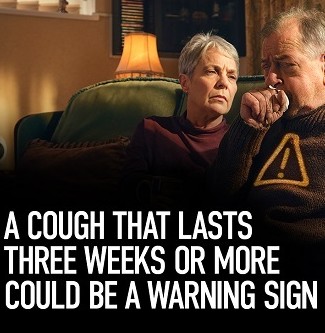
Despite lung cancer being the third most common cancer in England, suspected lung cancer referrals remain lower than normal.
As of December 2020, lung cancer referrals had reached just 73 per cent of pre-COVID levels.
If you’ve had a cough for three weeks or more, and it isn’t COVID-19, it could be a warning sign of cancer.
It’s probably nothing serious, but finding cancer early makes it more treatable.
|
The census is coming on Sunday 21 March.
By filling in your census, you will help shape Havering for the next 10 years.
Every household will soon receive a postcard, explaining what a census is, and in early March letters will arrive in the post inviting people to take part.
You will be encouraged, where possible, to complete the census online. It is simple, straightforward and should take just 10 minutes per person to fill out the form. If you, or a friend, neighbour or relation can’t get online, there will be paper forms available for those who need them, as well as support.
Census field officers will only follow up with households after Census Day on
21 March if householders have not yet completed their questionnaire. They will
never enter a household, they will always be socially distanced, be equipped
with PPE and work in line with all Government guidance.
|
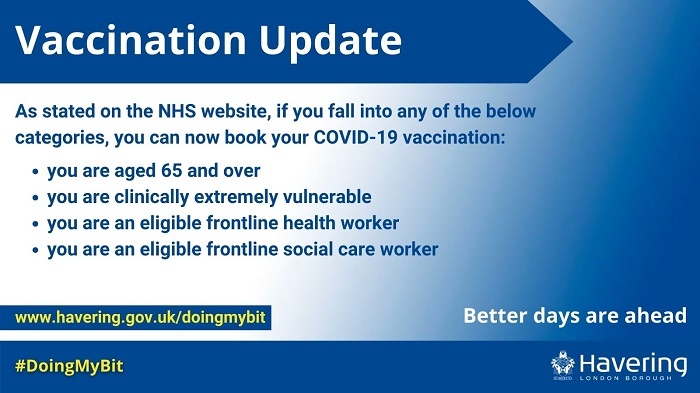
On Monday 15 February Havering Council posted information on social media regarding the groups that could now book a COVID-19 vaccination. Unfortunately the graphic that accompanied that information, that was also published in this newsletter on Monday, incorrectly included 16-64 year olds with underlying health conditions.
We apologise for the confusion and any distress caused.
Havering Council is doing its best to share key information with residents. However, we made a mistake and sent out incorrect information. We acknowledge this and unreservedly apologise.
As stated on the NHS website, if you fall into any of the categories listed below, you can now book your COVID-19 vaccination:
- you are aged 65 and over
- you have previously received a letter saying you are at high risk from coronavirus (clinically extremely vulnerable)
- you are an eligible frontline health worker
- you are an eligible frontline social care worker.
Unless you are in these four groups (also known as cohorts), you need to wait to be invited for your vaccination. The vaccination priority groups are decided by the Joint Committee on Vaccination and Immunisation (JCVI).
You must be registered with a GP to get the COVID-19 vaccination. If you are not registered with a GP, get more information on how to do that.
Please be aware that advice on COVID-19 and vaccinations is changing all the time and may have changed between the time that this newsletter was published and you reading it, so we advise to always check the NHS website or GOV.UK for the latest updates.
|