|
 Bright Start Blog
|
|
Promoting Sustainability Through Immersive Learning Processes: A Case Study by Effie Theodorou, Early Years Teacher at Willow Children's Centre |
|
|
10 minute read
- How can books be used to spark and ignite interests?
- How can I introduce the concept of sustainability to children in my setting?
- Why is it important to teach the importance of caring for our planet?
|
|
|
This case study explores two interconnected learning cycles at Willow Children’s Centre, driven by children's interests and showcasing a commitment to sustainability. The first cycle emerged from our exploration of the core text “This is the Bear”, which led to discussions about recycling and reusing materials. The second cycle transitioned naturally into “The Journey Home”, fostering an understanding of conservation, habitat protection, and environmental responsibility.
Cycle 1: Exploring Sustainability Through 'This is the Bear'
Inspired by children's curiosity about maps and routes, our journey began with This is the Bear by Sarah Hayes. As we explored the story, children became captivated by the idea of a bear being in a bin, sparking conversations about waste, recycling, and sustainability. They also discussed how the Bear might be feeling, showing great care and concern, and what they could do to make them feel better. This links with our Loving Pedagogy that promotes a nurturing approach, rooted in encouraging empathy and respect for others.
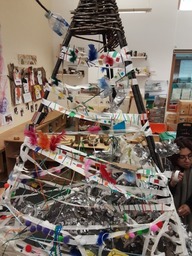
We integrated these discussions into our planning, ensuring sustainability remained a core focus. As we were getting ready to celebrate Christmas we decided to embrace this concept. Observing the children being very engaged in weaving and using string and tape to create enclosures we repurposed an old wigwam to a Christmas tree instead of buying a new one. This allowed children to engage in creative decision-making and problem-solving in a group situation.
Using donated and natural materials, they designed their own festive ornaments and used our woodwork area to bring them to life. We also repurposed old clothes and donated fabric and children had a chance to use the sewing machine to create bags to carry all their Christmas decorations in. Rather than buying new books, we invited families to participate in a book swap, encouraging the idea of reusing and sharing resources.
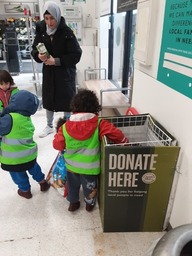
In the spirit of sustainability and community support, we also encouraged families to collect and donate food items for children to take to a local food bank, fostering empathy and social responsibility. We recycled paper from our old displays and shredded documents from our reception to create eco bricks, which children enjoyed making, painting and using to build a chimney for Father Christmas. Through our Home Learning Activities, we also encouraged parents to engage in recycling and re-purposing at home, “using old things to make new things”
Our celebration culminated in a showcase of the children's favourite songs and a unique Helicopter Story, which also included elements of sustainability “Father Christmas and his adventures” - brought to life through their imagination and voices.
|
Cycle 2: Conservation and Animal Habitats Through 'The Journey Home'
The natural next step in our sustainability journey was The Journey Home, a story about endangered animals and the importance of preserving their habitats, by Frann Preston Gannon.
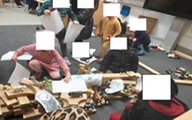
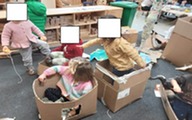
Children engaged in immersive, hands-on activities that deepened their connection to nature. They created their own binoculars for an animal hunt, learning how to transform rectangles into cylinders and joining them using tape, enhancing their spatial awareness and fine motor skills. They used boxes and blocks throughout the cycle to construct boats to transport the animals, adding food storage and safety belts for each one, demonstrating their understanding of care and protection. They used white paper to represent the icebergs and brought the story to life.
As children became more interested in ice and how it melts, we offered lots of activities and experiments with freezing and melting, so they could observe the changes in materials. They also looked at artwork of Olafur Eliasson who explores Glacial Currents and used ink and ice to create their own art. The ice was placed atop splashes of ink on a sheet of thick paper. As the ice gradually melted, the resulting water displaced the pigment, producing organic swells and fades of colour. Others decided to create a forest for orangutans, using a variety of upcycled materials such as coloured cellophane, cardboard, and paper. As they explored textures, layering, and colour mixing, they developed a deeper appreciation for animal habitats and how to protect them.
To further extend children’s critical thinking we also planned a provocation. One day they entered the classroom and found a picture of the four animals in the story plus a tiger in the boat. This immediately captured their curiosity and created a surprise element. How did the tiger end up there? They came up with creative ideas which again showed their deep engagement in sustainability themes and the impact of Loving Pedagogy, as well as how their learning is consolidated in general. Children commented: “The tiger was also in danger. Its habitat was getting destroyed by woodcutters so had to escape. The tiger was very scared so he jumped in the river but couldn’t swim very well. The other animals saw the tiger and he asked for help. They didn’t know how to lift the tiger in the boat. First, they thought they could lift him from their tail. But that would be very painful. They thought that if they had a strap or a rope they could throw that in the water to get the tiger. But they didn’t. So, they had to think of something else. They had 2 magnets. They threw one for the tiger to hold and they used the other one to attract the tiger. They all had to do it together. They saved the tiger and went to the island together”
Our sustainability efforts extended beyond play. We introduced a compost bin and a wormery made from an up-cycled old cot, teaching children about decomposition, soil health, and the role of worms in nature. Together, we sowed green manure in our garden to enrich the soil sustainably.
To extend this learning beyond our setting we started exchanging visits with Archway Children’s Centre to look at each other’s garden and do some seed swaps. We also hosted a parent consolidation event, where families joined us to celebrate our learning journey, sing and dance together and sow seeds to take home - symbolising the growth of both plants and sustainable mindsets.
|
Impact: The Difference We Made
This immersive, child-led approach had a profound impact on children, families, and practitioners. Children developed a strong connection to sustainability through learning experiences, internalising the importance of reusing, recycling, and protecting the environment. The children were fully involved in the process of choosing materials that would bring the story to life while deepening their understanding of what is happening in the world around us. Their play reflected a deepened understanding, as seen in their thoughtful creations and conversations about nature. For example, one day we observed some children when retelling the story, they had included dinosaurs with the animals from their story. We wondered why, a child said, “the dinosaurs are helping the animals not to become extinct”.
On another occasion, when talking about putting the lids back on felt tips so they don’t dry out a practitioner asked: “can we just go and buy more?” and a child replied: “buying more and more is not good. Is not good for the Planet.”
Families became active participants in sustainability through book swaps, the food bank initiative, our home learning ideas and our parent events, extending learning into home environment. On seeing the food bank activity on Tapestry, a parent commented: “I love seeing the kids doing this, thank you for organising and reminding us of the importance of giving and community at Christmas.”
Another parent posted photos of their child proudly growing cress at home commenting on the love and care she demonstrated.
Practitioners also embraced a holistic, process-led approach, prioritising exploration, conversation, and child-led decision-making rather than focusing on a final product. Each one of them brought the sustainability element in the area they are responsible for e.g. forest school, woodwork and gardening, creatively exploring possible lines of development.
|
Next Steps: How We Will Keep It Going
Sustainability is an ongoing journey and an element that organically weaves into our ethos around holistic immersive learning and Loving Pedagogy. Moving forward, we will continue embedding sustainable practices into our planning, encouraging children to reuse and re-purpose materials creatively. We also plan to continue our good practice for outdoor and nature-based learning, fostering a lifelong appreciation for the natural world.
Strengthening our community connections will be another key focus, as we seek to visit other settings and community gardens and organise more trips to enhance learning experiences for our children.
By following the children’s interests and empowering them to take ownership of their learning, we are not only building knowledge, but also nurturing a generation of environmentally conscious, individuals that look after themselves, others and the planet.
|
|
|
About the author
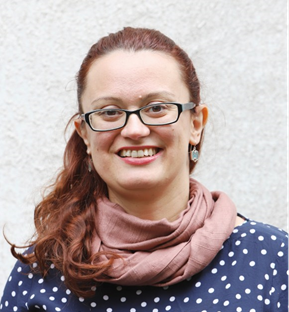
Effie Theodorou is an Early Years Teacher at Willow Children’s Centre. She has been supporting young children learn, grow, and flourish for over 20 years.
Deeply committed to inclusive practice, a child-centred pedagogy, and a deep love for nature, she nurtures learning through connection, curiosity, and care. Effie loves creating invitations for learning that enable children extend on their sparks and discover the magic of learning together.
|
|
|
|
|
|