|
Welcome to the latest edition of the M25 junction 28 improvement scheme newsletter, thank you for your interest in our project.
What we’ve been doing and what's coming up in early 2023
We’ve now finished installing our site compound and offices. This allows us to have our dedicated project team on site, and store materials needed for construction. The new access tracks into the site from M25 junction 28 clockwise entry slip have now been finished, which gives us another entry point into our site for deliveries or machinery arriving.
Bridges have been set up over the watercourses within our site, which means we now have access across the entire area within the boundary, and machinery and plant will no longer need to use the local network.
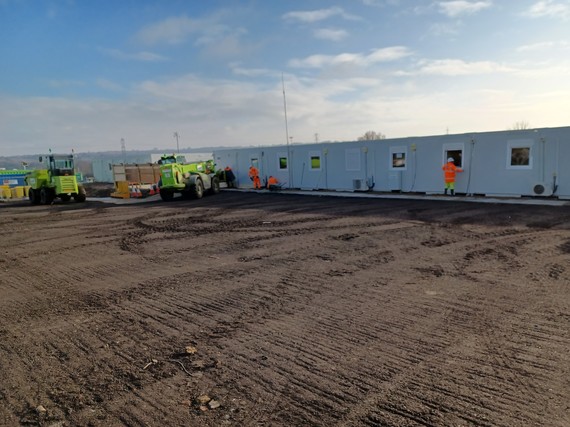 Our site compound being installed
Vegetation clearance and preparatory work
Across the site, we’ve been clearing vegetation and preparing the area to start work on the foundations for the new loop road bridges.
As part of this work, we carried out a number of ecological surveys, which including bat surveys. As it was discovered that there were a number of bats within the site boundary, we’ve relocated them into new roosts, so they can safely hibernate during the winter in their new homes.
A culvert which runs next to the M25 will need to be diverted, so it’s not in the way the new structures. Culverts are tunnels used to transport water from one area to another and are very important in making sure ditches and watercourses are kept flowing.
An important pipeline runs underneath the site and we've been busy installing protective sleeves to shield it during our work.
Piling work underway
A working platform, known as a piling mat, was recently set up so we can start installing piles for the foundations of the Alder Wood bridge. These mats provide a reliable and stable surface on which piling rigs and other heavy plant can operate safely.
Piling is a common construction technique, which uses a specialist drilling rig to install foundations, posts and walls. The drill digs down into the soil to create a hole that is then filled with concrete, known as a pile. A row of these ‘piles’ create your foundations or walls.
We’ll also be starting piling and concrete reinforcement work for the gas pipe diversion. Although piling is usually a noisy activity, we will be using a ‘silent piling’ technique. This involves using a hydraulic arm to push piles into the ground rather than dig, which has a huge reduction in the noise and vibration impact from other piling methods.
Our tunnel boring machine is ‘Simply the Best’
Pupils from the nearby Drapers Maylands Primary School helped us launch our tunnel boring machine (TBM) – Tina Turney.
The machine will be used to dig the new route of a gas main that’s being diverted as part of our works.
 TBMs are traditionally given female names for luck, and at the end of November, the pupils were challenged with the important job of coming up with a name for our machine.
The winner was Maanya, who came up with the name Turney, which was soon nicknamed Tina Turney.
The 44 year 5 and 6 pupils learnt about tunnelling and our work at junction 28 from the team, as well as why engineering is such a vital job and the importance of site safety.
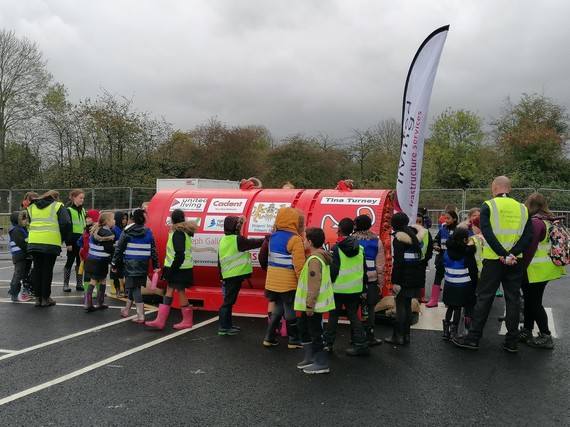 Pupils having a look around our TBM, Tina Turney
History enthusiasts learn more about our site’s past
We recently had 16 local residents and history enthusiasts join us to learn more about our improvements at junction 28 and meet with our archaeology team, to find out more about the work they are doing on the site and what they’ve discovered.
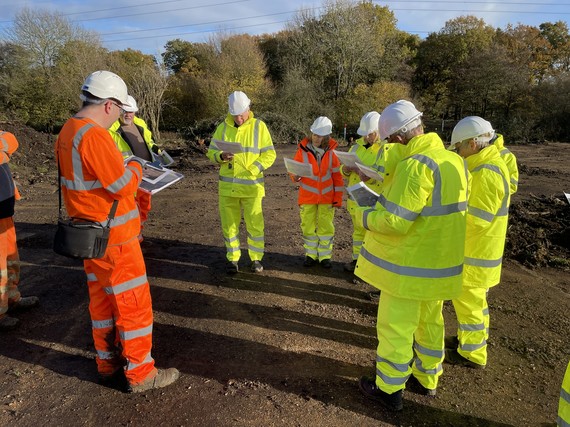 One of the archaeology team, explaining where the Maylands Aerodrome used to stand
One of the pieces the team have uncovered is believed to be an axe head or adze, a tool used for planning wood, anticipated to be around 7,000 years old and dating from the Mesolithic period.
We regularly work with archaeologists to look at what’s below the ground before we start any work, to make sure anything significant is recorded and, where necessary, protected.
This site has particular interest to local heritage groups as we’re working on the Maylands aerodrome, which used to be home to Hillman’s Airways. Maylands was one of the first sites in Britain to offer package holidays in 1930s and had world renowned pilots Amy Johnson and Jim Mollison flew out of the airfield. Hillman would later merge with Spartan Airlines and United Airways, to become British Airways as we know today.
Our project manager Zach, and local historian Tony Philpots, were interviewed on the day, you can view the video on our Facebook page.
Find out more
Our project webpage is an ideal place to find out the latest news about the project and you can also sign up for direct updates to be delivered into your inbox. Our information portal is also open and features in-depth details about how we’re constructing the scheme, what we’re doing to enhance the environment and a fly-through video of how the scheme will look once completed amongst much more.
We’d like to thank everyone for your on-going patience and understanding whilst we’ve been carrying out the works. We will be taking a short break over Christmas, so you may not see any work happening.
To find out about any other work in the area, visit One Network webpage.
As you enjoy this holiday season, the team wishes you safe journeys and hope you all have a very happy new year.
|