|
FSA Northern Ireland Industry Bulletin
We want to make it easy for industry organisations, businesses and interested parties within the food system to feel informed about EU legislative developments on food and feed matters.
Future editions will be guided by subject matter so maybe irregular in their frequency.

|
|
EU consultation
Food Labelling - revision of rules on information provided to consumers
This public consultation, closing on 7 March, covers different initiatives for revising the EU legislation on food information to consumers.
Included are key actions related to the EU Farm to Fork Strategy and Beating Cancer Plan:
-
Front-of-pack nutrition labelling
-
Origin labelling and date marking
-
Setting of nutrient profiles to restrict the use of claims on foods that do not meet some nutritional quality
-
Labelling of alcoholic beverages
Citizens and stakeholders are invited to share their views and experiences on the main obstacles they are facing in these food labelling areas and on possible ways to overcome these obstacles. Subsequent changes to EU rules on information provided to consumers would be applicable in Northern Ireland under the current terms of the Protocol on Ireland/Northern Ireland (NIP).
We welcome your views directly on this too. Please use the subject heading ‘EU food labelling consultation’ and direct to standardsanddietaryhealth@food.gov.uk.
Removed authorisation for use of Titanium Dioxide as a Food Additive
This update is of most interest to the food manufacturing industry.
E171 Titanium Dioxide is a substance commonly used to change or enhance the colour of food in products such as bakery goods, soups and sauces. The European Food Safety Authority (EFSA)'s updated safety assessment in May 2021 stated that it was no longer safe when used as a food additive. Following that update, the European Union (EU) has published Commission Regulation (EU) No. 2022/63 which removes the authorisation for use of E171 Titanium Dioxide as a Food Additive.
Current position in Northern Ireland
Commission Regulation (EU) No. 2022/63 is applicable in Northern Ireland, under the current terms of the Protocol on Ireland/Northern Ireland (NIP). This means that food manufacturing companies in Northern Ireland who use E171 will no longer be permitted to produce or place on the market food products containing the food additive from 7 August 2022.
Transition period
A six-month transition period applies whereby food products manufactured using E171 during this time can still be placed on the market. However, steps should be taken to reformulate and adapt to this change and phase out the use of it in production lines. From 7 August 2022 food products containing this additive will no longer be able to be placed on the Northern Ireland and EU market. Foods already on the market may remain until they reach their date of minimum durability or ‘use by’ date.
Current position in Great Britain
E171 will remain a permitted food additive in England, Wales and Scotland. GB manufacturers must produce products that comply with the market they are destined for. The FSA has conducted an independent review of the EFSA opinion and is taking this issue through the UK’s food and feed risk analysis process. As part of this process, the UK’s Scientific Advisory Committees are considering this issue. The Committee on Toxicity has released an Interim position paper detailing its current position. It is estimated the independent scientific assessment will conclude in the first quarter 2023, with a decision on the use of E171 in GB expected thereafter. We will continue to monitor developments, including outcomes of the UK risk analysis process, and provide updates when available.
For any queries, please email standardsanddietaryhealth@food.gov.uk
High Risk Food Not Animal Origin (HRFNAO)
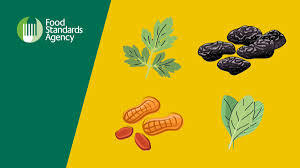
The HRFNAO restricted product list was updated last month. A consolidated list of goods, to which specific import controls apply for entry into the EU (and NI), can be found at Foodstuffs with import requirements.
Some foods of non-animal origin are considered high risk food of non-animal origin (HRFNAO) because they pose health risks associated with the country of origin. FSA Guidance explains this further.
|
New fishery requirements for GB to NI movements

New health certification rules are applying to GB businesses who are not Authorised Traders and moving fishery products to NI.
|

|
|
|
|